The Pythagorean Theorem — Visual Proofs
An extension of the topic of the Pythagorean theorem. In a right triangle, the area of the square on the hypotenuse equals the sum of the areas of the squares on the legs: a² + b² = c². Visual proofs show this by rearranging the same figures, without formulas. The theorem was already known in antiquity (Pythagoras and the Pythagoreans, c. 500 BC) and has hundreds of different proofs.
I will give you legs a and b — give the hypotenuse c = √(a² + b²).
What just happened?
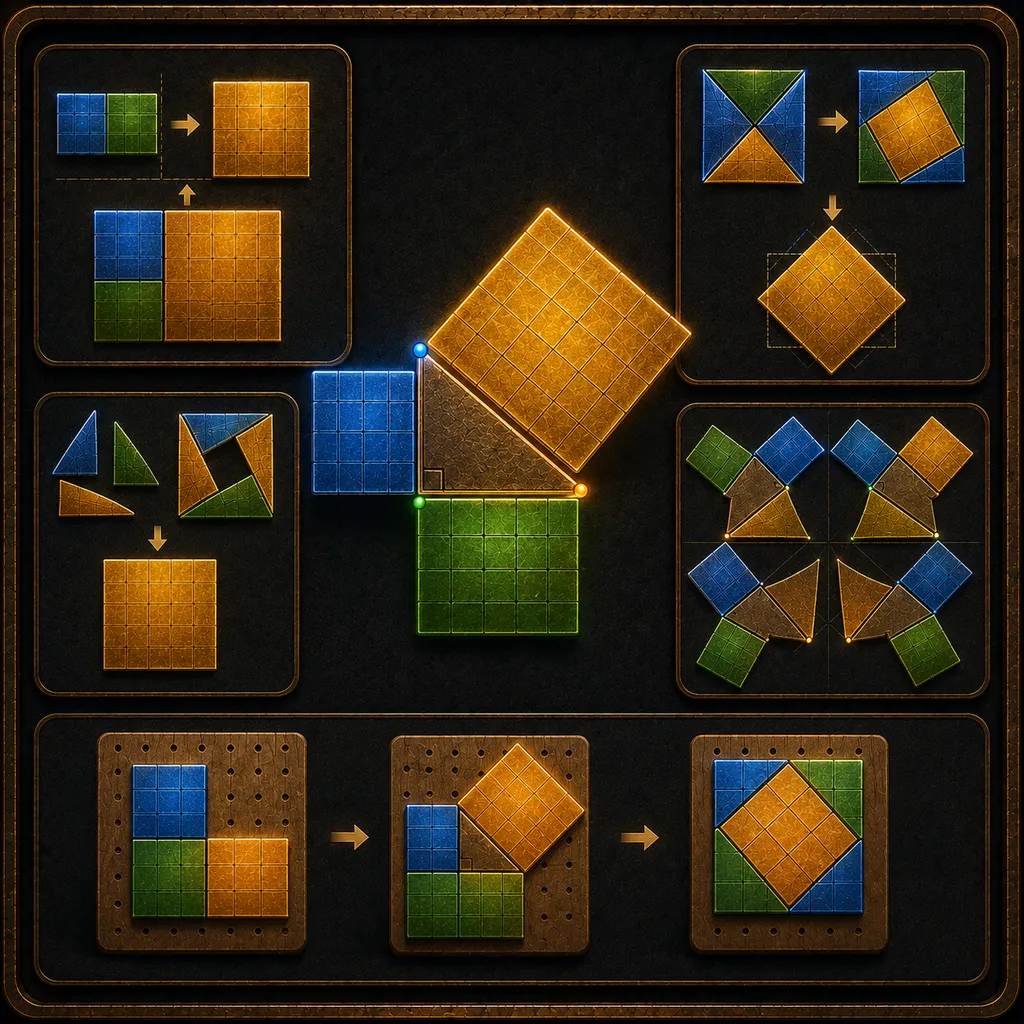
The square built on the hypotenuse has exactly the same area as the sum of the squares built on both legs. You can see it without a formula: blue and green tiles, once rearranged, fill cells of the square on the hypotenuse — with no gaps and no overlap.
The Pythagorean theorem:
In a right triangle with legs , and hypotenuse we have:
For the triangle this gives , that is . It is one of the oldest and most important theorems in geometry — attributed to Pythagoras and the Pythagoreans (c. 500 BC), though it was known earlier to the Babylonians and in India.
Proofs "without words":
The theorem has hundreds of different proofs — many of them elegant visual proofs, based on rearranging and laying out the same figures. The same set of pieces, arranged in two ways, forms once , and once — and since they are the same pieces, their areas are equal.
The invariant — the right-angle condition:
The equality holds only for a right triangle (a right angle between the legs and ). For an acute angle , for an obtuse angle . The converse says that if , then the triangle must be right-angled — that is how a right angle is recognised.
Why you need this for the exam:
The Pythagorean theorem is the foundation of Euclidean geometry, trigonometry and analytic geometry — the formula for the distance between points is Pythagoras directly. Trick: recognise the right angle, label the legs and the hypotenuse, substitute into .
Remember: in a right triangle, the area of the square on the hypotenuse is the sum of the areas of the squares on the legs — (e.g. ).
Theory & formulas
The theorem
In a right triangle with legs and hypotenuse :
Proof by areas
Inside a square of side we arrange four such triangles in two ways. Comparing the empty areas gives — by rearranging figures alone, with no calculation.
The converse
If , then the triangle is right-angled — hence, for example, the triple : .
Notation: — legs, — hypotenuse.
Frequently asked questions
›What does the area of the square on the hypotenuse equal?
The sum of the areas of the squares built on the two legs: a² + b² = c².
›When does the relation a² + b² = c² hold?
Only for a right triangle — when there is a right angle between the legs.
›What is the Pythagorean theorem used for?
For computing the lengths of sides and the distance between points; it is the foundation of trigonometry and analytic geometry.
Teaching? Embed this experiment on your site.
Free widget — paste it on your school site, blog or notes. It links to the full version.