Pick's theorem
An extension of the topic of polygon area and lattice geometry. The area of a polygon whose vertices lie at grid nodes is i + b/2 − 1, where i is the number of interior lattice points and b the boundary points — you find the area by counting dots, without integration. The formula was given by Georg Pick in 1899.
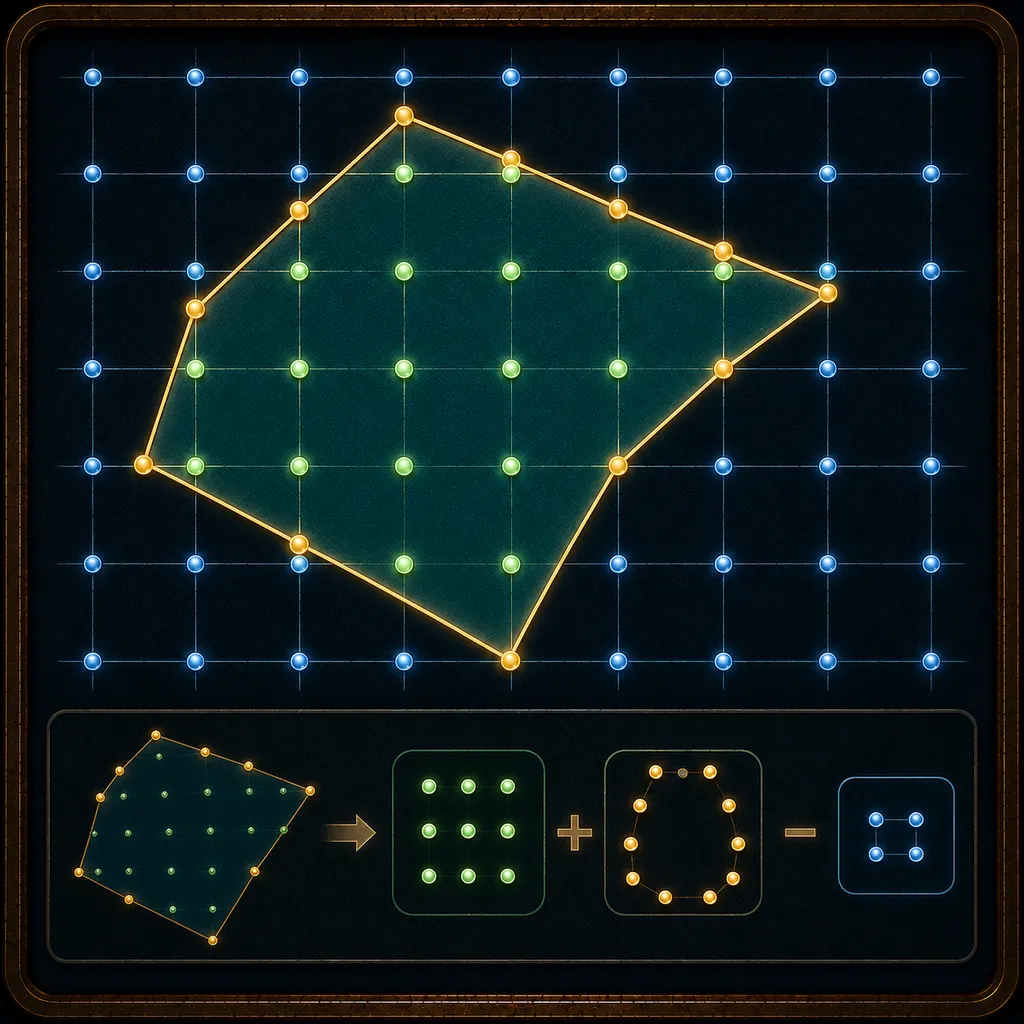
I’ll give you the number of interior and boundary points — compute the area of the lattice polygon: P = i + b/2 − 1.
What just happened?
You changed the figure — from a rectangle to a non-convex polygon. Each time the number of lattice points inside () and on the boundary () was different, yet always gave exactly the area of the figure. You found the area by counting dots.
Pick’s theorem:
Formulated by the Austrian mathematician Georg Pick in 1899, it gives a surprisingly simple formula for the area of a polygon whose vertices all lie on lattice points (with integer coordinates): is the number of lattice points inside the polygon, and is the number of lattice points on its boundary. This means the area can be found simply by COUNTING DOTS — no integration, no complicated formulas!
Check for yourself:
Rectangle: . Triangle: . L-polygon: . Each time the result matches the area computed with the shoelace formula.
How to count b (boundary points)?
On each boundary segment the number of lattice points (not counting one endpoint) is the greatest common divisor of the coordinate differences: for a segment from to it is . Summing over all sides gives .
For any simple polygon:
The formula works for any (including non-convex) simple polygon with lattice vertices. Pick’s theorem is a favourite example of “discrete mathematics meeting geometry” and is used, among other things, in computational geometry.
Why this matters for the exam:
When a figure has vertices at lattice points, you can compute the area as without splitting it into triangles and trapezia — just carefully count the dots inside and on the boundary. It is also an elegant example of the link between geometry and discrete mathematics.
Remember: for a polygon with lattice vertices — the interior points plus half the boundary points minus one give the area.
Theory & formulas
Pick's formula
For a polygon with vertices at grid nodes:
How to count
- — the number of grid nodes strictly inside the polygon,
- — the number of grid nodes on the boundary (including the vertices).
Advantages
It works for any simple polygon (including non-convex ones) — you find the area by counting dots, without integration.
Notation: area, interior nodes, boundary nodes.
Frequently asked questions
›How do you compute the area of a polygon on a grid?
With Pick's formula: P = i + b/2 − 1, where i is the number of grid points inside and b on the boundary.
›Does Pick's formula work for non-convex polygons?
Yes — for any simple polygon with vertices at grid nodes.
›Who formulated Pick's theorem?
The Austrian mathematician Georg Alexander Pick, in 1899.
Teaching? Embed this experiment on your site.
Free widget — paste it on your school site, blog or notes. It links to the full version.