Euler's Formula for Polyhedra
An extension of the topic of solids and solid geometry. For every convex polyhedron, Euler's formula holds: V − E + F = 2 (vertices − edges + faces). For example, a cube: 8 − 12 + 6 = 2; a tetrahedron: 4 − 6 + 4 = 2. This relation is always true, regardless of the solid. Leonhard Euler discovered it in 1752, giving rise to topology.
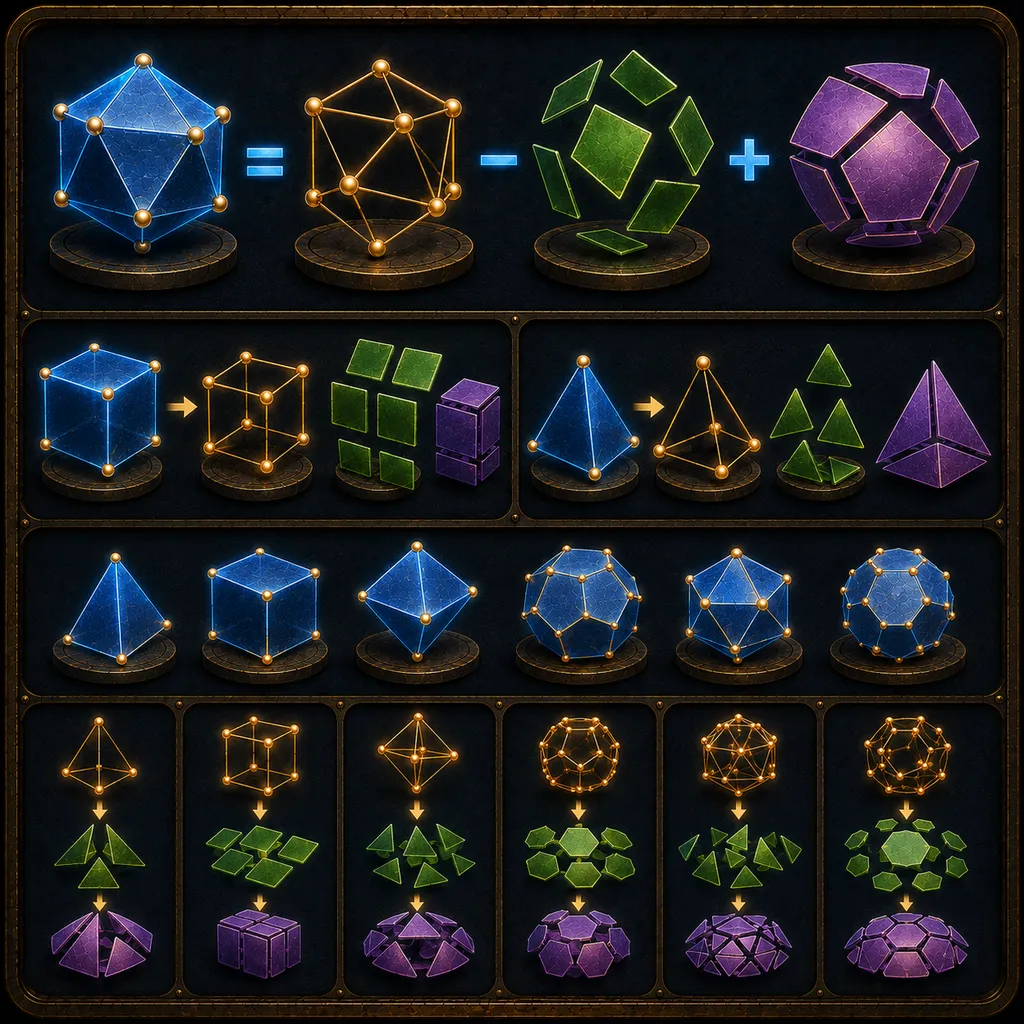
I will give you the number of vertices V and edges E — find the number of faces F from the formula V − E + F = 2.
What just happened?
You changed the solid — from the simple tetrahedron to the prism. Each time the numbers of vertices , edges and faces were different, yet the combination always gave exactly 2. This is no accident — it is one of the most beautiful results in mathematics.
Euler's formula for polyhedra:
For every convex polyhedron, the number of vertices () minus the number of edges () plus the number of faces () equals 2 — no matter how complicated the solid is.
Check it yourself:
Cube: . Tetrahedron: . Octahedron: . It always comes out 2.
Where did it come from?
The relation was discovered by Leonhard Euler — he announced it in a letter to Goldbach in 1750 and published it in 1752. It links three seemingly independent features of a solid and holds from the simplest tetrahedron to solids with hundreds of faces.
The invariant — the Euler characteristic:
The number is the Euler characteristic of a surface. For all solids equivalent to a sphere it equals 2, but for a solid with a "hole" (like a torus, i.e. a bagel) it equals 0. This number is invariant under continuous deformations of shape — which is why the formula gave rise to a new branch of mathematics: topology (the study of properties of shapes invariant under stretching and bending without tearing).
Why you need this for the exam:
The formula lets you quickly find the missing value when you know the other two (e.g. the number of faces, given the vertices and edges). It is also a classic example of an invariant and an introduction to planar graphs. Applications reach into chemistry (fullerenes) and computational geometry.
Remember: for every convex polyhedron — vertices minus edges plus faces always give 2.
Theory & formulas
The formula
For every convex polyhedron:
Examples
- cube:
- tetrahedron:
- dodecahedron:
Significance
The number is the Euler characteristic — a topological invariant. For a solid "with one hole" (a torus) it equals , not — hence the beginning of topology.
Notation: — number of vertices, — of edges, — of faces.
Frequently asked questions
›What is the value of V − E + F for a convex polyhedron?
Always exactly 2, regardless of the shape and complexity of the solid.
›What do V, E and F mean in Euler's formula?
V — the number of vertices, E — the number of edges, F — the number of faces of the polyhedron.
›Why is Euler's formula important?
It gave rise to topology — the number V − E + F is a topological invariant (the Euler characteristic).
Teaching? Embed this experiment on your site.
Free widget — paste it on your school site, blog or notes. It links to the full version.