Weight on bodies of the Solar System
A scale measures weight (the force of gravity), not mass. Set a mass and pick a celestial body, and you will compare the scale reading on Earth and there. Mass does not change — only g changes, and so does the weight. On the Moon you weigh ~1/6, on Jupiter ~2.5× of what you weigh on Earth.
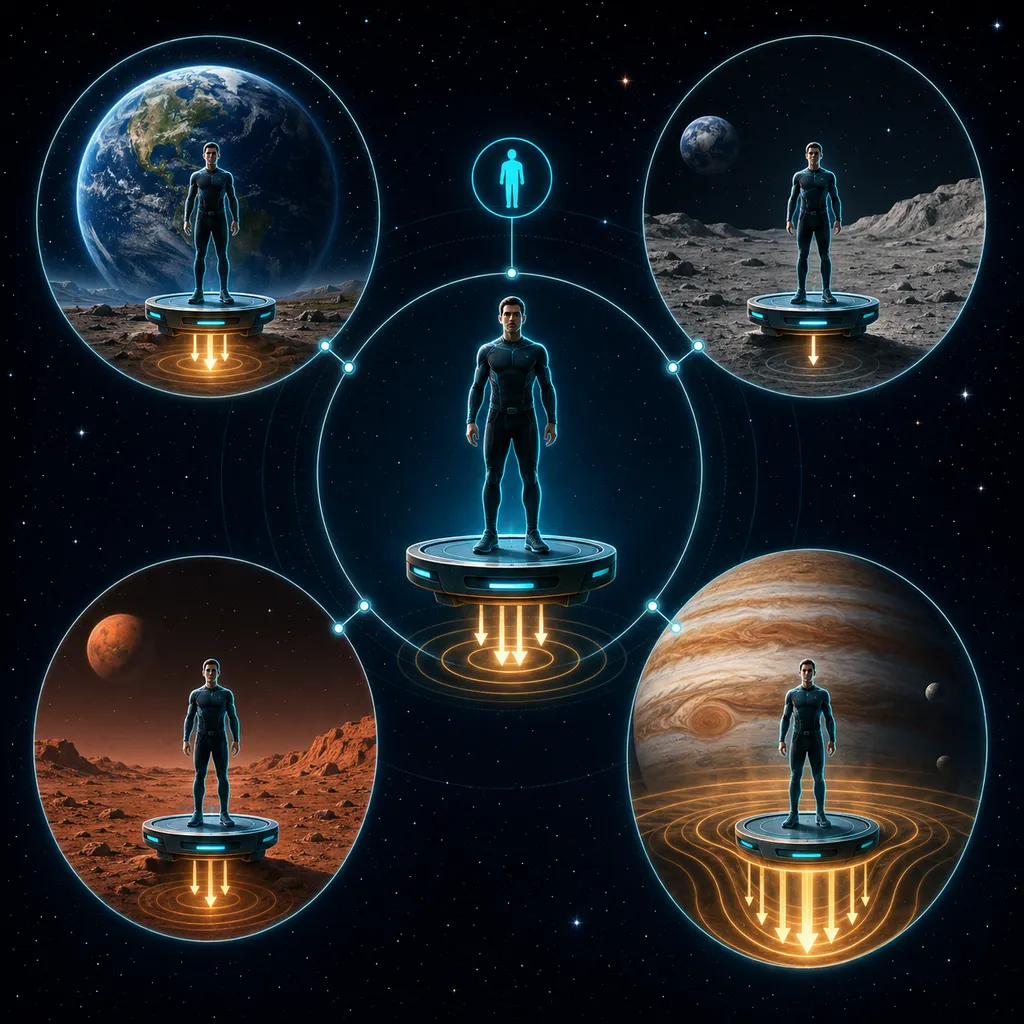
What just happened?
A scale measures weight — the force with which gravity pulls you down — not mass. Weight depends on the gravitational acceleration of a given body, which can be dramatically different.
Weight:
The same mass gives a different weight on every body, because depends on the mass and radius of the body.
Invariant — mass does not change:
The amount of matter (mass) is the same everywhere. An 80 kg astronaut is 80 kg on both Earth and the Moon — only how strongly gravity pulls them changes, i.e. the weight and the scale reading.
Why this matters for your exam:
Telling mass from weight and the formula are classics of dynamics and gravitation problems. Here you see them "on your own scale" across 18 bodies of the Solar System.
Remember: . Mass is constant; weight depends on the body's g (on the Moon ~1/6 of Earth's).
Theory & formulas
Weight vs mass
A scale measures weight (the force of gravity), not mass: Mass is the same everywhere; only changes, and so does the weight.
Gravitational acceleration
depends on the mass and radius of the celestial body. On the Moon (~1/6 of Earth's), on Jupiter (~2.5×).
Notation: — weight, — mass, — gravitational acceleration, — gravitational constant, — mass of the body, — its radius.
Frequently asked questions
›What is the difference between mass and weight?
Mass is the amount of matter — it is constant and the same everywhere (kg). Weight is the force with which gravity pulls on that mass (N), and it depends on the body's g. A bathroom scale measures weight but displays it in kg, assuming Earth's g.
›Why are you lighter on the Moon?
Because the Moon has a smaller mass and radius than Earth, so its gravitational acceleration g=GM/R² is ~1.62 m/s², i.e. ~1/6 of Earth's. The same mass yields a ~6× smaller weight there.
›Where would you weigh the most?
Among bodies you could stand on — on Jupiter (g≈24.8 m/s², ~2.5× Earth, though that is the "cloud top"). On the Sun g≈274 m/s² (~28×), but there is no surface there. The least — on small bodies like Ceres or Pluto.
Teaching? Embed this experiment on your site.
Free widget — paste it on your school site, blog or notes. It links to the full version.