Cosmic velocities (I and II)
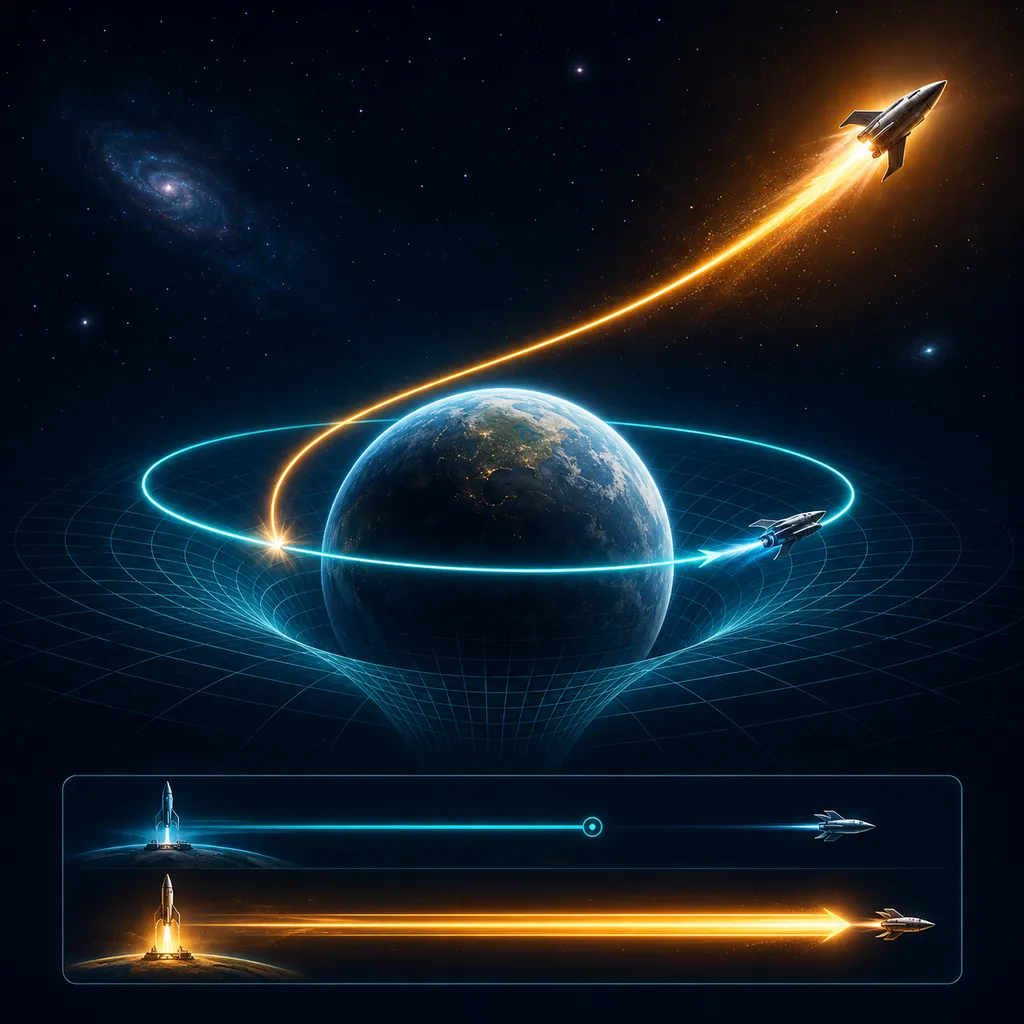
To stay in a circular orbit just above the surface, a body must reach the first cosmic velocity v_I=√(GM/R). To escape the gravitational field, it needs the second cosmic velocity v_II=√(2GM/R), which is always √2 times larger than the first. Change the mass and radius of the celestial body.
What just happened?
You changed the mass of the celestial body — both velocities grew, but the escape velocity stayed exactly times larger than the orbital one. This ratio does not depend on the planet.
Cosmic velocities:
— first cosmic velocity: the minimum speed to stay in a circular orbit just above the surface. — second cosmic velocity: the minimum speed to escape the gravitational field entirely. G — gravitational constant, M — mass of the body, R — its radius.
Why do they depend on M and R?
A larger mass M pulls harder → you must travel faster. A larger radius R moves you farther from the centre, weaker gravity at the surface → the velocities drop. For Earth km/s, and km/s.
Why is it easier to lift off from the Moon?
The Moon has a small mass and radius, so both velocities are several times smaller than on Earth ( km/s). That is why the lander needed far less fuel to launch back up. It is the same physics as universal gravitation.
Why you need this for the exam:
The formulas and solve most problems about satellites and escape. The trick: compute , and you get the second velocity by multiplying by .
Remember: the escape velocity is always times larger than the orbital one — no matter which planet you launch from.
Theory & formulas
First cosmic velocity
The smallest horizontal speed for a circular orbit just above the surface — gravity acts as the centripetal force:
Second cosmic velocity
The escape velocity from the gravitational field (from the energy balance ): Always times larger than the first.
For Earth
, . A smaller mass and radius of the body → smaller cosmic velocities.
Symbols: — gravitational constant, — mass of the body, — its radius, — first and second cosmic velocity.
Frequently asked questions
›What is the first cosmic velocity?
The smallest horizontal speed at which a body orbits in a circular path just above the surface (for Earth ≈ 7.9 km/s).
›When does a rocket escape a planet?
When it reaches the second cosmic velocity v_II=√(2GM/R) (for Earth ≈ 11.2 km/s) — then it overcomes the gravitational field.
›Why is it easier to lift off from the Moon?
Because the Moon has a much smaller mass and radius than Earth, so its cosmic velocities are much smaller.
Teaching? Embed this experiment on your site.
Free widget — paste it on your school site, blog or notes. It links to the full version.
Related experiments