Weight on different planets
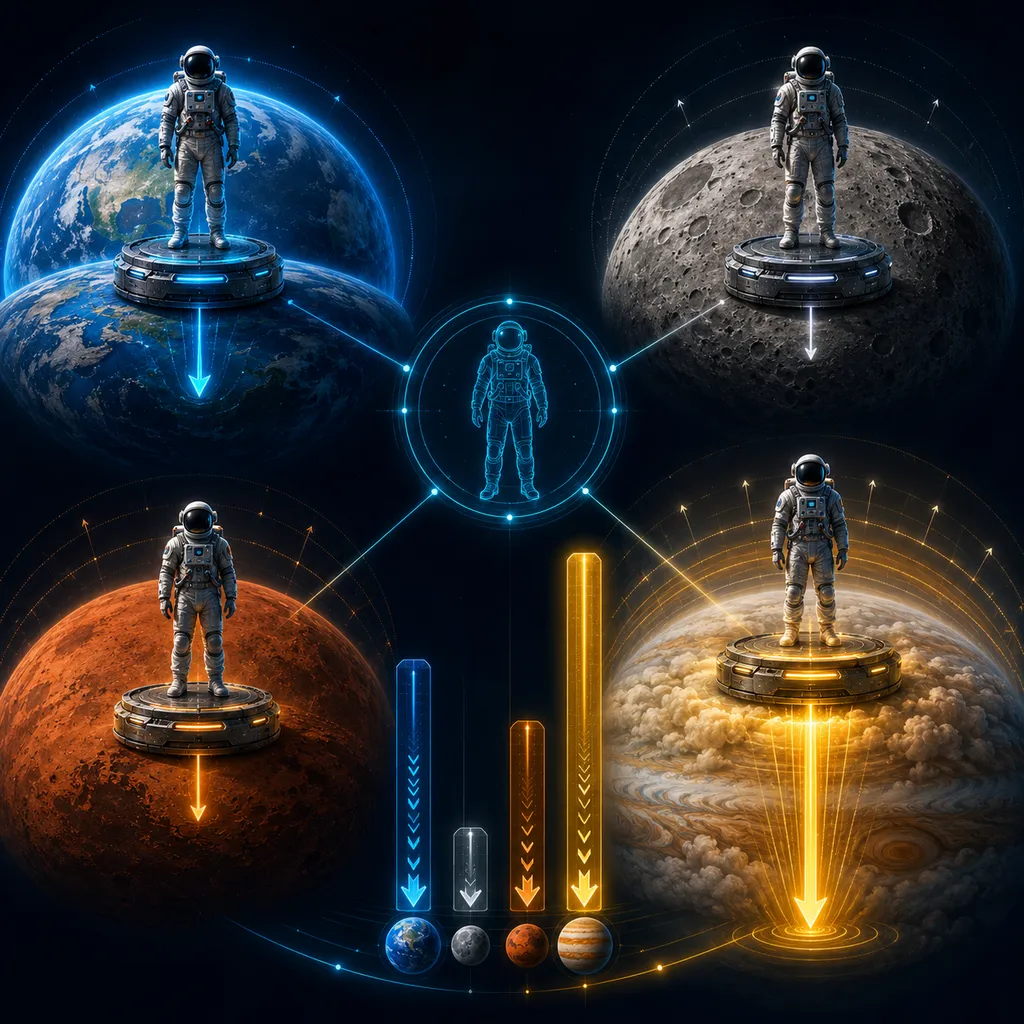
How much would you weigh on another planet? Gravitational acceleration g=GM/R² depends on the mass M and radius R of a celestial body (it falls off with the square of the radius). Your mass does not change, but your weight F=mg differs on Earth, the Moon, Mars or Jupiter. Change the planet's mass and radius, as well as the astronaut's mass.
I will give you a target acceleration g — pick the mass and radius of a planet that produces it. g = GM/R².
What just happened?
I increased the planet mass, but its radius even more — and the acceleration dropped. Surface gravity depends not on the mass alone, but on the ratio of mass to radius squared.
Gravitational acceleration and weight:
— is the acceleration at the surface (m/s²), and the weight is the force (N) with which the planet attracts a body. M — planet mass, R — its radius, m — body mass, G — gravitational constant.
Mass vs weight — do not confuse them!
Mass m (in kg) is the amount of matter — it is unchanging, the same on Earth, the Moon and Jupiter. Weight F (in N) is a force and changes together with . That is why a scale on different planets shows different readings, even though the "amount of you" is the same.
Why do we weigh ~1/6 on the Moon?
The Moon has a small mass and a small radius. Substituting into gives m/s² — about six times less than on Earth. The astronaut's mass does not change, so their weight is also ~6× smaller.
Why you need this for the exam:
The formulas and solve problems about weight on other planets and the dependence of g on R (it falls with the square of the distance from the center). Trick: don't compare masses alone — compare the ratio . It connects to the law of universal gravitation.
Remember: mass is constant, weight depends on the planet — , and what matters is the ratio of M to R², not the mass alone.
Theory & formulas
Gravitational acceleration
At the surface of a celestial body, the gravitational acceleration depends on its mass and radius: It grows with the mass and falls off with the square of the radius .
Mass vs weight
Mass (in kilograms) is the amount of matter — it is the same everywhere. Weight is the gravitational force acting on that mass:
On different planets
The same mass gives a different weight, because every planet has a different . On the Moon, is about 6 times smaller than on Earth, so the weight is about 6 times smaller too.
Notation: — gravitational acceleration, , — planet mass, — planet radius, — body mass, — weight.
Frequently asked questions
›Why do we weigh less on the Moon?
Because the Moon has a smaller mass and radius, so its g is ~6× smaller than on Earth — the weight (F=mg) is ~6× smaller too.
›What is the difference between mass and weight?
Mass (kg) is the amount of matter — the same everywhere. Weight (N) is the gravitational force F=mg — it depends on where we are.
›What does g depend on?
On the mass and radius of the body: g=GM/R². It grows with the mass and falls off with the square of the radius.
Teaching? Embed this experiment on your site.
Free widget — paste it on your school site, blog or notes. It links to the full version.