Electrical power and Joule heating — heating element
Change the voltage and the heating element's resistance. The power P=U²/R rises as the resistance falls (at constant U), and the energy dissipated is Q=P·t. See how a heating element with lower resistance heats up more intensely.
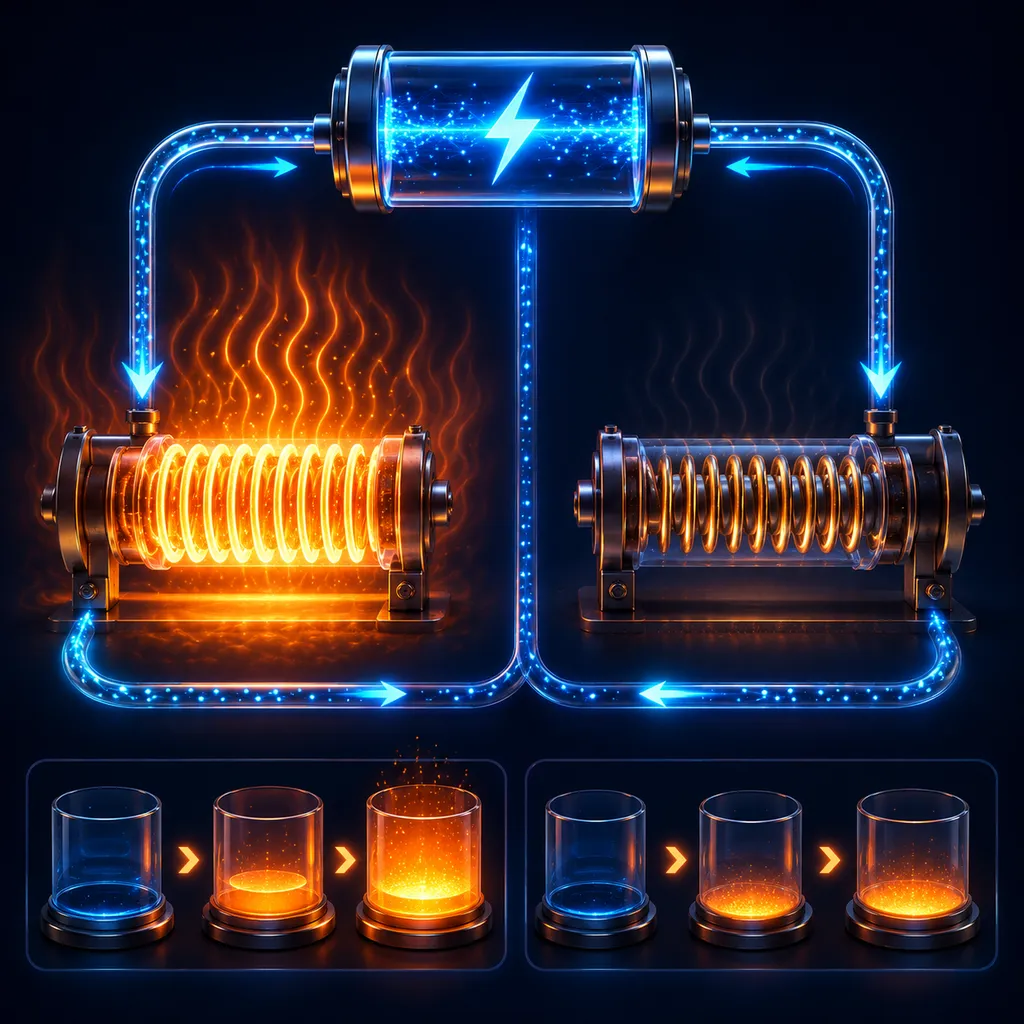
I'll give you a target power — tune the voltage and heating-element resistance to reach it. P = U²/R.
What just happened?
You lowered the heating-element resistance at constant voltage — the current rose, and the dissipated power rose even more, because the element glowed hotter. Lower resistance means higher power.
Electrical power and Joule heating:
— the power dissipated in the heating element depends on voltage and resistance, and the heat is power times time. U — voltage (V), R — resistance (Ω), I — current (A), P — power (W), Q — heat (J).
What does this mean in practice?
At constant voltage a heating element with lower resistance draws a larger current and heats more strongly — that is why a kettle with a thick, short heating wire boils water faster. Watch out for the two faces of the same formula:
At a given voltage the power falls with resistance; at a given current it rises with resistance. Always check what is held constant.
Why does time matter?
Power tells you how fast energy is released; the heat tells you how much accumulated in total. The same heating element switched on twice as long releases twice as much heat.
Why you need this for the exam:
P = U²/R = I²R and Q = P·t solve problems about heating elements, kettles and fuses. Trick: write down what is constant (U or I), pick the right form of the P formula, and compute the heat as P·t.
Remember: at constant voltage, lower heating-element resistance means higher power — P = U²/R, and the heat Q = P·t grows with time.
Theory & formulas
Heating-element power
At constant voltage, lower resistance → higher power (a larger current flows).
Joule–Lenz heating
The dissipated heat grows with the power and with the time the current flows.
Symbols: — power, — voltage, — current, — resistance, — heat, — time.
Frequently asked questions
›Why does lower resistance mean higher power?
At constant voltage P=U²/R — the smaller the denominator R, the higher the power, because a larger current flows.
›How much heat does a heating element release?
Q=I²Rt=P·t — proportional to the power and to the time the current flows (the Joule–Lenz law).
›Why do wires heat up?
Because they have resistance — the work done by the current turns into heat, P=I²R.
Teaching? Embed this experiment on your site.
Free widget — paste it on your school site, blog or notes. It links to the full version.