Series and parallel circuits — equivalent resistance
What we'll do: We'll connect two resistors once in series and once in parallel and check how the equivalent resistance changes, and what happens when we unscrew one bulb.
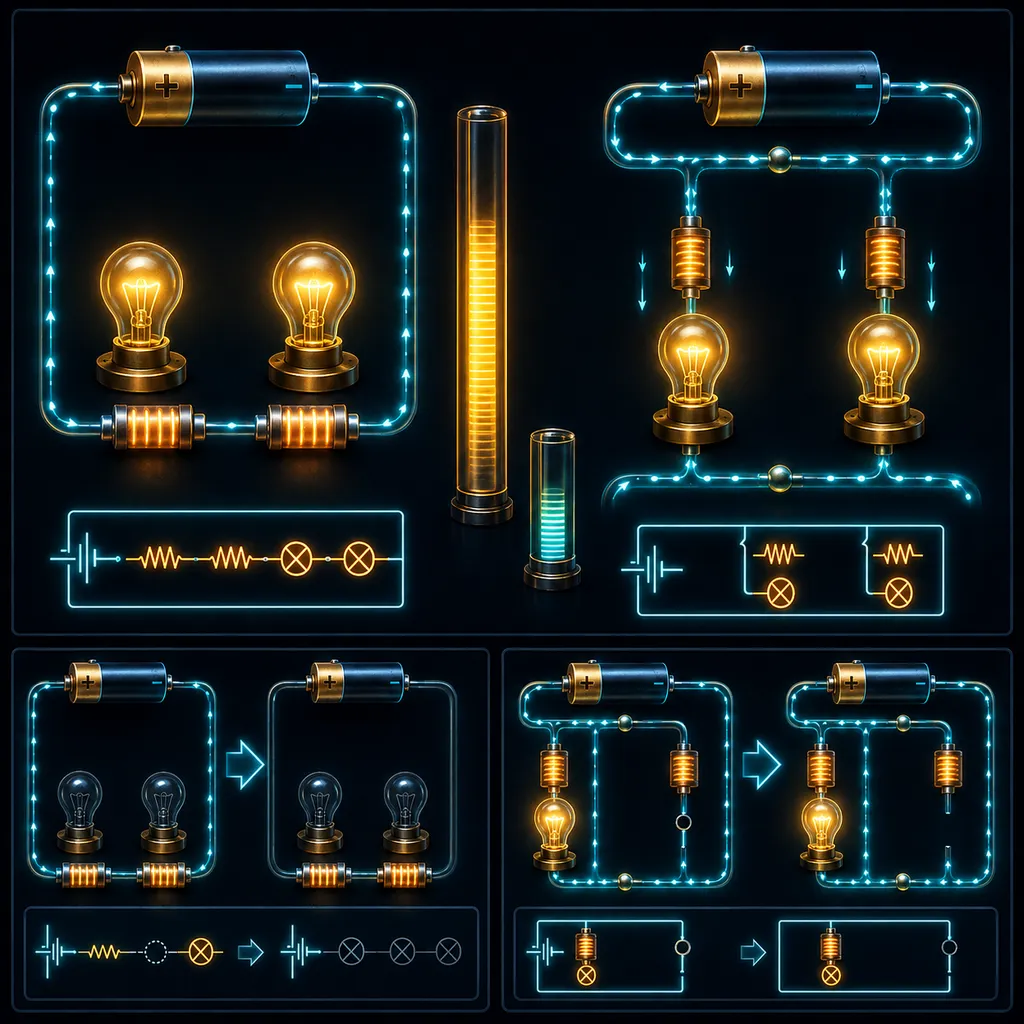
What you see on screen: A circuit diagram with a battery, two resistors and bulbs, a switch for the connection type, and a button to unscrew a bulb. Flowing electrons and bulb brightness show the current; a bar computes the equivalent resistance. Readouts: connection type, resistances, equivalent resistance, current and the branch distribution.
I'll give you a target equivalent resistance — choose the connection (series/parallel) and R₁ and R₂ to reach it.
What just happened?
In a parallel circuit unscrewing one bulb did not put out the other — because each has its own independent path for the current.
Series connection:
resistors one after another, a single path for the current. The equivalent resistance ADDS UP:
The current is the same everywhere, but any break puts out the whole circuit (because it breaks the only path).
Parallel connection:
resistors side by side, each on its own branch. The equivalent resistance is computed from reciprocals:
Each branch has the same voltage, and the current splits. A break in one branch does not affect the others. That is why appliances at home are wired in parallel — switching one off does not cut the rest.
Why you need this for the exam:
computing the equivalent resistance and the distribution of currents/voltages in both circuit types is a standard problem. Trick: in series add the resistances, in parallel add their reciprocals.
Remember: in series the resistances add (a break puts out everything), in parallel their reciprocals add (the branches are independent).
Theory & formulas
Series connection
The resistances add up: A single shared current flows; a break in one element puts out the whole circuit.
Parallel connection
The reciprocals add up (the equivalent resistance is smaller than the smallest one): Each branch has an independent path — unscrewing one bulb does not put out the other.
Notation: — equivalent resistance, — component resistances.
Frequently asked questions
›How do you compute the equivalent resistance for a series connection?
The resistances add up: R_z = R₁ + R₂.
›How do you compute the equivalent resistance for a parallel connection?
From reciprocals: 1/R_z = 1/R₁ + 1/R₂ — the equivalent resistance is smaller than the smallest of the resistors.
›Why does unscrewing one bulb in a parallel circuit not put out the other?
Because each branch has its own independent path for the current; a break in one does not interrupt the others.
Teaching? Embed this experiment on your site.
Free widget — paste it on your school site, blog or notes. It links to the full version.