Ohm's law — the formula I = U/R, voltage, resistance, current
What we'll do: We'll build a simple circuit and change the voltage and resistance, checking how they control the current and the brightness of the bulb.
What you see on screen: A circuit diagram with a battery, a resistor and a bulb, sliders for voltage U and resistance R, and electrons flowing along the wire whose stream thickens as the current grows. The relation bar shows I = U/R. Readouts: U, R, current I and power P.
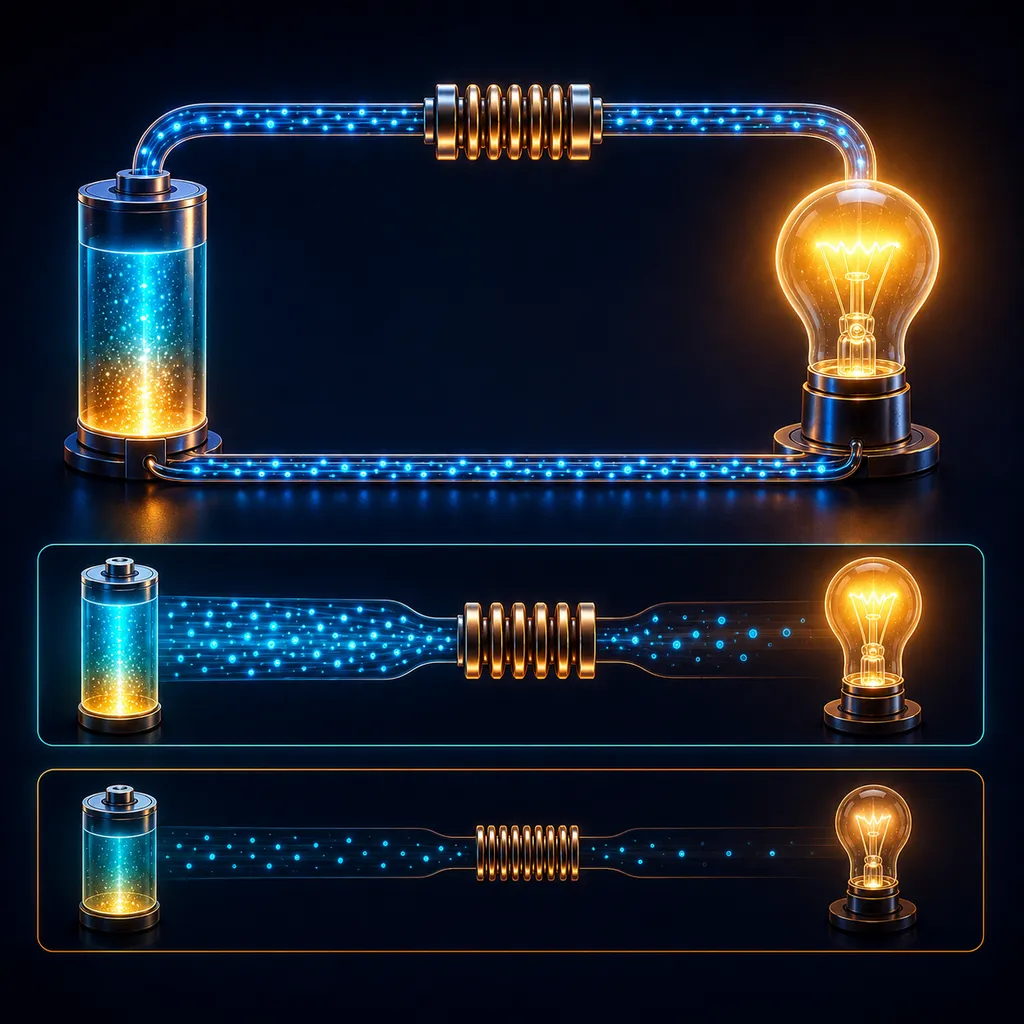
I’ll give you a target current — tune the voltage and resistance to reach it. I = U/R.
What just happened?
You doubled the resistance and the current dropped by half. At constant voltage the current and resistance are inversely proportional.
Ohm’s law:
— the current is directly proportional to the voltage and inversely proportional to the resistance. U — voltage (V), R — resistance (Ω), I — current (A).
What does it mean in practice?
Higher voltage “pushes” the charges harder → more current. Higher resistance hinders the flow → less current. Hence:
Why do wires and fuses heat up?
Current flows through the resistor and power is released — the larger the current, the more heat. That is why a thin, heavily loaded wire heats up.
Why you need this for the exam:
I = U/R plus P = U·I solve most problems about simple circuits. Trick: write down what is constant (U or R) and see how I changes.
Remember: the current rises with voltage and falls with resistance — I = U/R. It is the foundation of all electricity.
Theory & formulas
Ohm's law
The current is directly proportional to the voltage and inversely proportional to the resistance.
What follows
- at constant : larger → smaller current,
- at constant : larger → larger current.
Power
Flowing current releases power converted into heat — that is why wires heat up.
Symbols: — current, — voltage, — resistance, — power.
Frequently asked questions
›What does Ohm's law state?
The current is directly proportional to the voltage and inversely proportional to the resistance: I = U/R.
›What happens to the current when the resistance rises?
It decreases — at constant voltage the current is inversely proportional to the resistance.
›Why do wires heat up?
Because the flowing current releases power P = U·I converted into heat; more current = more heat.
Teaching? Embed this experiment on your site.
Free widget — paste it on your school site, blog or notes. It links to the full version.
Related experiments