Combining capacitors — equivalent capacitance
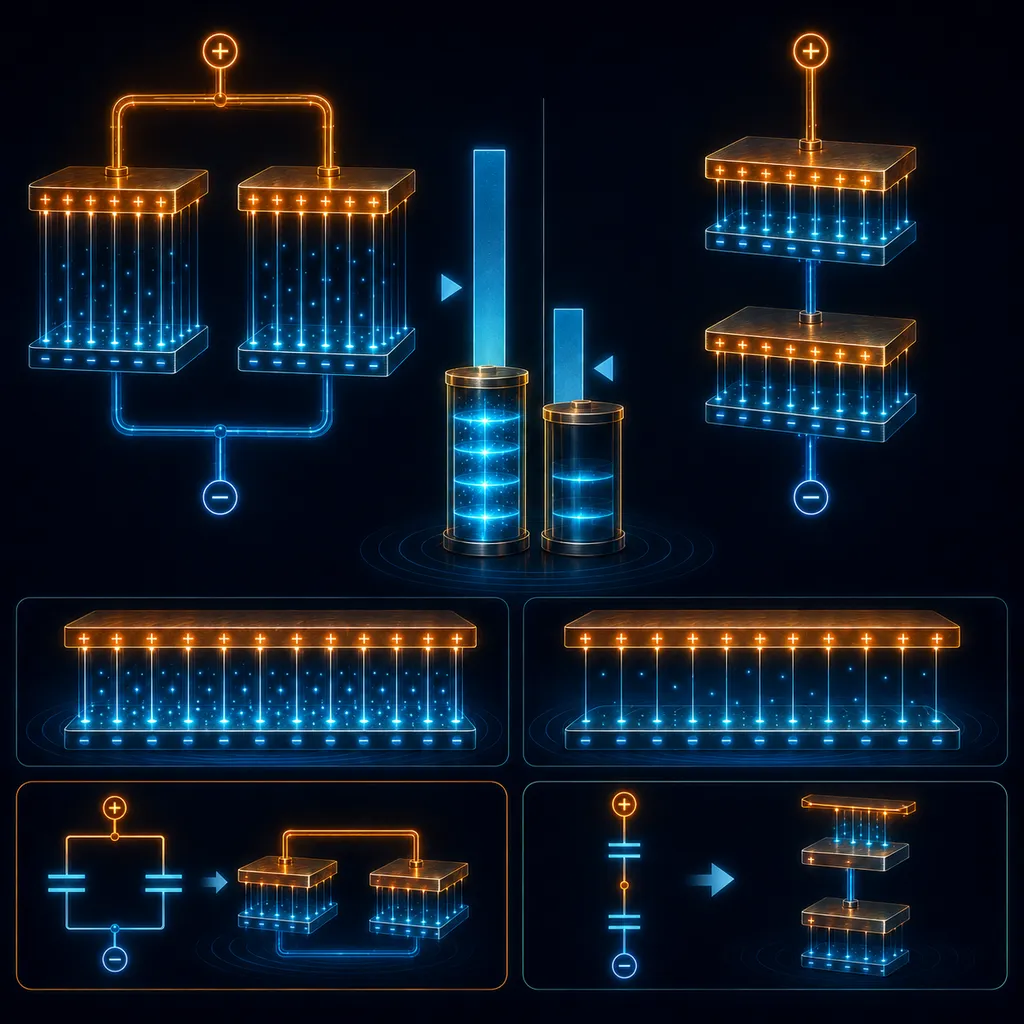
Choose how two capacitors are connected. In parallel the equivalent capacitance grows (C=C₁+C₂); in series it drops (1/C=1/C₁+1/C₂). This is the reverse analogy to combining resistors. Watch the schematic and the capacitance bar.
I’ll give you a target equivalent capacitance — pick C₁, C₂ and the connection type to reach it. Parallel: C₁+C₂; series: less than the smaller one.
What just happened?
In a parallel connection the capacitances add, so the equivalent capacitance increases. In series it is the opposite — the equivalent is smaller than the smallest capacitor. It is a mirror image of the rules for combining resistors.
Parallel connection:
— the plates act like one larger surface, so at the same voltage they collect more charge. The capacitance always increases.
Series connection:
— it is like increasing the distance between the plates: the equivalent capacitance drops below the smallest of the component capacitances.
Where does this “inversion” relative to resistors come from?
For resistors, series adds up and parallel uses reciprocals. For capacitors the roles are swapped. One formula: — at constant U, a larger capacitance means more stored charge.
Why you need this for the exam:
You break capacitor-bank problems into steps: add the parallel sections directly, combine the series ones from reciprocals. Trick: parallel = sum (more), series = less than the smallest.
Remember: in parallel C = C₁ + C₂ (increases), in series 1/C = 1/C₁ + 1/C₂ (decreases). The opposite of resistors.
Theory & formulas
Parallel connection
The capacitances add (the effective plate area sums up):
Series connection
The reciprocals add, so is smaller than the smallest component:
This is the reverse analogy to combining resistors.
Notation: — equivalent capacitance, — component capacitances.
Frequently asked questions
›How do you connect them to increase capacitance?
In parallel — then C=C₁+C₂, because the effective plate area sums up.
›What is the series capacitance?
Smaller than the smallest component: 1/C=1/C₁+1/C₂.
›Why is it the reverse of combining resistors?
Because for capacitors a parallel connection gives the sum (like resistors in series), while a series connection gives the sum of reciprocals (like resistors in parallel).
Teaching? Embed this experiment on your site.
Free widget — paste it on your school site, blog or notes. It links to the full version.