The capacitor — capacitance, charge, energy
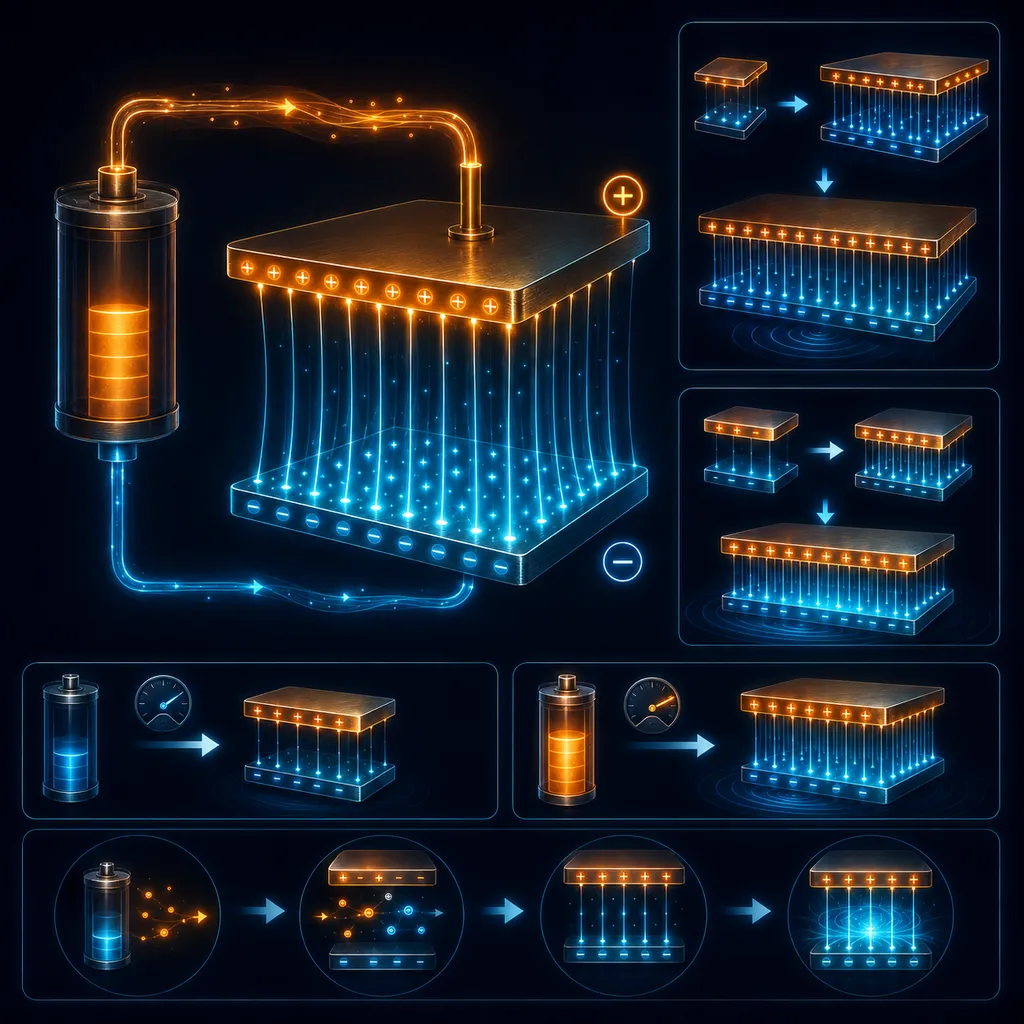
A capacitor stores charge on two plates. Its capacitance C=ε₀·S/d grows with the plate area and drops with the separation between the plates — moving the plates closer increases C. The charge is Q=CU, and the energy stored in the field between the plates is E=½CU². Change the voltage, plate area and plate separation.
I will give you a target energy — set the voltage, plate area and plate separation to store it. E = ½CU², C = ε₀S/d.
What just happened?
You halved the distance between the plates, and the capacitance doubled. Capacitance and plate separation are inversely proportional.
What is capacitance?
It is a capacitor’s ability to store charge: . The same charge at a lower voltage means a larger capacitance. It depends on the plate geometry and the dielectric:
— it grows with the plate area S, drops with the separation d, and filling it with a dielectric (ε_r > 1) increases it. ε₀ = 8.85·10⁻¹² F/m is the permittivity of free space.
Charge and energy
Connected to a voltage U, the capacitor stores a charge , and in the electric field between the plates it stores energy:
The energy does not sit "in the wire" — it is stored in the electric field in the space between the plates. That is why a charged capacitor can release it suddenly (camera flash, defibrillator).
Invariant: constant charge
Disconnect the source — the charge Q stays trapped. Then from it follows that decreasing the capacitance (e.g. pulling the plates apart) increases the voltage U, because the product CU must stay the same.
Why this matters on the exam:
C = ε₀S/d, Q = CU and E = ½CU² solve almost every capacitor problem. The trick: check what stays constant — the voltage U (source connected) or the charge Q (source disconnected) — and only then calculate.
Remember: capacitance grows with the plate area and drops with their separation (C = ε₀S/d), and the capacitor stores energy in the electric field between the plates (E = ½CU²).
Theory & formulas
Capacitance
It grows with the plate area and drops with the separation — moving the plates closer increases .
Charge and energy
The energy is stored in the electric field between the plates.
Symbols: — capacitance (farad), — charge, — voltage, — plate area, — separation between them, — permittivity of free space, — energy.
Frequently asked questions
›What is capacitance?
A measure of a capacitor's ability to store charge at a given voltage: C=Q/U. The unit is the farad (F).
›What does C depend on?
On the plate area S, the separation between them d and the type of dielectric: C=ε₀·S/d (without a dielectric).
›Where does a capacitor store energy?
In the electric field between the plates; the energy is E=½CU².
Teaching? Embed this experiment on your site.
Free widget — paste it on your school site, blog or notes. It links to the full version.