Lorentz force — a charge moving in a magnetic field
A charge moving in a magnetic field feels the Lorentz force F=qvB·sinα, always perpendicular to the velocity. That is why a charge entering perpendicular to field B moves along a circle of radius r=mv/(qB). The Lorentz force does no work — it changes only the direction, not the magnitude of the velocity. Change v, B and q.
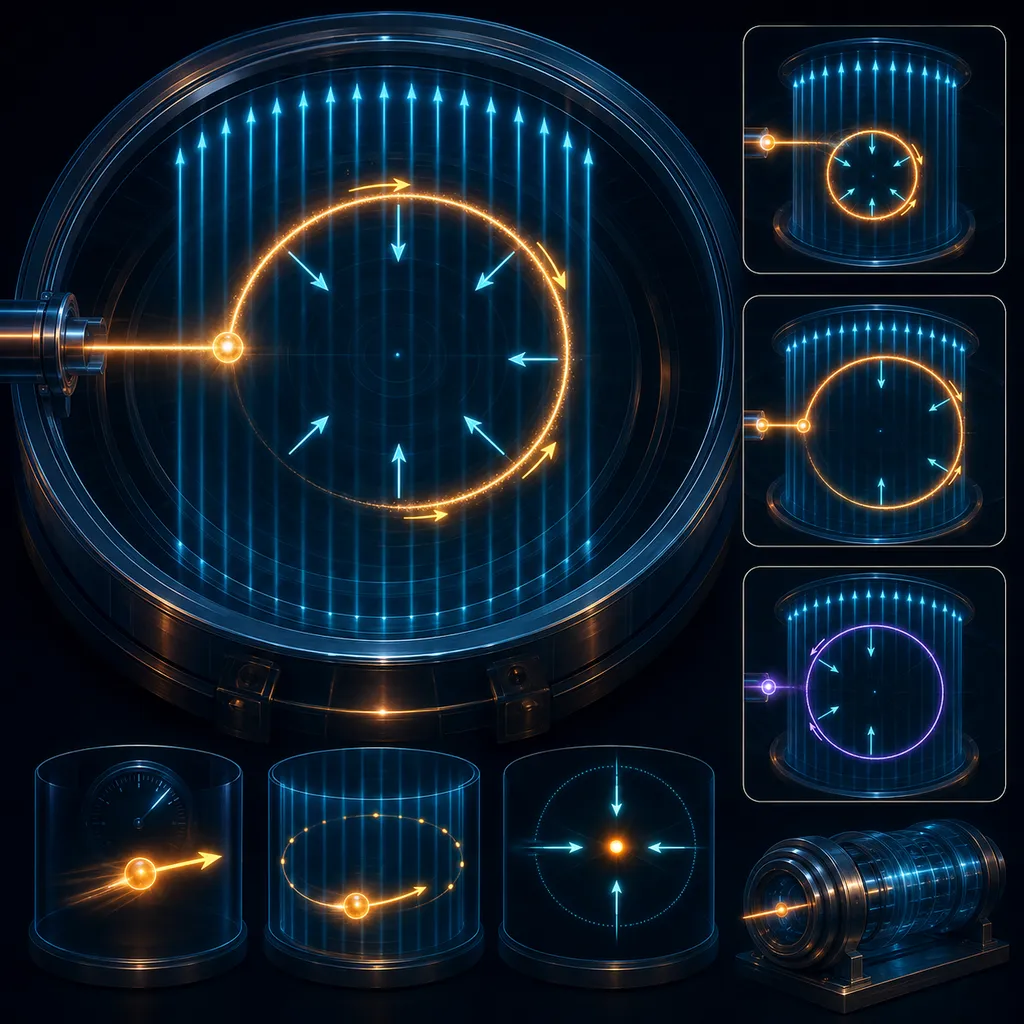
I'll give you a target Lorentz force — tune velocity, flux density and charge to reach it. F = qvB.
What just happened?
The charge flew in perpendicular to the magnetic field and, instead of going straight, curved into a circle. It keeps turning the same way and returns to its starting point.
The Lorentz force:
— the force acting on a charge moving in a magnetic field. It is perpendicular both to the velocity and to the field . For perpendicular entry , so .
Why is the path circular?
The force has a constant magnitude and always points toward the centre — a perfect centripetal force. Setting it equal to :
A stronger field or a larger charge → a tighter circle. A higher velocity → a wider circle.
Why does the speed not change?
The force is perpendicular to the velocity, so it does no work — it neither speeds up nor slows the charge. Only the direction of motion changes, while the speed stays constant.
Where does this apply?
The cyclotron (accelerates particles along a spiral), the aurora (charged solar-wind particles enter Earth's field), the old cathode-ray tube (deflecting the electron beam).
Why you need this for the exam:
Two formulas — and — solve most problems about a charge moving in a magnetic field. The trick: the Lorentz force is centripetal, so compare and solve for the unknown quantity.
Remember: a charge entering perpendicular to field B circles with radius , and its speed does not change — the Lorentz force only turns it.
Theory & formulas
The Lorentz force
A charge moving in a magnetic field feels the force: It is always perpendicular to the velocity and to the field. For motion perpendicular to () its magnitude is .
Circular motion
Being perpendicular to the velocity, the force acts as the centripetal force (), so the charge circles with radius:
No work
The Lorentz force is perpendicular to the displacement, so it does no work — it changes the direction, not the magnitude of the velocity. Applications: cyclotrons, the aurora, mass spectrometers.
Symbols: — Lorentz force, — charge, — velocity, — magnetic flux density, — angle between and , — mass, — radius of the circle.
Frequently asked questions
›What is the Lorentz force?
The force F=qvB·sinα acting on a charge moving in a magnetic field, perpendicular to the velocity and to the field.
›Why is the path circular?
Because the Lorentz force stays perpendicular to the velocity and acts as the centripetal force (qvB=mv²/r), bending the path into a circle.
›Where does this apply?
In cyclotrons and accelerators, in the formation of the aurora, in cathode-ray tubes and mass spectrometers.
Teaching? Embed this experiment on your site.
Free widget — paste it on your school site, blog or notes. It links to the full version.
Related experiments