Circular motion — centripetal force and the formula F = mv²/r
What we will do: We will set a body into circular motion and check how the force needed to keep it on its path depends on speed, mass and radius — and what happens once the string is cut.
What you see on screen: A ball orbiting on a string, with a force vector pointing toward the center and a velocity vector that is tangential, sliders for mass, speed and radius, and a button to cut the string. Once the constraint is cut, the ball flies straight. Readouts: mass, speed, radius, centripetal force, acceleration and period.
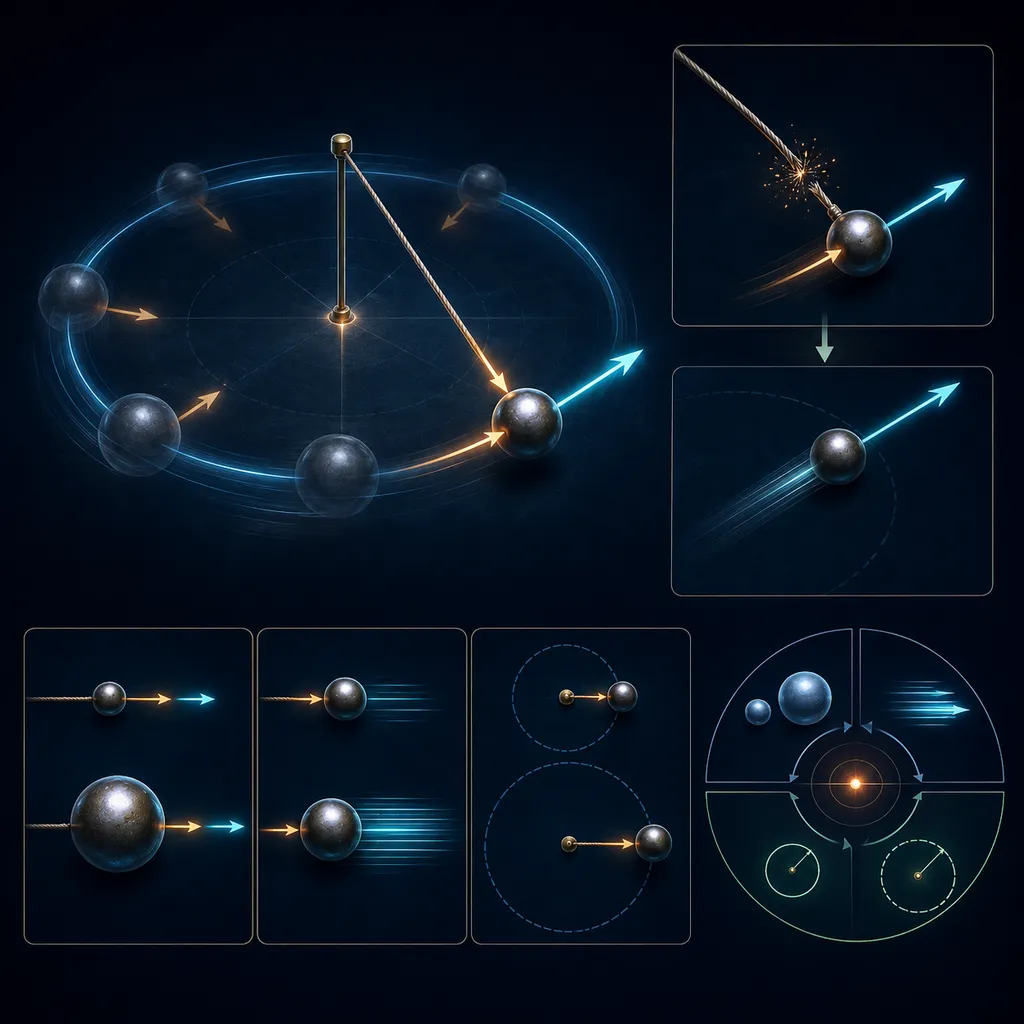
What just happened?
You doubled the speed, and the force needed to keep the body on the circle grew FOURFOLD. The centripetal force grows with the square of the speed.
What is the centripetal force?
It is a force directed toward the CENTER of the circle that constantly "turns" the body, keeping it on the circular path. Without it the body would fly straight.
Formula:
It grows with mass and with the square of the speed, and decreases with radius. The centripetal acceleration:
What does cutting the constraint do?
When the centripetal force disappears (you cut the string), the body does not "fly outward", but travels TANGENTIALLY — along a straight line, following inertia (Newton's first law).
Where does this force come from in practice?
From the tension of a string, the friction of tires on the road in a turn, the gravity keeping a planet in orbit — there is always "something" playing the role of the centripetal force.
Why you need this for the exam:
and solve problems about turns, satellites and centrifuges. The trick: the centripetal force is not a new force, just a role played by a real force directed toward the center.
Remember: you compute the force on a circle from (it grows with the square of the speed), and after the constraint is cut the body flies tangentially, not outward.
Theory & formulas
Circular motion
A body moving along a circle has a centripetal acceleration directed toward the center:
Centripetal force
It keeps the body on its path and is directed toward the center of the circle: It grows with the square of the speed — twice as fast means four times the force.
Cutting the constraint
When the centripetal force vanishes (the string breaks), the body keeps moving tangentially to the circle along a straight line (inertia) — it does not fly "outward".
Symbols: — centripetal force, — mass, — linear speed, — radius of the circle, — angular speed, — centripetal acceleration.
Frequently asked questions
›How do you calculate the centripetal force?
From the formula F = mv²/r — it depends on the mass, the square of the speed, and the radius.
›In which direction does the centripetal force point?
Always toward the center of the circle — it is what keeps the body on its circular path.
›What happens when the centripetal force disappears?
The body keeps moving tangentially to the circle (along a straight line), following inertia — it does not fly outward.
Teaching? Embed this experiment on your site.
Free widget — paste it on your school site, blog or notes. It links to the full version.