Hooke's Law — elastic force and the formula F = kx
What we will do: We will stretch a spring with different forces and watch how its extension changes, and what difference the stiffness of the spring makes.
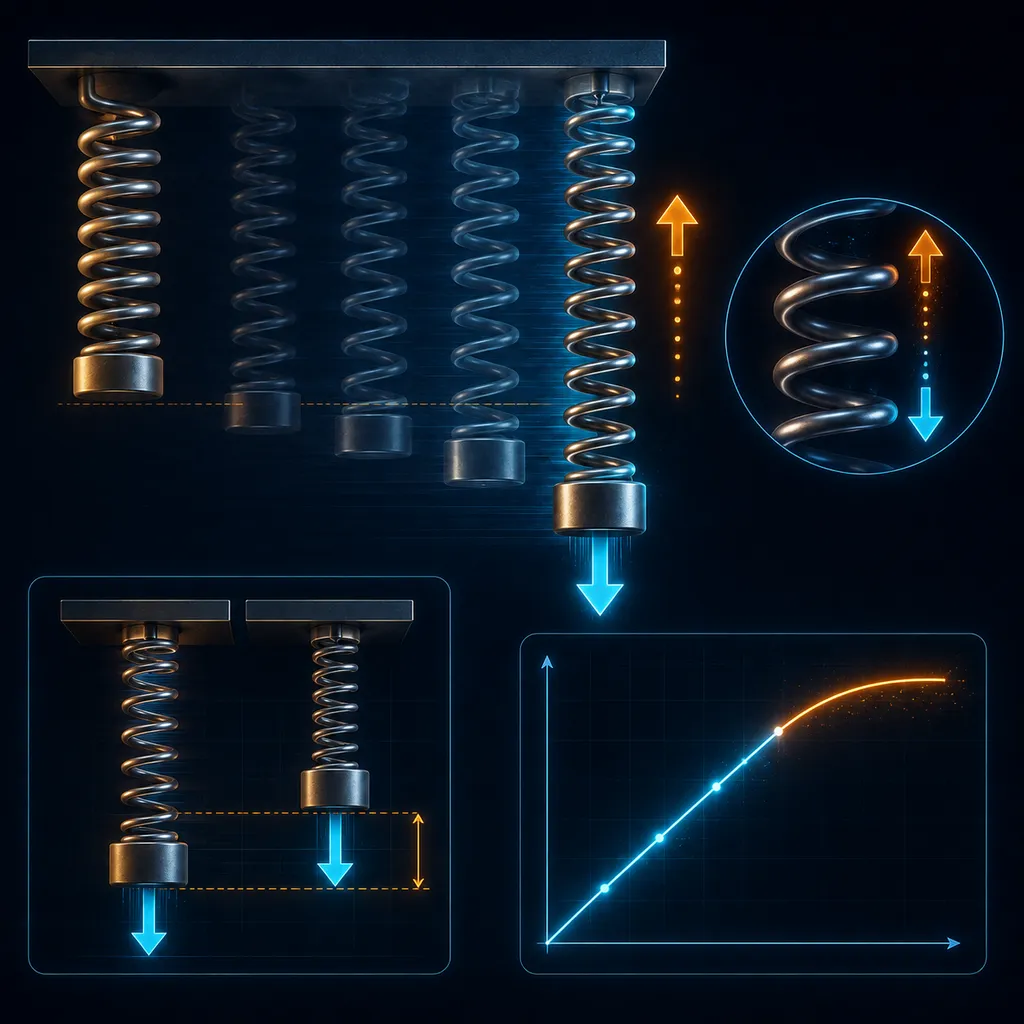
What you see on screen: A spring with a weight, sliders for the force and the spring constant, and an F(x) graph rising along a straight line. A stiffer spring extends less; once the elastic limit is passed, the line bends. Readouts: force, the constant k, extension and elastic energy.
What just happened?
You doubled the force and the spring extended exactly twice as much. The extension is directly proportional to the force.
Hooke's law:
F — stretching force, x — extension, k — spring constant (the spring's stiffness). The larger k is, the stiffer the spring and the less it extends under the same force.
What does it mean?
Double the force → double the extension, triple → triple. On the F(x) graph this is a straight line, and its slope is exactly k:
Elastic energy:
a stretched spring stores energy — it is what launches the body once released.
Note — the elastic limit:
Hooke's law holds only up to a certain force. Beyond it the spring deforms permanently and no longer returns to its original length.
Why you need this for the exam:
F = kx and Ep = ½kx² are the basis of problems on springs, elastic force and oscillations. The trick: find k from the measured F and x, then compute the energy.
Remember: the extension is proportional to the force (F = kx), but only within the elastic range. A stiffer spring (larger k) extends less.
Theory & formulas
Hooke's law
Within the elastic range, a spring's extension is directly proportional to the applied force: The graph is a straight line whose slope equals the constant .
Spring constant
is the stiffness of the spring: the larger is, the harder it is to stretch (a smaller extension for the same force).
Elastic energy
A stretched spring stores elastic potential energy: Once the elastic limit is exceeded, the law no longer holds — the spring deforms permanently.
Notation: — force, — spring constant (in ), — extension, — elastic energy.
Frequently asked questions
›What does Hooke's law state?
A spring's extension is directly proportional to the applied force: F = kx (within the elastic range).
›What does the spring constant k mean?
The stiffness of the spring — the larger k, the harder it is to stretch; it is the slope of the F(x) graph.
›When does Hooke's law stop holding?
Once the elastic limit is exceeded — the spring then deforms permanently and its extension is no longer proportional to the force.
Teaching? Embed this experiment on your site.
Free widget — paste it on your school site, blog or notes. It links to the full version.