The double pendulum and deterministic chaos
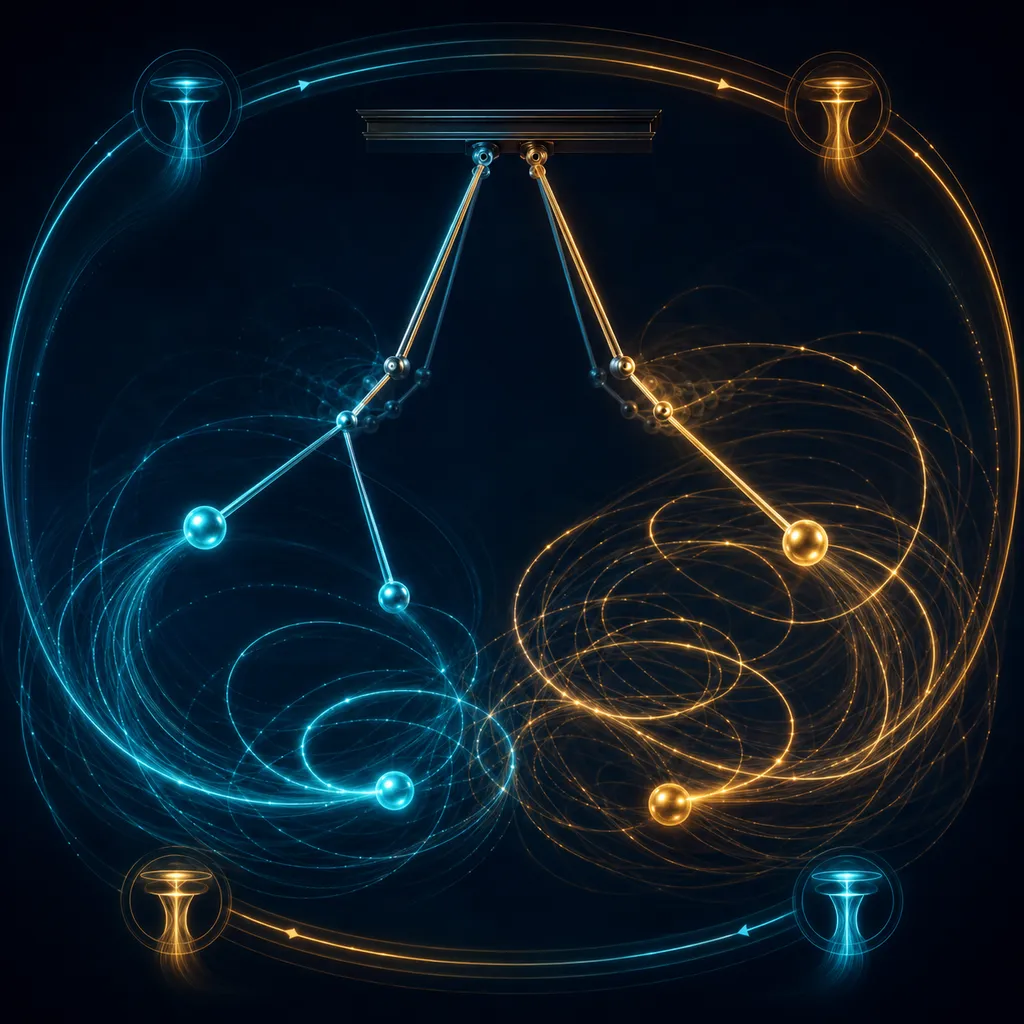
This extends the school topic of oscillatory motion and conservation of energy — beyond the core syllabus. Release two nearly identical double pendulums: after a short while their trajectories diverge completely (the butterfly effect), even though the system is fully deterministic and the total energy is conserved.
I'll give you a feature of the system — decide whether over time it stays CONSERVED (an invariant) or DIVERGES (chaos).
What just happened?
Both pendulums are computed from the same equations of motion — there is no randomness here. And yet a tiny difference in the start (0.001 rad) builds up, and after a few seconds the paths of the tips have nothing in common. This is the essence of deterministic chaos.
Sensitive dependence on initial conditions:
The divergence of two almost identical states grows exponentially in time ( is the Lyapunov exponent). That is why even perfect knowledge of the equations is not enough for a long-term forecast — the error in the starting measurement explodes.
The invariant — conservation of energy:
Chaos does NOT mean “a mess with no rules”. Although the trajectories diverge, the total energy of the system stays continuously conserved — in the panel on the right the top of the bar does not wobble, only the split into Eₖ and Eₚ changes. Determinism ≠ predictability.
Where will you meet this?
The weather behaves the same way: the model is deterministic, but a small error in the initial conditions makes a 2-week forecast practically impossible. Hence the “butterfly effect”.
Why you need this for the exam:
This extends the topic of oscillatory motion and the pendulum. A simple mathematical pendulum is predictable — its period does not depend on the amplitude (for small swings). Adding a second arm destroys that regularity, but conservation of energy still holds — and that is what you use most often in problems.
Remember: a deterministic system can be unpredictable — a tiny difference in the start grows exponentially (the butterfly effect). But the total energy is always conserved: E = Eₖ + Eₚ = const.
Theory & formulas
A deterministic system
The double pendulum is governed by exact equations of motion — there is no randomness in it. And yet its motion is practically unpredictable.
Conservation of energy
Throughout (with no friction) the total mechanical energy is constant:
Sensitive dependence on initial conditions
Two nearly identical starting configurations diverge exponentially fast — a tiny difference grows with time: This is the "butterfly effect": a tiny cause produces, after a short while, a completely different trajectory.
Notation: — total energy, — kinetic, — potential, — divergence of trajectories, — exponent (growth rate), — time.
Frequently asked questions
›What is deterministic chaos?
Motion governed by exact equations, yet so sensitive to initial conditions that it becomes practically unpredictable.
›Why can't the trajectory be predicted?
An infinitesimally small difference in the start grows exponentially — after a short while the trajectories are completely different.
›What is the butterfly effect?
A vivid name for sensitive dependence on initial conditions: a tiny cause produces a large, distant effect.
Teaching? Embed this experiment on your site.
Free widget — paste it on your school site, blog or notes. It links to the full version.