Double-slit experiment with single electrons
This extends the school topic of interference and diffraction and the de Broglie wave — beyond the high-school syllabus. Fire electrons one at a time and watch an interference pattern emerge on the screen (each electron interferes "with itself"). Turn on the "which-slit" detector — the interference disappears.
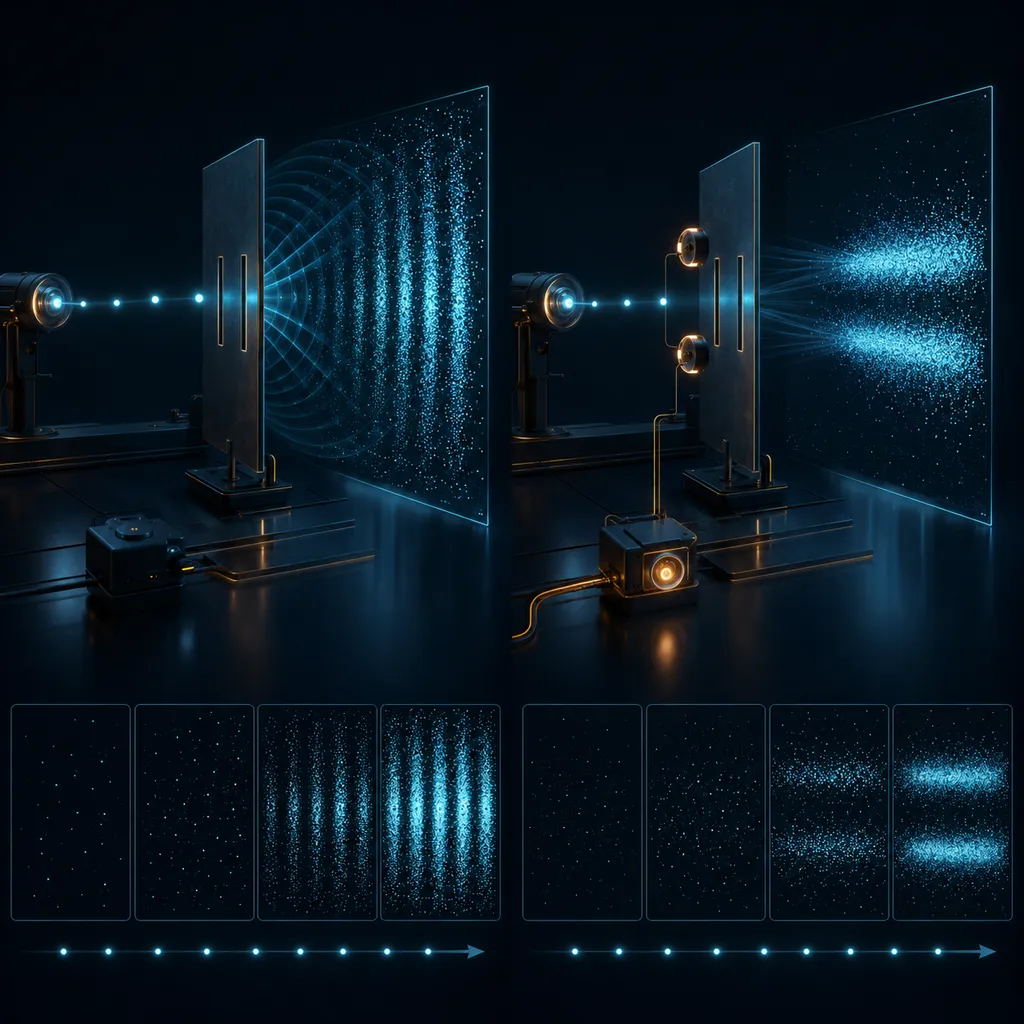
I will give you a which-slit detector setting — guess what forms on the screen after millions of hits.
What just happened?
The electrons travel one at a time — never two at once. At small the hits look like random dots. But once you collect millions of hits, they arrange into regular fringes: bright and dark bands. This is interference — a phenomenon characteristic of waves, not of classical balls.
Wave-particle duality:
Every particle has an associated de Broglie matter wave of wavelength:
where is the Planck constant and is the electron momentum. It is this wave that passes through both slits and interferes with itself. The probability of hitting a given spot on the screen is described by :
where is the slit separation, is the distance to the screen, and is the position on the screen. It is this formula that generates the fringes seen in the simulation.
The role of measurement — why does the detector spoil the pattern?
When you turn on the which-slit detector, you measure which way the electron went. The wave function collapses — there is no longer a superposition of the two paths, so the interference term vanishes. What remains is the plain sum of two single slits, that is two peaks:
The very act of observation changes the result — one of the deepest features of quantum mechanics. The invariant holds: Σ hits = N — every fired electron reaches the screen; only the distribution changes.
Why you need this for the exam:
This extends the topic of interference and diffraction and the de Broglie wave. The trick: fringes = wave (interference), two peaks = a particle "caught" by measurement. Problems combine with the bright-fringe condition — write down what is given (, , ), and compute the positions of the maxima.
Remember: a single electron interferes with itself — gives fringes. The which-slit measurement destroys interference and two peaks remain. Matter is simultaneously a wave and a particle.
Theory & formulas
Matter wave
An electron has an associated de Broglie wave of wavelength: It is this wave that passes through both slits and interferes "with itself".
Interference pattern
Even when fired one at a time, the electrons gradually build up fringes on the screen — the probability distribution . The positions of the maxima are described by the same condition as for light:
The role of measurement
Turning on the "which-slit" detector collapses the wave function onto a single path — the fringes disappear and two peaks remain. Observation destroys the interference.
Notation: — de Broglie wavelength, — Planck constant, — electron momentum, — slit separation, — angle, — fringe order, — wave function.
Frequently asked questions
›How can a particle interfere with itself?
The electron is described by a wave function passing through both slits; its parts superpose, giving a probability distribution |ψ|² in the form of fringes.
›Why does observation destroy the fringes?
A "which-slit" measurement collapses the wave function onto a single path — the superposition disappears and two peaks remain.
›What is a wave function?
A mathematical description of a particle's state; its |ψ|² is the probability density of finding the particle at a given location.
Teaching? Embed this experiment on your site.
Free widget — paste it on your school site, blog or notes. It links to the full version.