The de Broglie wave — matter duality
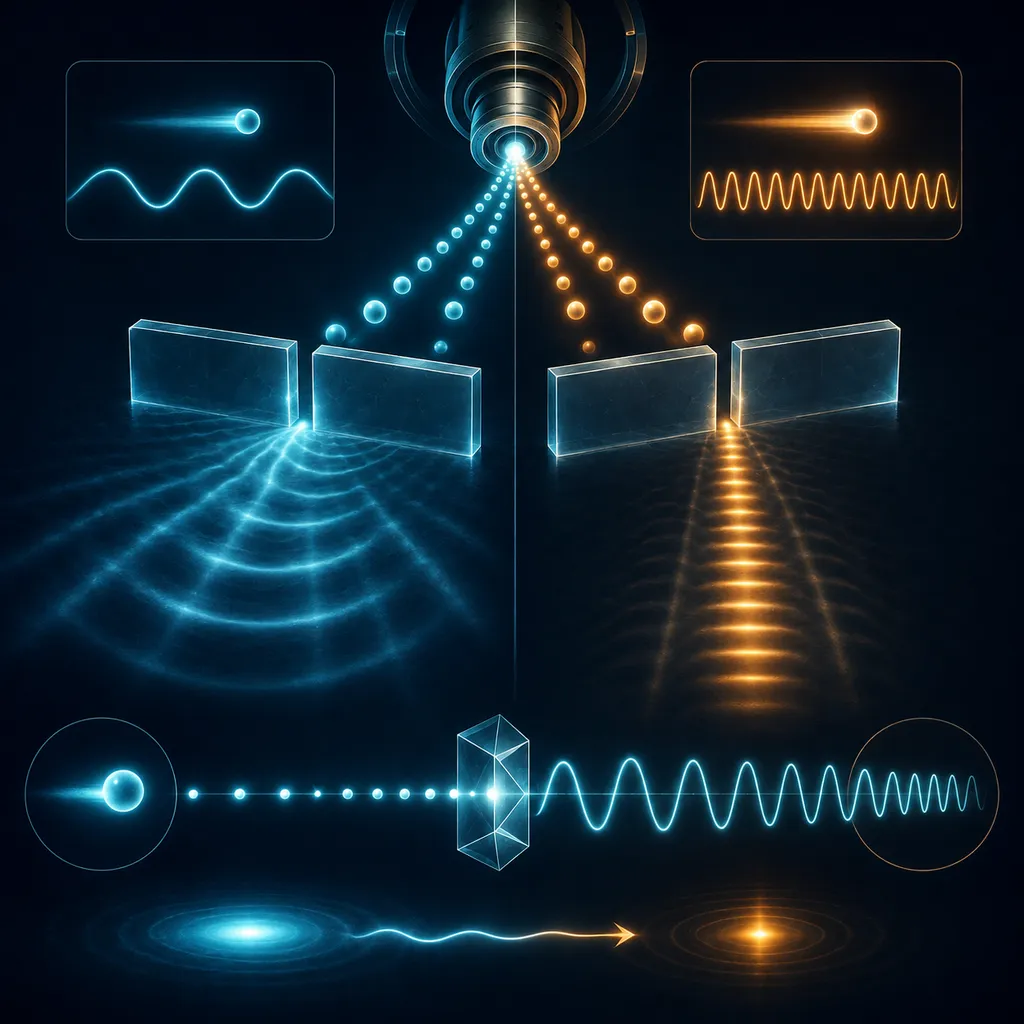
Change the particle's momentum. Every particle has a matter wave of wavelength λ=h/p (wave–particle duality); the greater the momentum, the shorter the wave — which is why wave behaviour only shows up for very small particles.
I'll give you a target matter wavelength — tune the particle momentum to reach it. λ = h/p.
What just happened?
You doubled the particle momentum, and its matter wave shrank by half. Wavelength and momentum are inversely proportional — that is the heart of wave–particle duality.
The de Broglie hypothesis:
— every moving particle (an electron, a proton, even a ball) has a matter wave of wavelength . Here is the Planck constant, and — the particle momentum.
What does it mean in practice?
The faster and heavier the particle (greater momentum), the shorter its matter wave. That is why wave properties show up for light, slow particles — for macroscopic bodies is vanishingly small and immeasurable. Notice that the product stays constant:
How do we know?
Electron matter waves are confirmed by diffraction on a crystal (the Davisson–Germer experiment) — electrons, like waves, are diffracted and form an interference pattern. The electron microscope is built on this.
Why you need it for the exam:
The formula solves most matter-wave problems. The trick: compute the momentum (or ), then divide the Planck constant by it. Remember: momentum rises → decreases.
Remember: every particle has a matter wave — the wavelength decreases as momentum rises. This is a cornerstone of quantum physics.
Theory & formulas
Matter wave
Every particle has a wave of wavelength: The greater the momentum, the shorter the wave.
Why a ball's wave behaviour is invisible
Macroscopic bodies have enormous momentum, so is unimaginably small — wave behaviour only reveals itself for very small particles (electrons). This is the essence of wave–particle duality.
Notation: — matter wavelength, — the Planck constant, — momentum, — mass, — velocity.
Frequently asked questions
›How does momentum affect the matter wavelength?
The opposite — the greater the momentum, the shorter the wave (λ=h/p).
›What is wave–particle duality?
Particles show both particle-like and wave-like features.
›Why is a ball's wave behaviour invisible?
It has enormous momentum — the wavelength is unimaginably small.
Teaching? Embed this experiment on your site.
Free widget — paste it on your school site, blog or notes. It links to the full version.