The Davisson–Germer experiment — matter waves
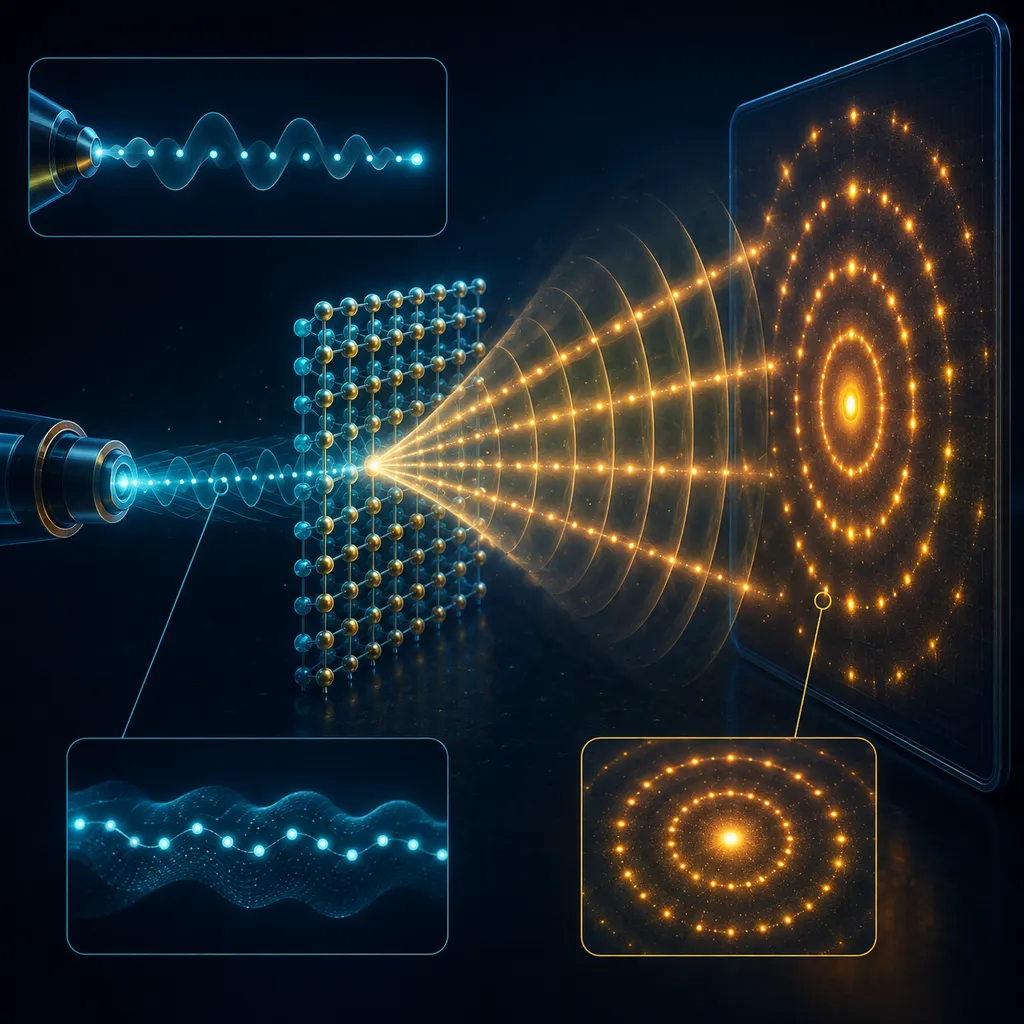
An extension of the de Broglie wave topic. A beam of electrons strikes a crystal and produces a diffraction pattern — just as waves do (λ=h/p). This is direct confirmation that particles have a wave nature (Nobel Prize 1937).
I will give you a target angle for the first maximum θ₁ — tune the voltage U and the lattice spacing d so the maximum falls at that angle. d·sinθ = λ = h/p.
What just happened?
The electron beam reflected off the nickel crystal gave not a single spot but a set of maxima — exactly like a wave diffracting off a grating. Davisson and Germer (1927) thereby confirmed de Broglie's matter-wave hypothesis.
The de Broglie matter wave:
— every particle of momentum corresponds to a wave of wavelength . The greater the momentum (the higher the beam energy), the shorter the wave. — the Planck constant.
Condition for maxima (Bragg):
Maxima arise where the waves scattered off successive lattice planes reinforce one another (the path difference is a whole multiple of ). Changing shifts the maxima; hence their position depends on the electrons' momentum.
What does this mean in practice?
An electron is not “just a tiny ball” — it has a wave nature. Electron diffraction is no curiosity: this is how the electron microscope works, as do the diffractometers that probe crystal structure.
Why you need this for the exam:
λ = h/p together with d·sinθ = nλ solves problems on matter waves and diffraction. The trick: compute λ from the momentum (or voltage), then plug it into the Bragg condition to find the maximum angle.
Remember: electrons are matter waves — λ = h/p, and on a crystal they produce a diffraction pattern. This is proof of wave–particle duality.
Theory & formulas
Electron diffraction
A beam of electrons strikes a crystal and produces a diffraction pattern — just as waves do. This is direct confirmation of de Broglie waves (Nobel Prize 1937).
The Bragg condition
Maxima appear when: The regular crystal lattice acts as a diffraction grating for the electrons' matter waves.
Symbols: — spacing between lattice planes, — angle of incidence, — order of the maximum, — matter-wave wavelength, — Planck constant, — electron momentum.
Frequently asked questions
›What did the Davisson–Germer experiment confirm?
The wave nature of electrons — de Broglie's matter-wave hypothesis.
›Why do electrons produce a diffraction pattern?
Because, as waves of wavelength λ=h/p, they diffract off the regular crystal lattice (the Bragg condition).
›What is a matter wave?
A wave description of a particle with wavelength λ=h/p — the greater the momentum, the shorter the wave.
Teaching? Embed this experiment on your site.
Free widget — paste it on your school site, blog or notes. It links to the full version.