Neutrino — the ghost particle that passes through everything
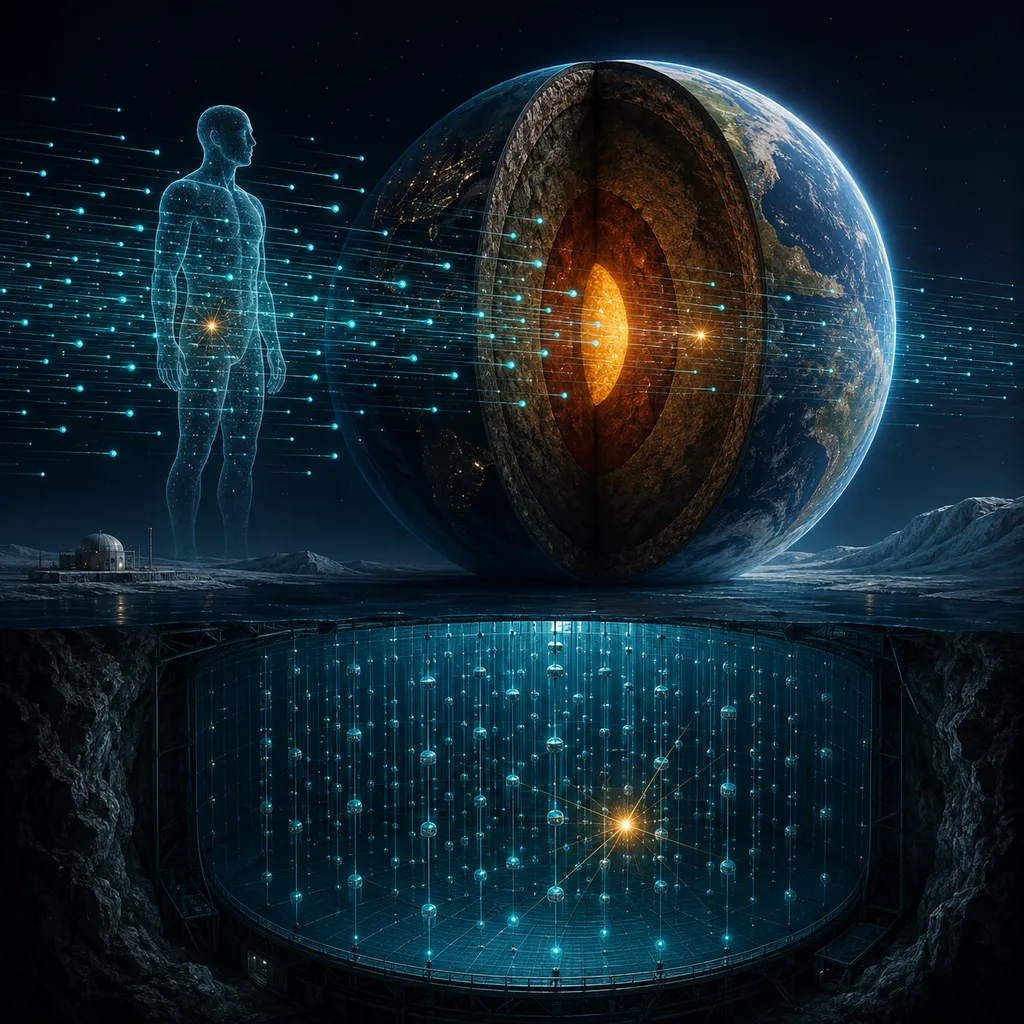
An extension of the topic of elementary particles and interactions. Trillions of neutrinos pass through the human body every second, hardly interacting with matter at all — even the thickness of the whole Earth barely weakens their beam. Catching even a few neutrinos requires gigantic detectors (Nobel Prize in Physics 1995, Frederick Reines).
I’ll give you a target number of interactions per billion neutrinos — tune the thickness of matter d. P = 1 − e^(−d/λ).
What just happened?
You set the thickness of matter in the neutrinos’ path to the entire diameter of the Earth — and the beam still passed through to the other side almost without loss. A neutrino does not “feel” matter the way light or even gamma radiation does: it interacts only through the weak interaction, and that happens extremely rarely.
Interaction probability:
— where d is the thickness of matter and λ (the neutrino’s mean free path) is gigantic, on the order of a light-year in dense matter. Even with d equal to the diameter of the Earth (about 12,800 km) the ratio d/λ is so small that P stays close to zero.
The ghost particle — what it is and how it was discovered
A neutrino is an elementary particle with no electric charge and a vanishingly small mass. In 1930 Wolfgang Pauli proposed its existence on purely theoretical grounds — as the “missing” particle in beta decay, needed to conserve energy and momentum. It was nicknamed the “ghost particle” because it almost never interacts with matter. In the 1950s Frederick Reines, together with Clyde Cowan, carried out an experiment at a nuclear reactor — first at Hanford, then at Savannah River — placing a huge tank of water right next to the reactor. In 1956 they observed traces of neutrinos experimentally for the first time and sent a telegram with the news to Pauli himself.
Why are they so hard to catch?
Modern detectors are true giants — e.g. Super-Kamiokande in Japan (a tank holding thousands of tonnes of ultra-pure water) or IceCube at the South Pole (a cubic kilometre of ice packed with sensors). Even they catch only a tiny fraction of the particles flying through — because the more matter there is, the more chances for a rare interaction, yet there are still astronomically few of them.
Where do neutrinos come from?
They are produced in nuclear reactions: trillions pass through your body every second, mostly from the Sun. They also arise in nuclear reactors, in the atmosphere under cosmic radiation, and in violent supernova explosions.
Why this matters for your exam:
The neutrino is the standard example of a particle that interacts only weakly — a good starting point for questions about the fundamental interactions and about why beta decay “loses” energy to an invisible particle. The 1995 Nobel Prize in Physics awarded to Frederick Reines (“for the detection of the neutrino”) is also a common example in questions about the history of discoveries.
Remember: a neutrino interacts only through the weak force, so it almost never “collides” with matter — even the whole Earth in its path changes almost nothing.
Theory & formulas
The ghost particle
A neutrino is electrically neutral and almost never interacts with matter. Trillions of neutrinos pass through the human body every second, and even the thickness of the whole Earth barely weakens their beam.
Why they are so hard to catch
The probability of a neutrino interacting with matter is extremely small. The key relationships:
- the greater the mass (number of atoms) of the detector, the more interactions are recorded,
- the longer the measurement time, the more neutrinos are caught.
That is why gigantic detectors are built (huge tanks of water or liquid).
Sources
Neutrinos come mainly from the Sun, as well as from nuclear reactors, the atmosphere, and supernova explosions.
Frequently asked questions
›What is a neutrino?
An electrically neutral elementary particle that almost never interacts with matter.
›Why is a neutrino so hard to catch?
Because the probability of it interacting with matter is extremely small, which is why gigantic detectors are needed.
›Where do neutrinos come from?
Mainly from the Sun, but also from nuclear reactors, the atmosphere, and supernova explosions.
Teaching? Embed this experiment on your site.
Free widget — paste it on your school site, blog or notes. It links to the full version.