Cherenkov radiation — the blue glow of reactors
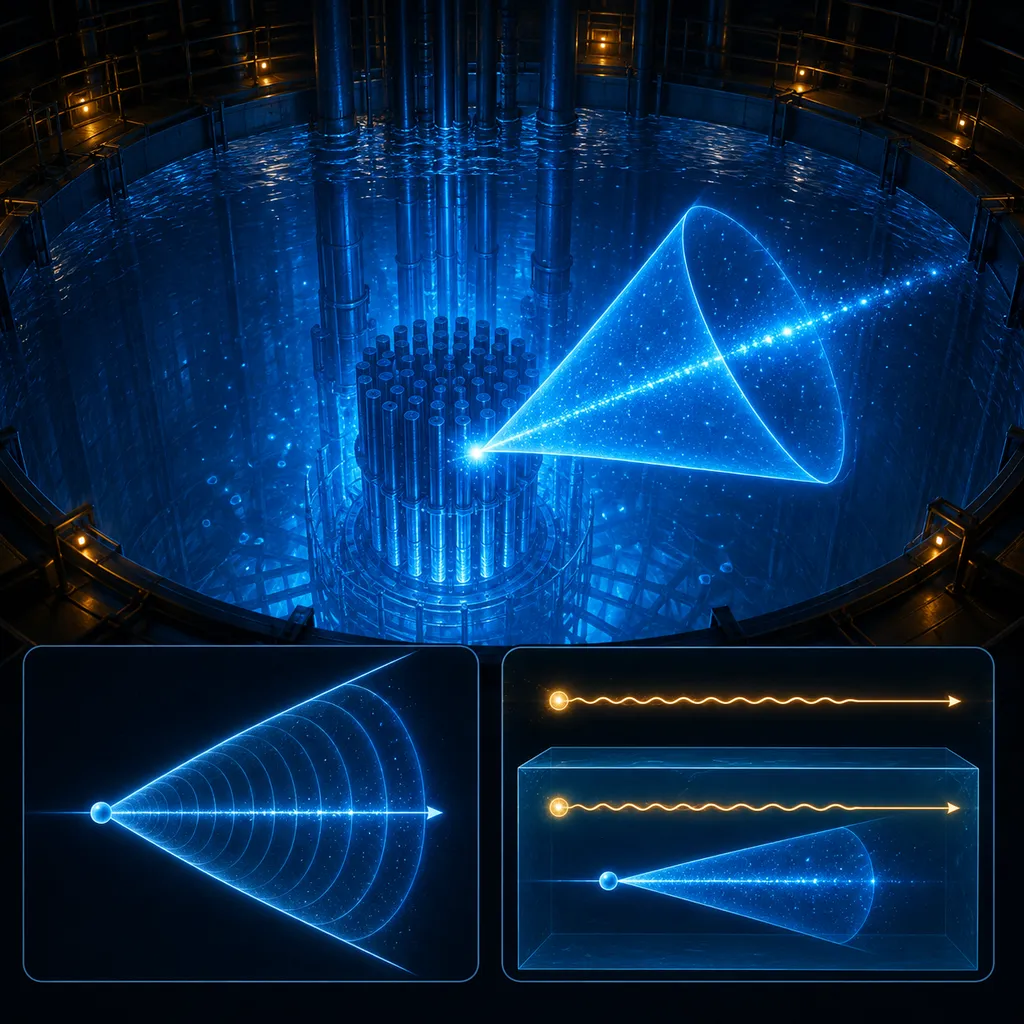
An extension of the topic of the speed of electromagnetic waves in a medium. When a charged particle moves through a medium (e.g. water) faster than light in THAT medium (v > c/n), yet always slower than c in vacuum — relativity stays intact — a characteristic blue glow forms in the shape of a cone, which is the source of the blue shimmer of the water cooling nuclear reactors (Nobel Prize in Physics 1958; Cherenkov, Frank, Tamm).
I'll give you a target Cherenkov cone angle — tune the particle speed to reach it (cos θc = 1/(nβ)).
What just happened?
Pavel Cherenkov observed the effect experimentally in the 1930s, and the full theoretical explanation was given by Ilya Frank and Igor Tamm (1937). A charged particle moving through a medium (e.g. water) faster than light in that medium — yet always slower than in vacuum, so relativity stays intact — polarizes the molecules of the medium along its track. As they return to the ground state they emit the characteristic blue radiation in the shape of a cone.
Emission condition:
— where is the refractive index of the medium (for water , so the threshold is ). Below this threshold the particle does not outrun the waves it itself stirs up in the medium, and no glow forms.
Cone angle:
The more the particle exceeds the threshold, the wider the cone — exactly like the acoustic shock wave when a plane breaks the sound barrier, except here it is light.
Why does the water in a reactor pool glow blue?
Charged particles (e.g. electrons) produced in nuclear reactions move through the cooling water faster than light in that water — producing the characteristic faint blue glow, visible to the naked eye in research-reactor pools.
Does this break the speed-of-light limit?
No. The particle is always slower than in vacuum — it only beats the speed of light slowed down by the medium, which is forbidden by no law of physics.
Where is it used?
In particle detectors (e.g. for neutrinos, as at the Super-Kamiokande observatory) and as a visual indicator of radiation intensity in nuclear reactors.
Why this matters for your exam:
Remember the difference between the speed of light in vacuum (constant, unbeatable) and in a medium (slowed down, beatable). This is a common hook for questions testing whether you understand that relativity limits only the speed in vacuum.
Remember: the blue Cherenkov glow appears when — the particle outruns light in the medium, never in vacuum.
Theory & formulas
Speed of light in a medium
In a medium with refractive index , light travels slower than in vacuum:
Emission condition
The blue Cherenkov glow appears when a charged particle moves through the medium faster than light does there: The particle still remains always slower than in vacuum — relativity is not violated.
Radiation cone
The wavefronts form a cone whose angle is given by: Hence the blue shimmer of the water cooling reactors; the effect is exploited by particle and neutrino detectors.
Notation: — particle speed, — speed of light in the medium, — speed of light in vacuum, — refractive index, — cone angle.
Frequently asked questions
›Why does the water in a reactor pool glow blue?
Because charged particles move through the water faster than the light slowed down there, triggering the Cherenkov effect.
›Does the Cherenkov effect break the speed-of-light limit?
No — the particle is always slower than c in vacuum, only faster than the light slowed down in the given medium.
›Where is the Cherenkov effect used?
In particle detectors, e.g. to detect neutrinos in huge tanks of water.
Teaching? Embed this experiment on your site.
Free widget — paste it on your school site, blog or notes. It links to the full version.