The Higgs boson — where particles get their mass
Descriptive card (beyond-the-syllabus extension) — the Higgs field fills all of space; by interacting with it, particles "acquire" mass — the stronger a particle's coupling to the field, the greater its mass. The existence of the Higgs boson (the quantum of this field) was confirmed experimentally at the Large Hadron Collider (LHC, CERN) in 2012 (Nobel Prize 2013, Englert and Higgs).
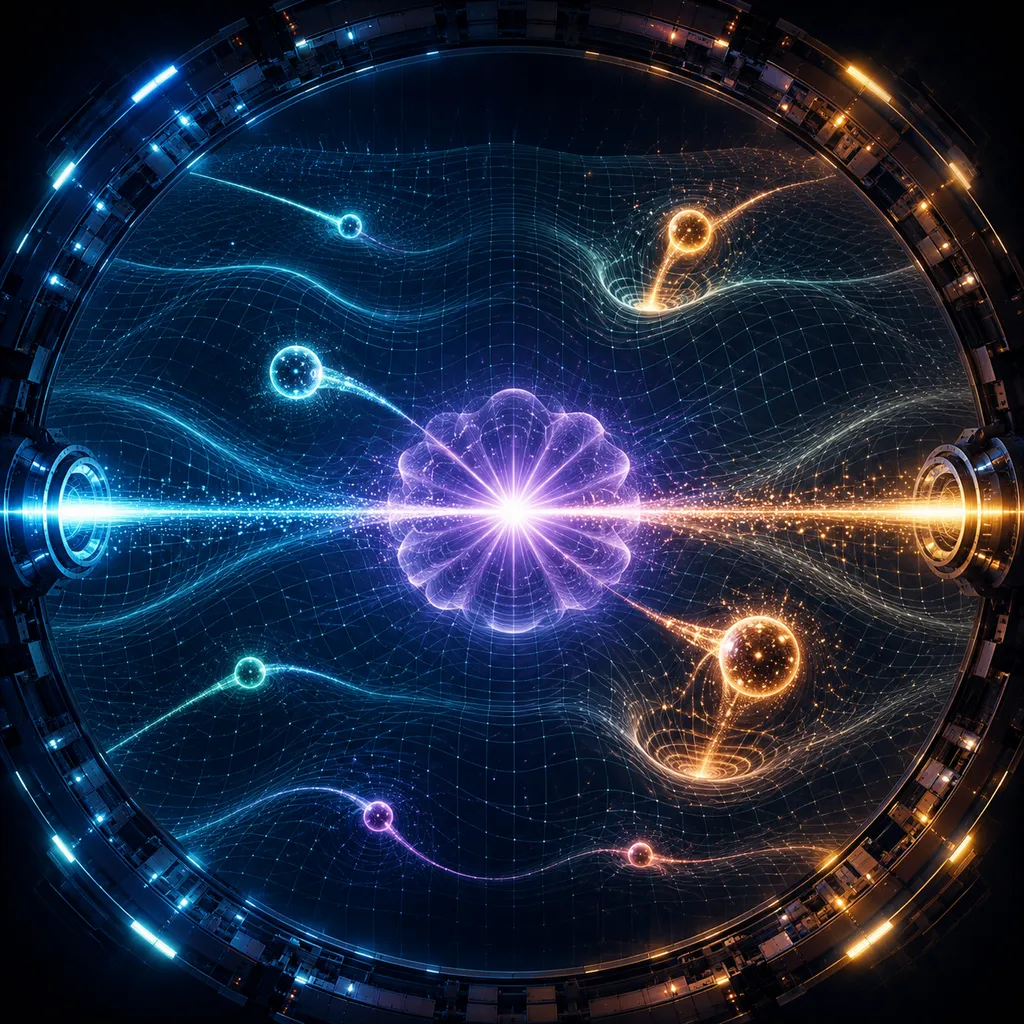
I will give you a particle and its coupling strength to the Higgs field — guess how large its mass is. m ∝ g.
What is the Higgs field?
According to the Standard Model, an invisible Higgs field fills all of space — it exists everywhere, even in “empty” vacuum. Elementary particles (electrons, quarks and others) interact with it ceaselessly, moving through it just as, in the simulation above, the particle flies through the “crowd” of violet dots representing the field.
How does the Higgs field give mass?
The strength of this interaction is described by the so-called Yukawa coupling — the more strongly a given particle “clings” to the Higgs field, the harder it is to accelerate or stop, i.e. the greater its mass:
where is the coupling constant of a given particle to the field, and — the vacuum expectation value of the Higgs field (a constant, about 246 GeV). Photons do not interact with the Higgs field at all () and are therefore massless. The electron has a very small , whereas the top quark — enormous, so it is almost 350,000 times heavier than the electron.
Confirmation at the LHC — 2012
The Higgs boson itself is a quantum of the oscillations of this field — its detection was proof that the field really exists. On 4 July 2012, two independent experiments at the Large Hadron Collider (LHC) at CERN — ATLAS and CMS — announced the discovery of a new particle with a mass of about 125 GeV, consistent with the predictions for the Higgs boson.
Nobel Prize 2013
The mechanism by which the field (today called the Higgs field) gives particles their mass was proposed theoretically as early as 1964 by, among others, Peter Higgs and François Englert. After experimental confirmation at the LHC, in 2013 both received the Nobel Prize in Physics “for the theoretical discovery of a mechanism that helps us understand the origin of the mass of subatomic particles”.
Why this matters for your exam:
This extends the topic of elementary particles and the Standard Model — it shows where mass comes from in the first place (it is not a “built-in” property of matter, but an effect of interaction with the field) and what modern confirmation of physical theories in large experiments looks like (LHC, CERN).
Remember: the Higgs field fills all of space; the stronger a particle coupling to this field, the greater its mass; the Higgs boson (a quantum of this field) was discovered at CERN in 2012 (ATLAS, CMS), and Englert and Higgs received the Nobel Prize for it in 2013.
Theory & formulas
The Higgs field
The Higgs field fills all of space. By interacting with it, particles "acquire" mass — just as a body moving through a dense medium meets resistance.
Mass and coupling
Not all particles have the same mass. A simple qualitative relationship holds:
- the stronger a particle's coupling to the Higgs field, the greater its mass,
- particles not coupled to the field (e.g. the photon) remain massless.
Confirmation
The Higgs boson is the quantum (excitation) of this field. Its existence was confirmed by the ATLAS and CMS experiments at the Large Hadron Collider (LHC, CERN) in 2012 (Nobel Prize 2013, Englert and Higgs).
Frequently asked questions
›What is the Higgs field?
A field filling all of space, with which particles interact and thereby acquire mass.
›How was the existence of the Higgs boson confirmed?
The ATLAS and CMS experiments at the Large Hadron Collider (LHC) at CERN detected it in 2012.
›Do all particles have the same mass thanks to the Higgs field?
No — mass depends on the strength of a given particle's coupling to the field; the stronger it is, the greater the mass.
Teaching? Embed this experiment on your site.
Free widget — paste it on your school site, blog or notes. It links to the full version.