Nuclear radiation — penetration and shielding
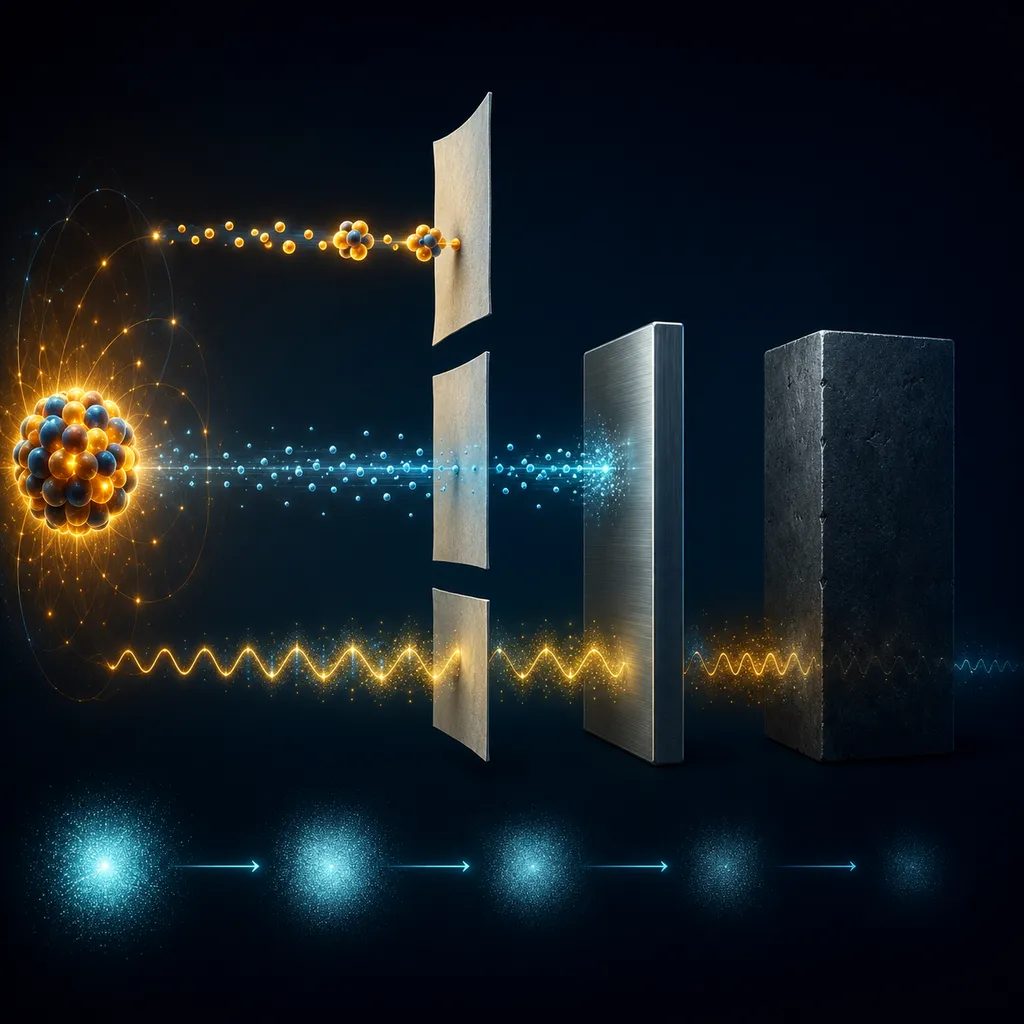
Pick the type of radiation and a shield. α radiation is stopped by a sheet of paper, β by an aluminium plate, and penetrating γ only by a thick layer of lead. The dose also decreases with distance (∝1/d²). Check what gets through the barrier.
I will give you a target dose behind the shield — pick the type of radiation, the shield and the distance d to reach it. D = T·1/d².
What just happened?
The same shield stops different radiation to different degrees. α particles are heavy and charged — a sheet of paper already stops them. β electrons are stopped by a few millimetres of aluminium. γ photons have no charge and penetrate the deepest — only thick lead attenuates them significantly.
Penetration increases in the order:
α — helium nuclei (paper), β — electrons (aluminium), γ — photons (thick lead). The smaller the charge and mass, the greater the range in matter.
Dose vs. distance:
Radiation from a point source spreads over an ever-larger sphere, so the intensity (and with it the dose) falls off with the square of the distance:
Moving 2× farther reduces the dose 4×; moving 3× farther — as much as 9×. That is why distance is one of the simplest and cheapest methods of protection (alongside time and shielding).
Why you need this for the exam:
Nuclear problems like to ask "what to shield with" and "how many times weaker the dose is after moving away". Trick: memorise the order of shields (paper → aluminium → lead) and the rule — the rest is just plugging in numbers.
Remember: a sheet of paper stops α, aluminium stops β, and only thick lead stops γ; and the dose falls off with the square of the distance ().
Theory & formulas
Penetration vs. shielding
The ability to penetrate matter increases in the order :
- — stopped by a sheet of paper or the skin,
- — stopped by an aluminium plate,
- — requires a thick layer of lead or concrete.
Attenuation in a material
The intensity of radiation decreases exponentially with the thickness of the shield :
Effect of distance
The dose from a point source decreases with the square of the distance: Moving twice as far away reduces the dose fourfold.
Notation: — intensity after passing through the shield, — initial intensity, — attenuation coefficient of the material, — shield thickness, — distance from the source.
Frequently asked questions
›What shields best against γ radiation?
A thick layer of high-density material, e.g. lead or concrete — γ is the most penetrating.
›Which radiation is the least penetrating?
Alpha (α) — it is stopped by a sheet of paper or the skin, but it is dangerous once it enters the body.
›How does distance affect the dose?
The intensity decreases with the square of the distance (∝1/d²), so moving away effectively reduces the dose.
Teaching? Embed this experiment on your site.
Free widget — paste it on your school site, blog or notes. It links to the full version.