Radioactive decay — half-life and the formula N = N₀(½)^(t/T)
What we'll do: We'll track how many radioactive nuclei remain in a sample as successive half-lives pass.
What you see on screen: A sample of nuclei as a grid of glowing dots that fade out as they decay, isotope presets (C-14, I-131, Ra-226) and a time slider. Beside it, the N(t) curve with markers after each half-life (100→50→25%). Readouts: the half-life T, time, the number of remaining and decayed nuclei, and the percentage remaining.
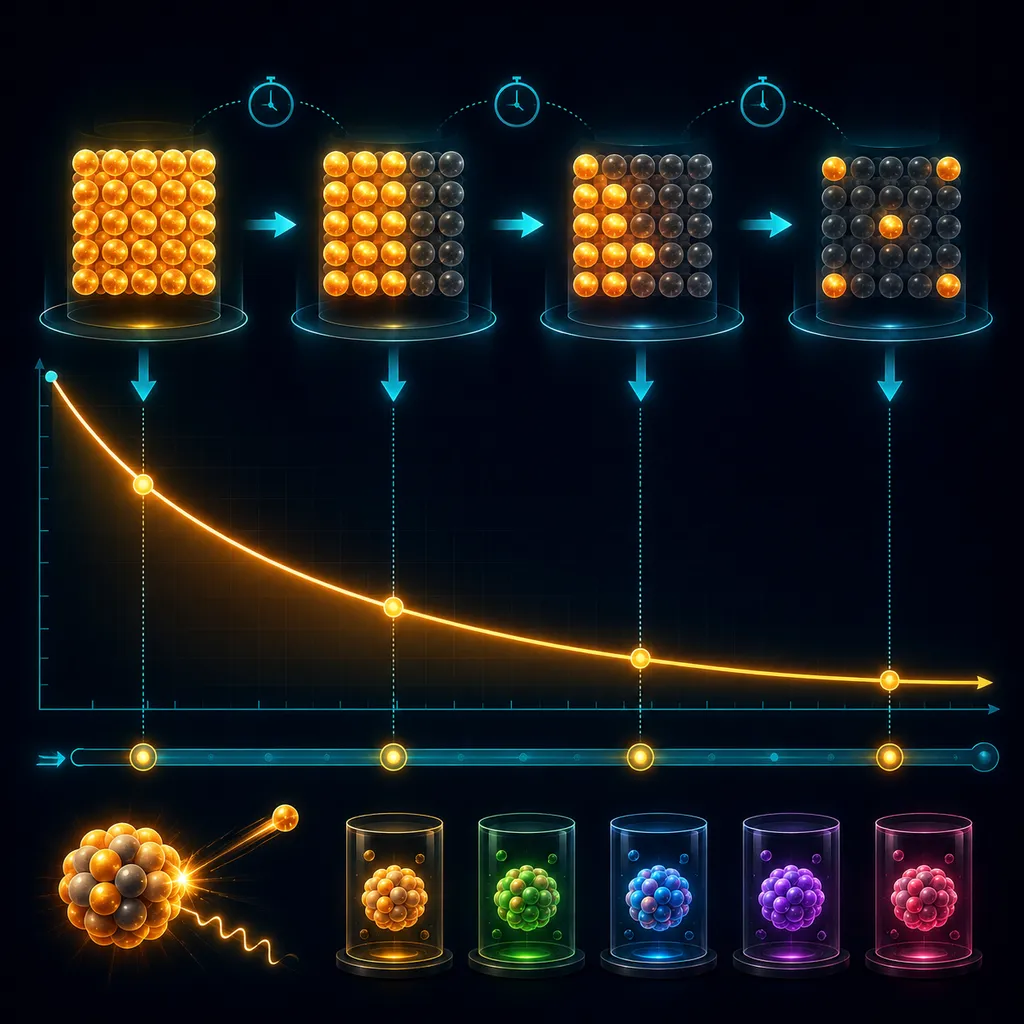
I'll give you a target percentage of nuclei remaining — set the time with the slider to reach it. N = N₀·(½)^(t/T).
What just happened?
After one half-life 50% of the nuclei remain, after the second 25%, after the third 12.5% — each time half of the previous amount. It never reaches zero.
What is a half-life?
It is the time T after which half of the radioactive nuclei in a sample decay. It is a fixed property of the isotope — it does not depend on temperature, pressure, or how many nuclei there were at the start.
The decay law:
N₀ — the number of nuclei at the start, N — after time t. The same formula works for the mass of the sample and for the activity.
Why exponential, not linear?
Because in each half-life HALF of what IS LEFT decays — not a fixed portion. The fewer nuclei, the fewer decays, so the curve falls more and more slowly and in theory never reaches zero.
Dating:
knowing the half-life T of carbon C-14 (5730 years) and measuring how much is left, the age of remains is calculated.
Why you need this for the exam:
the formula and working out “how many half-lives” are the core of nuclear physics problems. The trick: compute t/T, then raise ½ to that power.
Remember: after each half-life, half of the previous amount remains — decay is exponential, and the half-life T does not depend on external conditions.
Theory & formulas
The decay law
After each half-life one half of the nuclei remains: 100% → 50% → 25% → 12.5%…
Exponential form
is constant for a given isotope (e.g. C-14 ~5700 years — dating; I-131, Ra-226).
Notation: — the number of nuclei after time , — the initial number, — the half-life, — the decay constant, — time.
Frequently asked questions
›What is a half-life?
The time after which half of the radioactive nuclei in a sample decay; it is constant for a given isotope.
›What is the law of radioactive decay?
N = N₀·(½)^(t/T), where t is time and T is the half-life.
›How much of a sample remains after three half-lives?
One eighth (12.5%) — after each half-life, half of the previous amount remains.
Teaching? Embed this experiment on your site.
Free widget — paste it on your school site, blog or notes. It links to the full version.