Nuclear reactions — balance and types of decay
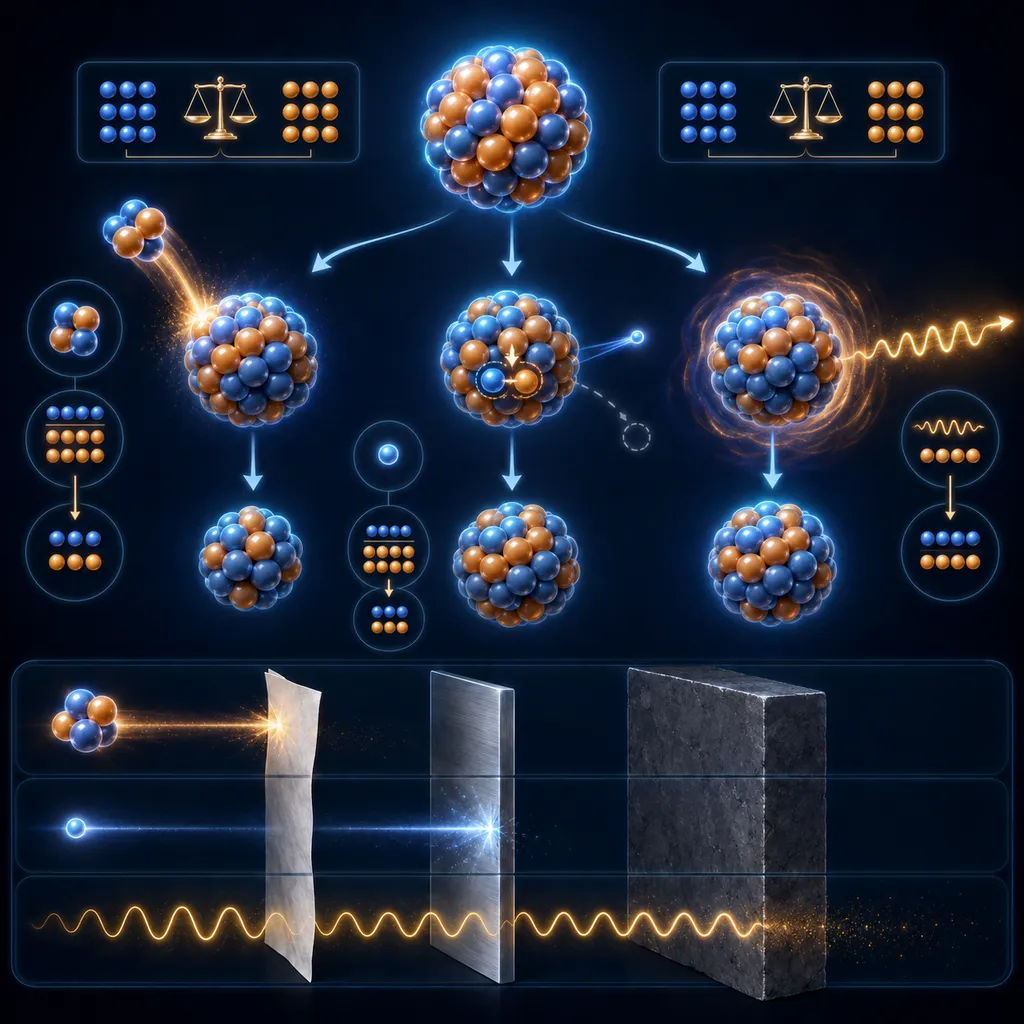
In every nuclear reaction the mass number A and the atomic number Z are conserved (the sums on both sides are equal). α decay changes the nucleus by (−4, −2), β⁻ by (0, +1) (neutron→proton), γ changes neither A nor Z. Penetrating power increases: α (paper) < β (aluminium) < γ (lead). Choose a decay type and a nucleus.
I'll give you a decay type — say by how much the nucleus's atomic number Z changes.
How do you balance a nuclear reaction?
In every nuclear reaction the mass number (upper index) and the atomic number (lower index) are conserved. The sums on both sides of the equation must match.
Nucleus notation and the general balance:
Types of decay:
In α decay the nucleus loses a particle. Beta decay is a transformation inside the nucleus: — neutron → proton + electron (Z increases by 1), — proton → neutron + positron (Z decreases by 1). In γ decay the nucleus merely radiates off excess energy — A and Z unchanged.
What penetrates the deepest?
The order of penetrating power is : an α particle is stopped by a sheet of paper, β radiation by a few-millimetre aluminium plate, and γ radiation only by a thick layer of lead.
Why you need this for the exam:
Most nuclear-physics problems are balancing exercises: fill in the missing A and Z using the conservation of both numbers. Trick: write the upper indices separately and the lower ones separately — both sums must match.
Remember: in a nuclear reaction A and Z are conserved. α: (A−4, Z−2), β⁻: (A, Z+1), β⁺: (A, Z−1), γ: (A, Z). Penetration: γ > β > α.
Theory & formulas
Conservation laws
In every nuclear reaction the following are conserved: the mass number (the number of nucleons) and the atomic number (the total charge). The sum of and the sum of on both sides of the equation must be equal.
Alpha decay
The nucleus emits a helium nucleus :
Beta-minus decay
A neutron turns into a proton (an electron is emitted): unchanged, increases by 1: radiation changes neither nor . Penetrating power increases: .
Symbols: — mass number, — atomic number, — parent nucleus, — daughter nucleus, — electron, — antineutrino.
Frequently asked questions
›How do you balance a nuclear reaction?
The sum of the mass numbers A and the sum of the atomic numbers Z must be equal on both sides of the equation (conservation of nucleons and charge).
›What penetrates the deepest?
γ radiation — it is stopped only by a thick layer of lead. α is stopped by a sheet of paper, β by a thin aluminium sheet.
›What is beta decay?
The transformation of a neutron into a proton (β⁻, Z increases by 1) or a proton into a neutron (β⁺, Z decreases by 1), with emission of an electron/positron and a neutrino.
Teaching? Embed this experiment on your site.
Free widget — paste it on your school site, blog or notes. It links to the full version.