Damped oscillations
In real systems oscillations decay — energy is dissipated (friction, drag). The amplitude decreases: x(t)=A·e^(−βt)·cos(ω′t). The larger the damping coefficient β, the faster the oscillations decay. With critical damping the system returns to equilibrium fastest, without oscillations. Change the damping.
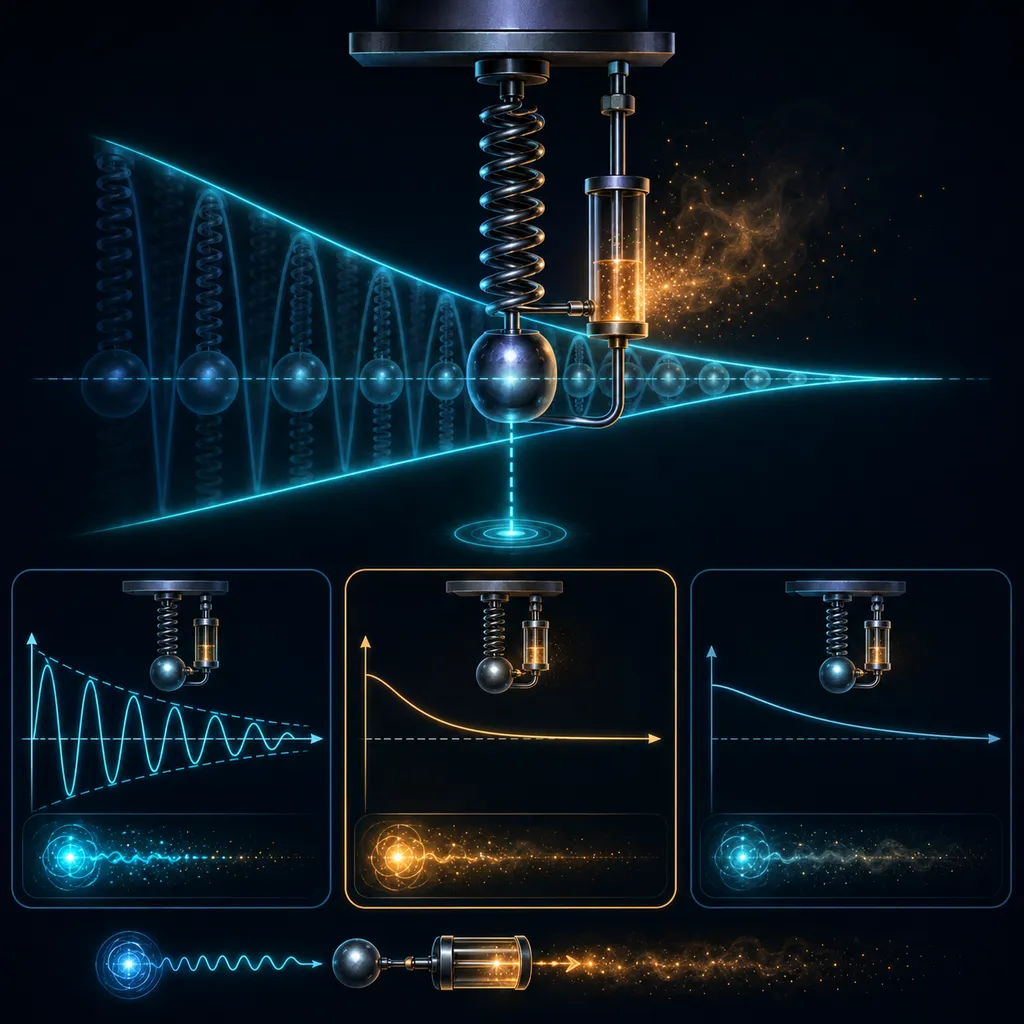
I'll give you a damping coefficient β — guess the regime (no slider). Natural frequency ω₀ = 3 rad/s.
What just happened?
You increased the damping and the oscillation amplitude dropped faster. The envelope of the displacement shrinks exponentially — the larger , the sooner the motion dies out.
Damped oscillations:
— the displacement oscillates with frequency , but is confined within a decaying envelope . A — initial amplitude, β — damping coefficient (1/s), — natural frequency.
What is damping?
It is the dissipation of oscillation energy — medium resistance, friction, viscosity. Mechanical energy turns into heat, so it decreases monotonically: . The motion never "gains" energy on its own.
Three regimes — and what is critical damping?
We compare β with the natural frequency :
With weak damping the system oscillates, slowly losing amplitude. Critical damping is the fastest return to equilibrium without a single oscillation. Above it — overdamping — the system also does not oscillate, but returns sluggishly.
Where does this apply?
Car shock absorbers are tuned close to critical damping: after a bump the wheel should return at once, without bouncing. The same goes for door closers, balance scales and vibration dampers in buildings.
Why you need this for the exam:
Read the regime off the graph: oscillations in a shrinking envelope = weak damping; a return without crossing zero = critical or overdamped. Remember that β increases the decay rate, and — damped oscillations are slower than free ones.
Remember: damping dissipates energy, so the amplitude decays exponentially — . Larger β → faster decay; at β = ω₀ the return is fastest and without oscillations.
Theory & formulas
Amplitude decay
Friction and drag dissipate energy, so the amplitude decays exponentially: The larger the damping coefficient , the faster the oscillations decay.
Critical damping
For a sufficiently large the system returns to equilibrium fastest, without oscillations — this is critical damping (shock absorbers, door closers, vibration dampers in buildings).
Symbols: — displacement, — initial amplitude, — damping coefficient, — damped oscillation frequency, — time.
Frequently asked questions
›What is damping?
The dissipation of oscillation energy (e.g. through friction or medium resistance), which makes the amplitude decrease over time.
›What is critical damping?
Damping at which the system returns to the equilibrium position fastest, still without oscillations (the boundary between underdamping and overdamping).
›Examples?
Car shock absorbers (tuned close to critical damping), door closers, vibration dampers in buildings.
Teaching? Embed this experiment on your site.
Free widget — paste it on your school site, blog or notes. It links to the full version.