Conservation of angular momentum
When no external torque acts, angular momentum L=Iω is conserved. That is why a figure skater who pulls her arms in (reducing the moment of inertia I) starts to spin faster (ω rises) — because the product Iω must stay constant. Change the radius over which the mass is spread.
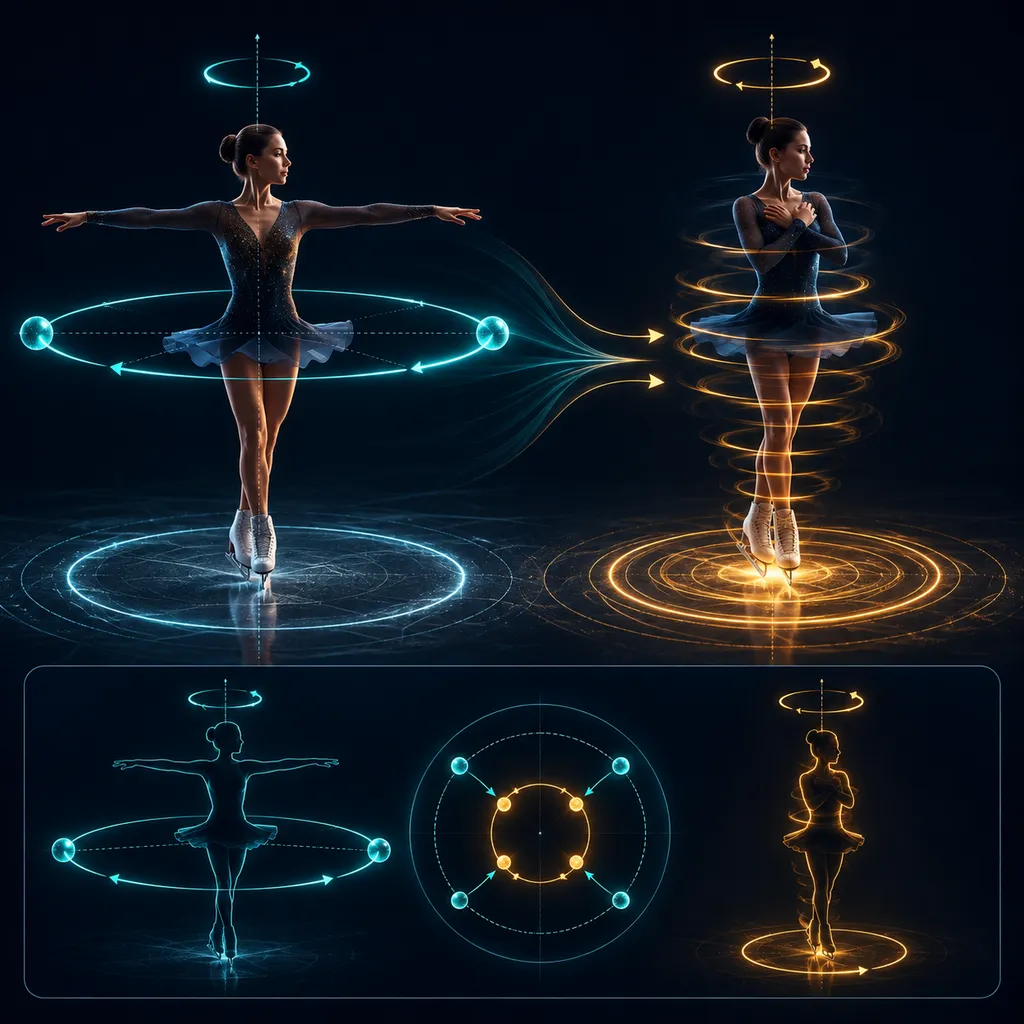
What just happened?
The skater pulled her arms in — the mass moved closer to the rotation axis, so the moment of inertia dropped. Because nothing braked her motion (no external torque), the angular momentum stayed the same, so the angular speed increased. The pirouette speeds up "on its own".
Conservation of angular momentum:
— when no net external torque acts on the body, its angular momentum stays constant. I — moment of inertia (kg·m²), ω — angular speed (rad/s).
Why does the skater speed up?
The moment of inertia depends on how far the mass is spread from the axis: . Pulling the arms in reduces , so drops. For the product to stay constant, ω must increase:
Where else does this apply?
A dancer's and a jumper's pirouette; planets speed up at perihelion as they approach the Sun; a collapsing star shrinks to the size of a city and becomes a neutron star spinning hundreds of times per second — everywhere is conserved.
Why you need this for the exam:
solves problems about pirouettes, carousels and planets. Trick: if there is no external torque, set equal and compute the unknown speed.
Remember: with no external torque the angular momentum is constant — smaller I means larger ω. That is why the skater spins faster with her arms pulled in: .
Theory & formulas
Angular momentum
describes the "amount of rotational motion".
Conservation law
When no external torque acts, is constant: That is why a skater pulling her arms in reduces and speeds up the spin (ω rises).
Where else
A dancer's pirouette, planetary motion (faster at perihelion), collapsing neutron stars.
Symbols: — angular momentum, — moment of inertia, — angular speed.
Frequently asked questions
›Why does the skater speed up?
Because pulling her arms in reduces the moment of inertia I; since L=Iω=const, the angular speed ω must increase.
›What is angular momentum?
The quantity L=Iω describing the "amount of rotational motion". It is conserved when no external torque acts.
›Where else does this apply?
In a dancer's pirouette, in planetary motion (faster at perihelion), and when stars collapse into fast-spinning neutron stars.
Teaching? Embed this experiment on your site.
Free widget — paste it on your school site, blog or notes. It links to the full version.