Gyroscope and precession — why a spinning top doesn't fall
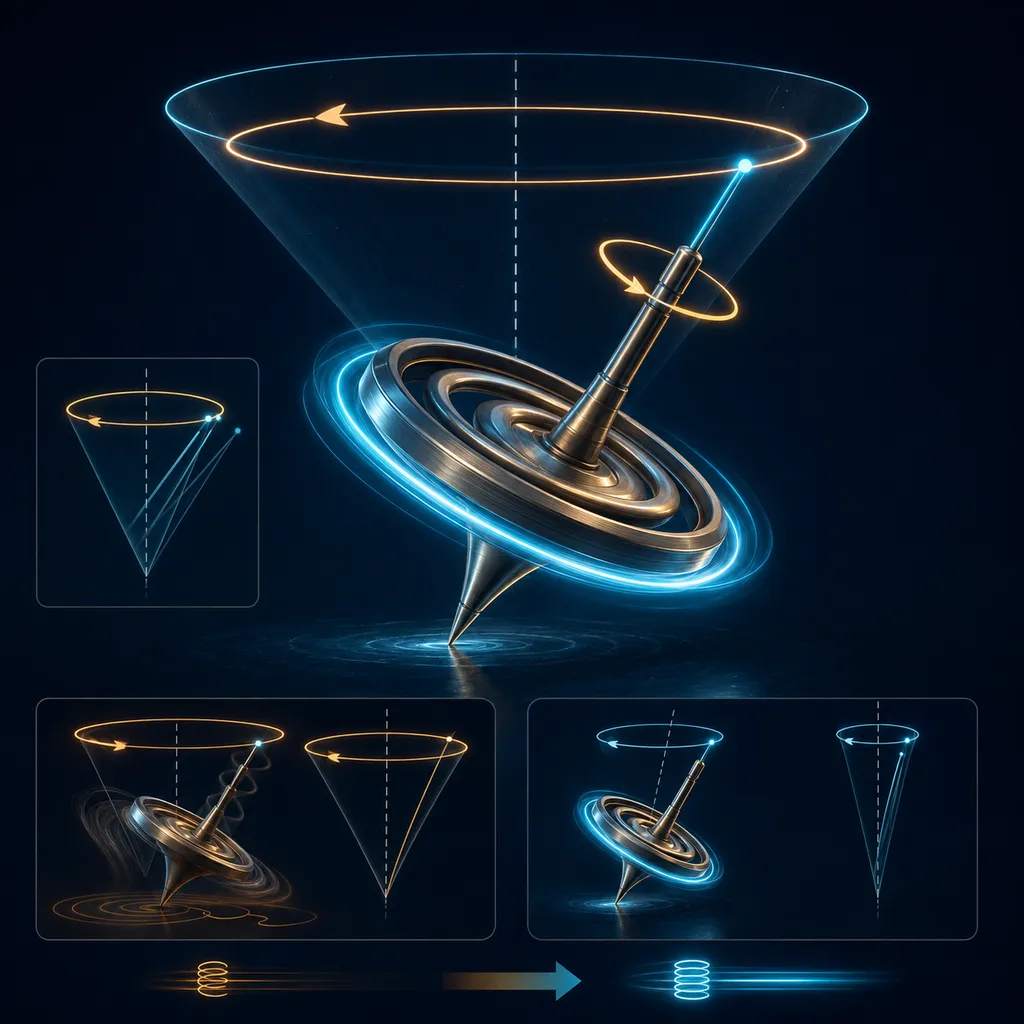
Spin the top up. The faster it spins, the harder it is to change the direction of its axis — thanks to the angular momentum L=Iω. Instead of falling, the axis slowly traces a circle (precession), and more slowly the larger ω is. Change the spin rate and observe.
What just happened?
You spun the top up, and its axis stopped dropping and only slowly traces a circle (precession). The faster it spins, the more stable the upright position.
Angular momentum of a rigid body:
— angular momentum is directly proportional to the spin rate. — moment of inertia, — angular velocity of the spin. A large is a vector that "defends" its direction.
Why does the top precess instead of falling?
Gravity provides a torque , which does not topple the axis but rotates it around the vertical at a rate:
The larger (and therefore ), the slower the precession and the more stable the upright position. For small the precession is fast and the axis clearly drops.
Why you need this for the exam:
The relations and explain the stability of a bicycle wheel, a phone gyroscope, or the Earth. Key idea: large angular momentum = small precession = axis direction "frozen".
Remember: a fast spin gives a large angular momentum , which resists any change in direction — so the top stays upright and precesses more slowly the faster it spins.
Theory & formulas
Angular momentum stabilizes the axis
A fast-spinning top has a large angular momentum along its axis. Changing the direction of this vector requires a torque, so the axis "resists" falling.
Precession
The gravitational torque does not topple the top but slowly rotates its axis along a cone — this is precession at a rate: The faster the spin (), the slower the precession.
Notation: — angular momentum, — precession rate, — gravitational torque, — moment of inertia, — spin rate, — distance from the pivot to the center of mass.
Frequently asked questions
›Why doesn't a spinning top topple over?
It has a large angular momentum L=Iω directed along its axis; changing the direction of this vector requires a torque, so the axis "resists" falling and performs precession instead.
›What is precession?
The slow motion of the spin axis along the surface of a cone, caused by the gravitational torque; its rate Ω=mgr/(Iω) decreases as ω increases.
›Where are gyroscopes used?
In stabilization (drones, ships, telescopes) and in navigation — they keep a constant reference direction.
Teaching? Embed this experiment on your site.
Free widget — paste it on your school site, blog or notes. It links to the full version.