Sound intensity level — decibels
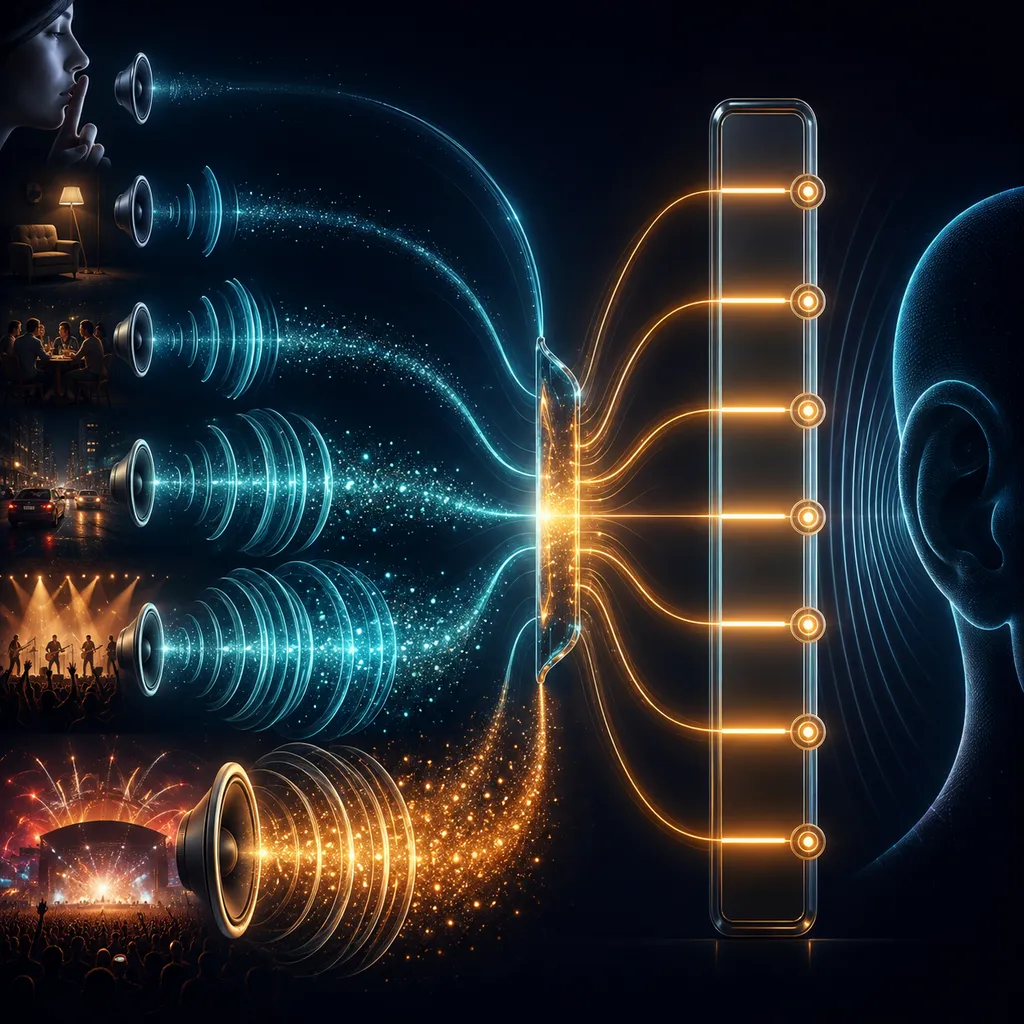
Increase the sound intensity and watch the level in decibels L=10·log(I/I₀). The scale is logarithmic: every tenfold increase in intensity is only +10 dB. That is why a whisper and a concert are separated by a huge difference in intensity, but only a small one — in decibels.
I will give you an intensity ratio I/I₀ — use the slider to set the level L that matches it. L = 10·log₁₀(I/I₀).
What just happened?
The intensity rose 10×, but the level rose only by 10 dB. The ear and the decibel scale respond to sound logarithmically — multiplying the intensity turns into adding decibels.
Sound intensity level:
— where is the sound intensity (W/m²), and is the threshold of hearing. Conversely: .
What does it mean in practice?
Every 10× greater intensity is a constant +10 dB, regardless of the starting point:
Why a logarithmic scale?
From a whisper to the threshold of pain the intensity grows over times. On a linear scale (the purple bar in the panel) almost everything "sticks" to zero. The logarithm squeezes this huge range into a convenient 0–140 dB.
Why you need this for the exam:
Acoustics problems rely on . The trick: compute the intensity ratio , take its base-10 logarithm and multiply by 10. Level difference: .
Remember: decibels are a logarithm — 10× the intensity = +10 dB, 100× = +20 dB. Multiplying the intensity means adding decibels. L = 10·log₁₀(I/I₀).
Theory & formulas
The decibel scale
The scale is logarithmic — matched to the enormous range of intensities heard by the ear.
Rules of thumb
- 10× greater intensity → +10 dB (because ),
- 2× greater intensity → +3 dB ().
Notation: — intensity level (dB), — sound intensity, — threshold of hearing.
Frequently asked questions
›Why is a 10× greater intensity only +10 dB?
Because we compute the level logarithmically: L=10·log₁₀(I/I₀); the log of 10 is 1, so a tenfold increase in intensity gives +10 dB.
›Why a logarithmic scale?
The ear responds to an enormous range of intensities — the logarithm brings them down to a convenient scale that matches perceived loudness.
›How many dB is a doubling of intensity?
About +3 dB (10·log2≈3).
Teaching? Embed this experiment on your site.
Free widget — paste it on your school site, blog or notes. It links to the full version.