Mechanical waves — v = λf
What we'll do: We'll change the frequency and wavelength (or the medium's speed) and check how the formula v = λf links them.
What you see on screen: A travelling wave with the wavelength marked (between crests) and the oscillation rate, plus sliders for frequency, wavelength and speed; an indicator shows the speed v = λf, and changing the frequency packs the waves closer or spreads them out. Readouts: frequency, wavelength, speed and period.
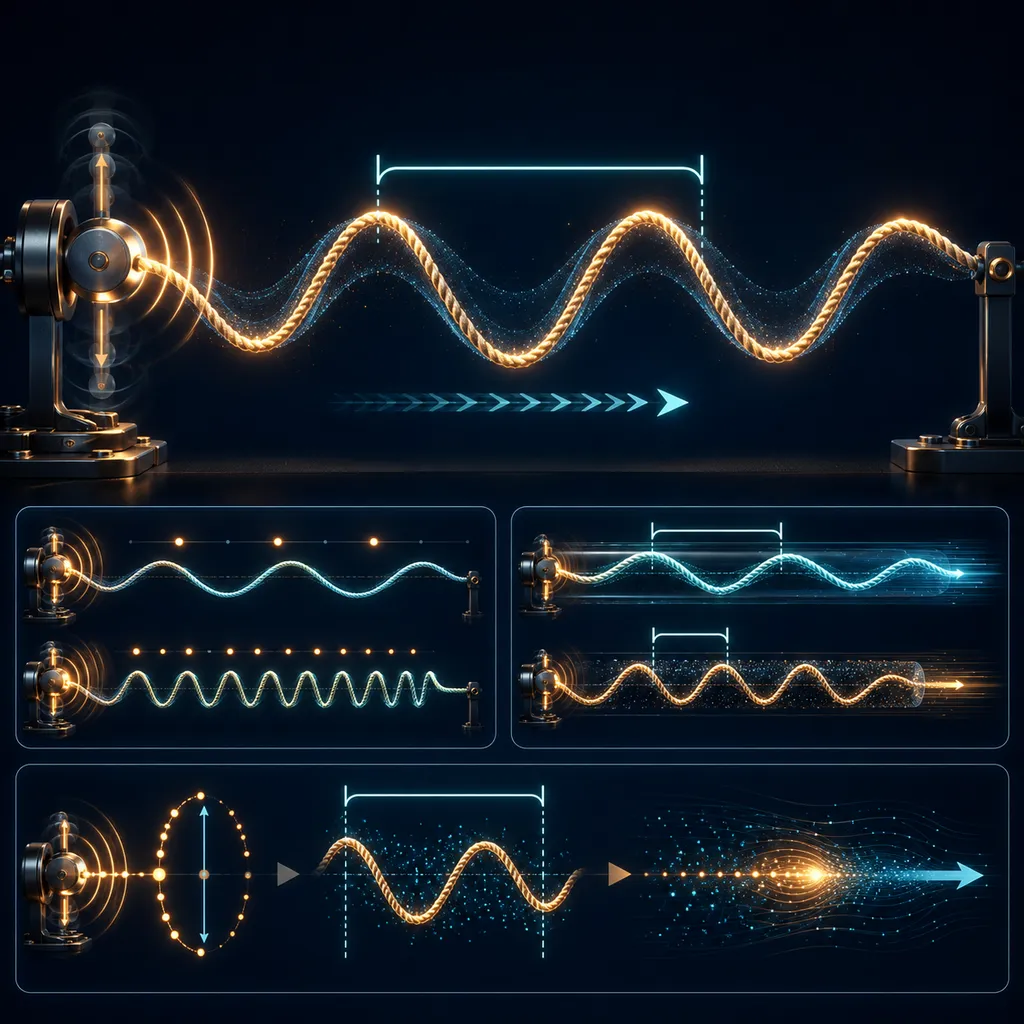
I'll give you a target wavelength — tune the frequency and speed to reach it. λ = v/f.
What just happened?
Doubling the frequency at a constant wave speed halved the wavelength — the waves “squeezed” closer together.
Three quantities describing a wave:
WAVELENGTH λ — the distance between two successive crests (or troughs); FREQUENCY f — the number of full oscillations per second (in hertz, Hz); WAVE SPEED v — how fast the wave travels through the medium.
They are linked by the formula:
What stays constant?
The wave speed depends on the MEDIUM (e.g. sound in air ~340 m/s), not on the source. That is why, when you raise the frequency, the wavelength decreases — so that the product λ·f (i.e. v) stays the same.
Examples:
a higher pitch means a greater frequency and a shorter wave; in light, a greater frequency corresponds to a different colour.
Why you need this on the exam:
calculations with (wavelength, frequency, speed) and understanding what depends on the medium and what on the source are the basis of the waves chapter. Trick: in a constant medium λ and f are inversely proportional.
Remember: v = λ·f; the wave speed depends on the medium, so at its constant value a greater frequency means a shorter wave.
Theory & formulas
Basic relation
The wave speed equals the product of the wavelength and the frequency.
What follows from what
- the speed depends on the medium, not on the source,
- at a constant : a higher frequency → a shorter wave ().
Period
Notation: — wave speed, — wavelength, — frequency, — period.
Frequently asked questions
›What is the relation between wavelength, frequency and wave speed?
v = λ·f — the wave speed equals the product of the wavelength and the frequency.
›What happens to the wavelength when the frequency increases?
At a constant speed it decreases — the wavelength is inversely proportional to the frequency.
›What does the wave speed depend on?
On the medium it travels through (e.g. its type and temperature), not on the wave source.
Teaching? Embed this experiment on your site.
Free widget — paste it on your school site, blog or notes. It links to the full version.