The Doppler effect for sound
When a sound source moves, we hear a different frequency than the one emitted: when approaching the waves compress (higher pitch), when receding they spread out (lower pitch) — f′=f·v_sound/(v_sound±v_z). That is why the siren pitch of a passing ambulance falls after it goes by. Change the source speed.
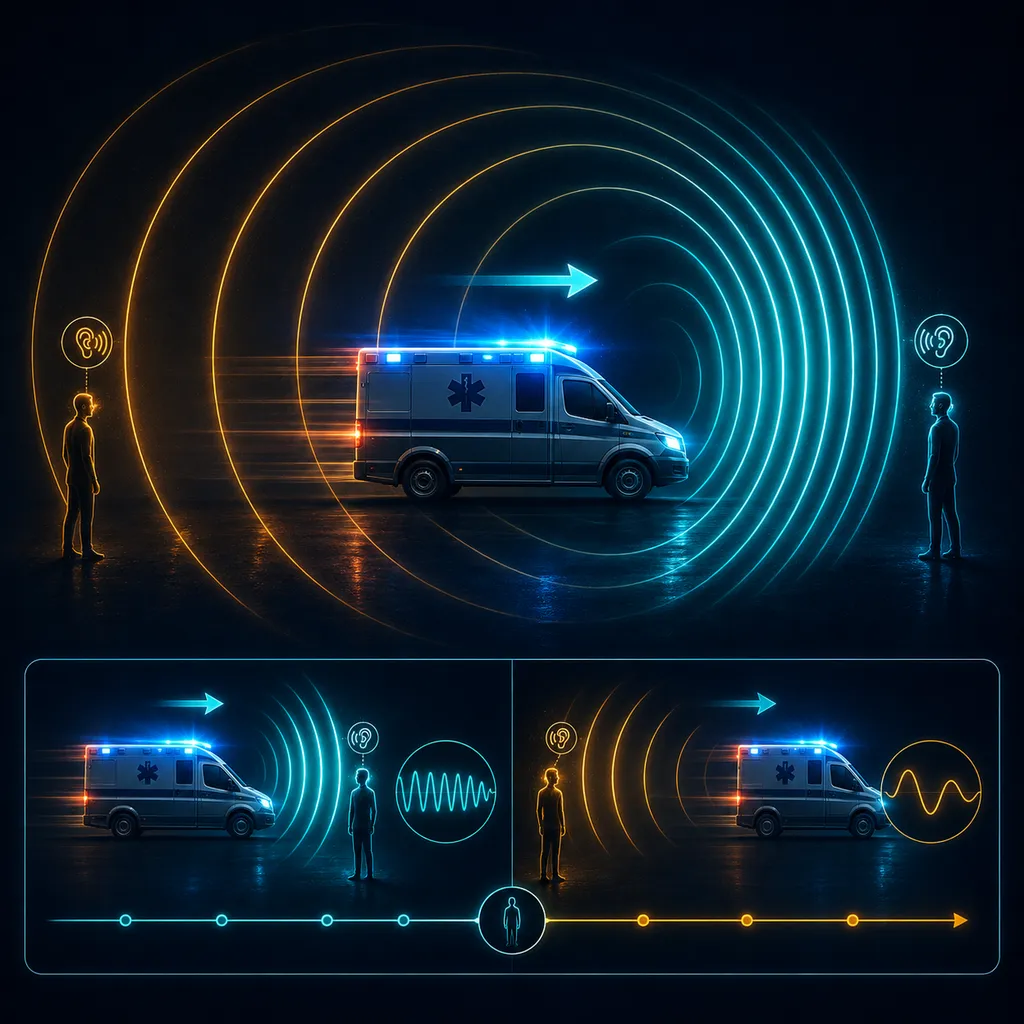
I'll give you a frequency the observer should hear — tune the source speed v_z to reach it. source f = 700 Hz.
Why does the siren change pitch?
The source moves relative to the air and "catches up" to its own waves. In front, the wavefronts compress (shorter wavelength → higher frequency), behind they spread out (longer wavelength → lower frequency). That is why an approaching ambulance sounds higher and a receding one lower.
Doppler effect for sound:
f — source frequency, vsound = 340 m/s — speed of sound, vz — source speed relative to the air. Approaching → smaller denominator → ; receding → larger denominator → .
When does the pitch rise?
When the source and observer approach each other — the received frequency is higher than the source frequency. The largest difference occurs just before passing; right after it the relative velocity changes sign and the pitch drops sharply.
How does it differ from the Doppler effect for light?
Sound needs a medium (air), so its effect depends on motion relative to the medium — frequency changes differently for a moving source than for a moving observer. Light propagates in vacuum with no privileged medium: only the relative velocity matters, and the formula is relativistic (the red/blue shift of the spectrum).
Why you need this for the exam:
Acoustics problems most often ask whether the received frequency rises or falls, and have you substitute into . The trick: determine the direction of relative motion, pick the sign in the denominator, compute.
Remember: approaching → higher pitch, receding → lower pitch, no relative motion → f' = f. That is the essence of the Doppler effect.
Theory & formulas
Moving source
When a sound source moves, the waves compress in front (higher pitch) and spread out behind (lower pitch): the "−" sign for approaching ( rises), "+" for receding ( falls).
The ambulance
That is why the siren pitch of a passing ambulance falls at the moment of passing. Unlike light, sound needs a medium, and the formula depends separately on the motion of the source and the observer.
Notation: — received frequency, — emitted, — speed of sound, — source speed.
Frequently asked questions
›Why does the siren change pitch?
Because the motion of the source compresses the waves ahead of it (higher frequency) and spreads them out behind it (lower) — that is the Doppler effect.
›How does it differ from the Doppler effect for light?
Sound needs a medium and the formula depends separately on the motion of the source and the observer relative to the air; for light only the relative velocity matters.
›When does the pitch rise?
When the source and observer approach each other — the received frequency is then higher than the emitted one.
Teaching? Embed this experiment on your site.
Free widget — paste it on your school site, blog or notes. It links to the full version.