The Mandelbrot Set — fractal geometry
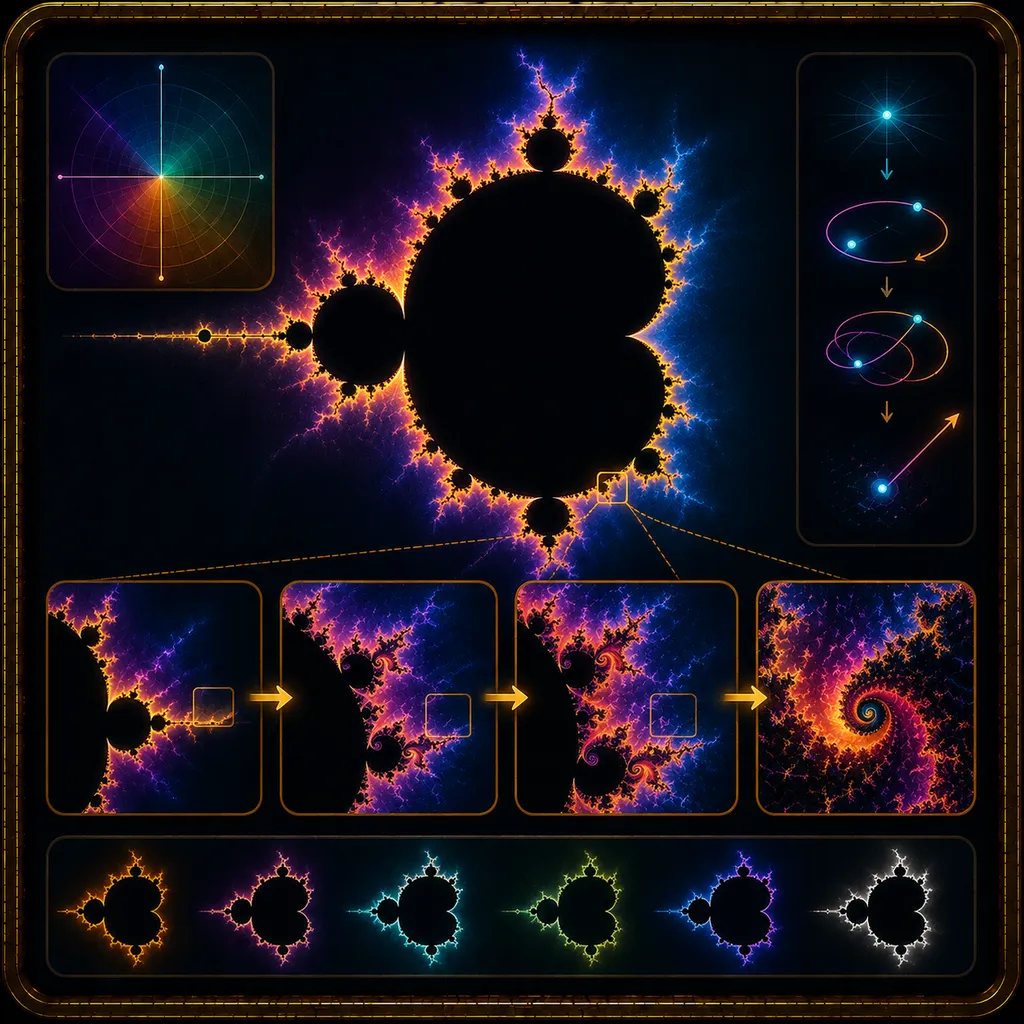
An extension of the topic of complex numbers and iteration. The Mandelbrot set is the set of points c in the complex plane for which the iteration z_(n+1)=z_n²+c does not escape to infinity. Its boundary has a fractal structure — zoom into any piece and you still see new, self-similar structures; it never becomes smooth. Benoit Mandelbrot was the first to visualize the set on a computer in 1980 (a landmark discovery — fractal geometry).
I’ll give you a point c — decide whether the sequence zₙ₊₁ = zₙ² + c stays bounded (member) or escapes to ∞.
What just happened?
You zoomed into a piece of the Mandelbrot set’s boundary, and it did not get any simpler. Instead of a smooth line you saw more swirls, spirals and miniature “bulbs” — copies of the whole set in miniature. This is what fractal geometry looks like: the boundary is infinitely complex at every scale.
Definition of the Mandelbrot set:
For each point of the complex plane we iterate this simple formula. The point belongs to the Mandelbrot set if the sequence of moduli stays bounded — it does not “escape” to infinity:
Why is the boundary never smooth?
Points that BELONG to the set are colored black, while points that escape are colored by the number of iterations needed to escape (hence the color gradient). The border between these two groups — the boundary — has a fractal structure: no matter how far we zoom into any piece of it, we keep seeing new, self-similar patterns. It never becomes “smooth”.
Who discovered it?
A similar shape was described mathematically in 1978 by Robert Brooks and Peter Matelski, but it was Benoit Mandelbrot — a mathematician working at the IBM Thomas J. Watson Research Center — who in March 1980 first used the power of the computer to visualize this set. He popularized it and coined the term “fractal”.
Why this matters for your exam:
The Mandelbrot set is a classic example that a simple recursive formula can generate an infinitely complex structure — a key idea in the study of sequences, limits and fractal geometry. Fractal geometry also describes coastlines, clouds, blood vessels and lungs, and is used in image compression.
Remember: the boundary of the Mandelbrot set has the same infinitely complex structure at every zoom level — it never becomes smooth.
Theory & formulas
Definition
Escape criterion
If for some we have , the sequence certainly escapes to infinity — the point does not belong to .
The fractal boundary
The boundary of the set is self-similar: at any level of magnification you still see new, similar structures — it never becomes smooth.
Notation: a point of the complex plane, a term of the iteration, its modulus.
Frequently asked questions
›What is the Mandelbrot set?
The set of points of the complex plane for which the iteration z_(n+1)=z_n²+c stays bounded.
›What is fractal self-similarity?
The property that, when you zoom into any piece of the boundary, you keep seeing similar, repeating structures.
›Who first visualized the Mandelbrot set on a computer?
Benoit Mandelbrot, in March 1980 at the IBM Thomas J. Watson Research Center.
Teaching? Embed this experiment on your site.
Free widget — paste it on your school site, blog or notes. It links to the full version.