The Spiral of Theodorus — Square Roots Geometrically
An extension of the topic of the Pythagorean theorem and square roots. By building successive right triangles each with a leg of length 1, we obtain hypotenuses of lengths √2, √3, √4, … — square roots drawn with compass and straightedge. Each step uses the Pythagorean theorem. The construction is attributed to Theodorus of Cyrene (c. 400 BC), who used it to prove the irrationality of the roots up to √17.
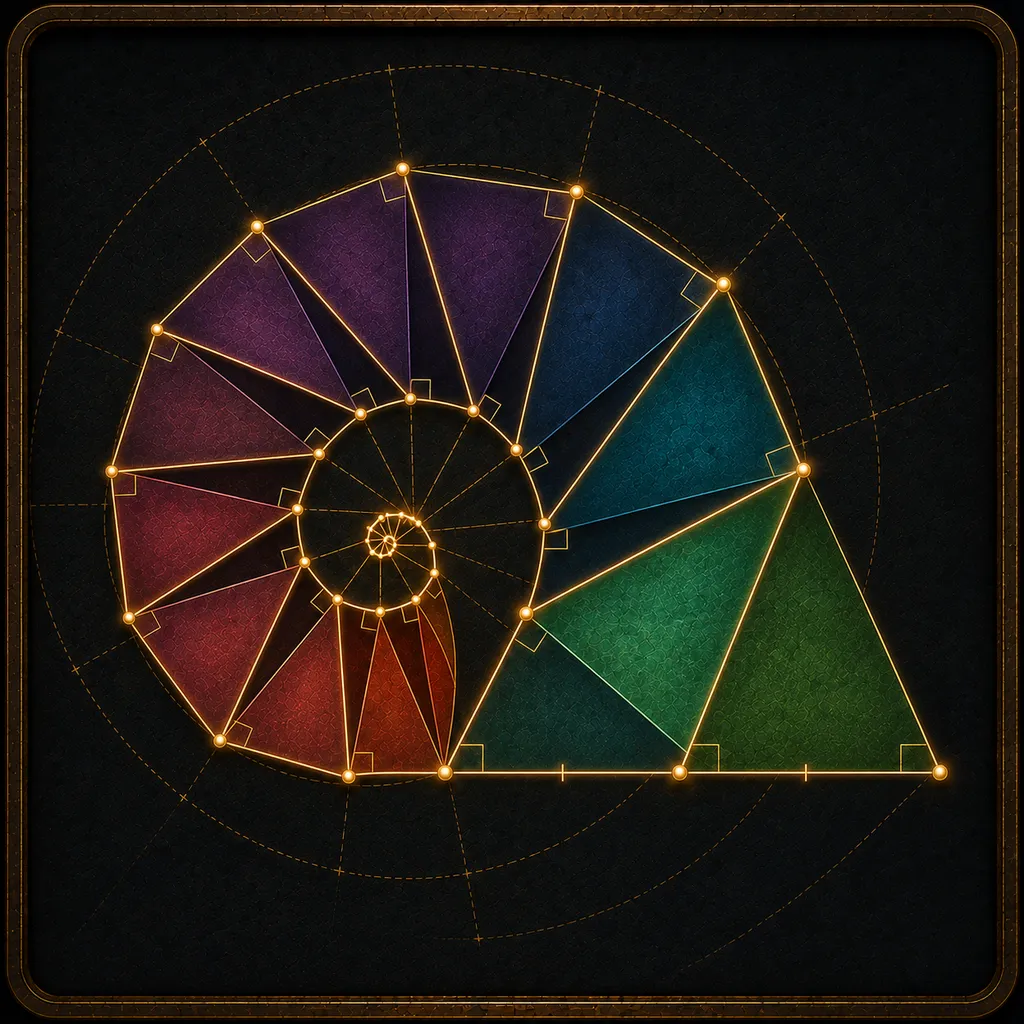
I will give you a target length of the newest hypotenuse √K — choose the triangle number n to reach it. The hypotenuse of triangle n is √(n+1).
What just happened?
By adding to the spiral successive right triangles in which one leg always has length , you get hypotenuses of lengths — the square roots of the successive natural numbers, "drawn" with compass and straightedge.
How the spiral is built:
We start with an isosceles right triangle with both legs — its hypotenuse has length (because ). To that hypotenuse we attach a new triangle with a leg — its hypotenuse is . And so on.
The invariant — one step is one Pythagoras:
Each successive hypotenuse is formed from the previous one and an attached leg , so it has length . Hence the sequence appears automatically.
Who was Theodorus?
The spiral of Theodorus (also called the Pythagorean spiral or the square-root spiral) is a construction attributed to Theodorus of Cyrene (c. 465–398 BC), a Greek mathematician and Pythagorean, a teacher of Plato. Theodorus used a similar construction to prove the irrationality of the roots of non-square numbers — up to .
Why does it matter?
The construction shows how abstract irrational numbers can be represented as concrete, measurable geometric lengths. The successive triangles wrap around a common centre with a constant "increment" of the angle , and at the spiral completes a full turn and begins to overlap itself.
Why you need this for the exam:
It is a model example of the Pythagorean theorem in action and of the geometric meaning of a square root. Remember the formula , which gives the hypotenuse at each step.
Remember: the spiral of Theodorus "draws" the roots ; each step is .
Theory & formulas
Construction
We start from a triangle with legs and : its hypotenuse is . To it we attach a leg of length — the new hypotenuse is , and so on.
The general step
By the Pythagorean theorem:
The result
The successive hypotenuses have lengths — square roots drawn with compass and straightedge.
Notation: — step number, — length of the -th hypotenuse.
Frequently asked questions
›What lengths do the successive hypotenuses of the spiral of Theodorus have?
The successive square roots: √2, √3, √4, √5, … — the square roots of the natural numbers.
›What does each step of the construction rely on?
The Pythagorean theorem: (√n)² + 1² = n + 1, so the new hypotenuse is √(n+1).
›What did Theodorus use this spiral for?
To prove the irrationality of the roots of numbers that are not perfect squares (√3, √5, …, up to √17).
Teaching? Embed this experiment on your site.
Free widget — paste it on your school site, blog or notes. It links to the full version.