The Poincaré Conjecture
An extension of the topic of geometry and topology (intuitively). A surface without "holes" (like a sphere) can be continuously deformed to a point — every loop drawn on it can be contracted. A surface with a "hole" (like a torus) cannot be deformed this way. The true Poincaré Conjecture (1904) concerned the analogous, far harder question for three-dimensional manifolds — it was proved by Grigori Perelman in 2002–2003, for which he was awarded the Fields Medal in 2006, which he declined to accept (as he also declined the one-million-dollar Clay Institute prize).
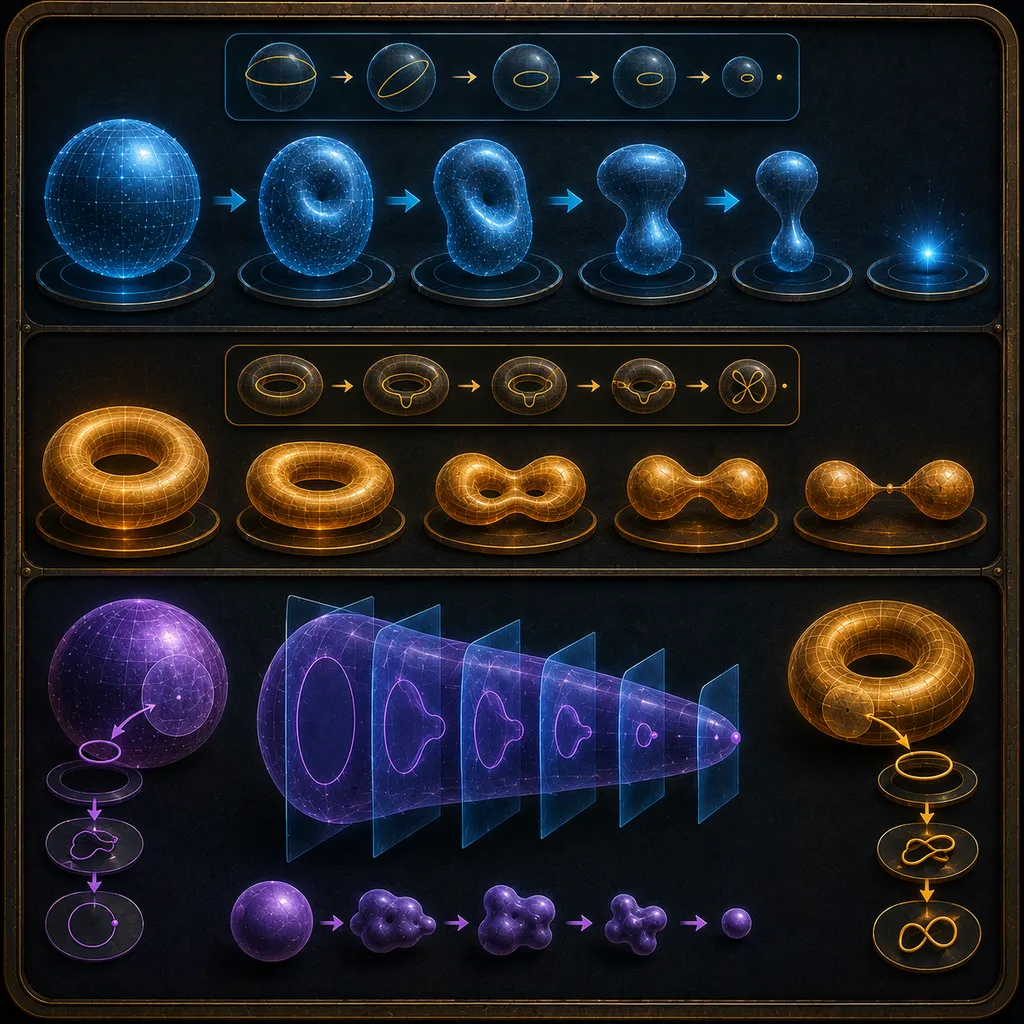
I will give you a surface — decide whether EVERY loop drawn on it can be contracted to a point. The number of "holes" (genus) decides.
What just happened?
On a sphere, every loop drawn on it (an elastic "rubber band" lying on the surface) can be continuously contracted to a point, without leaving the surface and without tearing it. On a torus — if the loop is wrapped around the "hole" — this is impossible: the loop can only shrink to the edge of the hole, where it gets stuck, taut, and cannot be reduced any further.
Note — this is a simplified 2D analogy
The visualization shows flat (two-dimensional) surfaces — a sphere and a torus — because they are easy to draw and "feel". The true Poincaré Conjecture concerns a far harder, abstract case: three-dimensional manifolds, which you simply cannot draw or fully picture. The classification of 2D surfaces (as here) was in fact already known to mathematicians in the 19th century — it is a classical theorem. The truly open, century-long problem was the analogous 3D case.
The invariant — the number of "holes" (genus):
For a closed, smooth 2D surface, the classical formula for the Euler characteristic holds:
where — the genus (number of "holes"/handles). A sphere has (every loop contracts to a point), a torus has (not every loop contracts any more). It is precisely this number that distinguishes the two surfaces in the scene.
The true Poincaré Conjecture (1904, the 3D case):
Henri Poincaré asked: must every closed, "simply connected" (without holes, in the topological sense) three-dimensional manifold be topologically a sphere ? Formally:
— if the fundamental group of a closed three-dimensional manifold is trivial (that is, every loop contracts to a point), then is topologically "the same" as the three-dimensional sphere. In 2D this is a classical theorem — in 3D it turned out to be one of the hardest problems in mathematics.
How did Grigori Perelman prove it?
The problem stayed open for almost 100 years and was placed on the list of seven "Millennium Prize Problems" of the Clay Mathematics Institute — a one-million-dollar prize was set for solving each. In 2002–2003 the Russian mathematician Grigori Perelman published a series of papers in which he developed the technique of "Ricci flow" by Richard Hamilton — a tool that gradually "smooths" the geometry of a manifold, revealing its true topological nature. After years of detailed verification by the mathematical community, the proof was accepted as correct.
Declining the prizes
In 2006 Perelman was awarded the Fields Medal for this achievement ("for his contributions to geometry and his revolutionary insights into the analytic and geometric structure of the Ricci flow") — Perelman declined to accept it. In 2010 he also declined the one-million-dollar Clay Institute prize, after which he withdrew from mathematical and public life. The Poincaré Conjecture is so far the only solved one of the seven Millennium Prize Problems.
Why you need this for the exam:
The Poincaré Conjecture itself goes far beyond the school curriculum, but classifying surfaces by genus and the Euler characteristic is a good example of topology — the branch of mathematics in which what matters is not shape or dimensions, but whether something can be continuously deformed into something else without tearing.
Remember: the contractibility of every loop to a point is a property exclusive to surfaces without "holes" (genus 0, topologically spheres). Poincaré posed this question for the harder three-dimensional case in 1904 — Grigori Perelman solved it in 2002–2003, after which he declined both the Fields Medal and the one-million-dollar prize.
Frequently asked questions
What is "Ricci flow"?
It is a mathematical tool (introduced by Richard Hamilton) that continuously "smooths" the curvature of a manifold — somewhat like heat spreading evenly across a metal plate. Perelman showed how to control this process (including handling the "singularities" that arise in it) to reach the proof.
Why did Perelman decline the prizes?
He never fully explained it publicly — he pointed, among other things, to his dissatisfaction with how the mathematical community assessed other researchers' contributions to the proof. After declining both prizes, he withdrew from active scientific work.
Is it the only solved Millennium Prize Problem?
Yes. Of the seven Millennium Prize Problems announced by the Clay Mathematics Institute in 2000 (including the Riemann hypothesis and the P vs NP problem), the Poincaré Conjecture is the only one solved so far.
Theory & formulas
Contractibility of loops
A surface is called "without holes" (simply connected) when every loop drawn on it can be continuously contracted to a point. A sphere satisfies this; a torus (with a hole) does not.
The statement of the conjecture
Every compact, simply connected three-dimensional manifold is topologically a sphere — it can be continuously deformed into a sphere, without cutting or gluing.
The proof
Grigori Perelman proved it in 2002–2003 using the technique of Ricci flow (gradual smoothing of curvature). It is the only Millennium Prize Problem solved so far.
Frequently asked questions
›What does the Poincaré Conjecture say (intuitively)?
That every "simple" (simply connected) space without "holes" is topologically a sphere.
›Who proved the Poincaré Conjecture, and when?
Grigori Perelman, in 2002–2003, using the technique of Ricci flow.
›Why is Perelman famous beyond mathematics?
Because he declined to accept the Fields Medal (2006) and the one-million-dollar Clay Institute prize for solving a Millennium Prize Problem.
Teaching? Embed this experiment on your site.
Free widget — paste it on your school site, blog or notes. It links to the full version.