The Möbius Strip
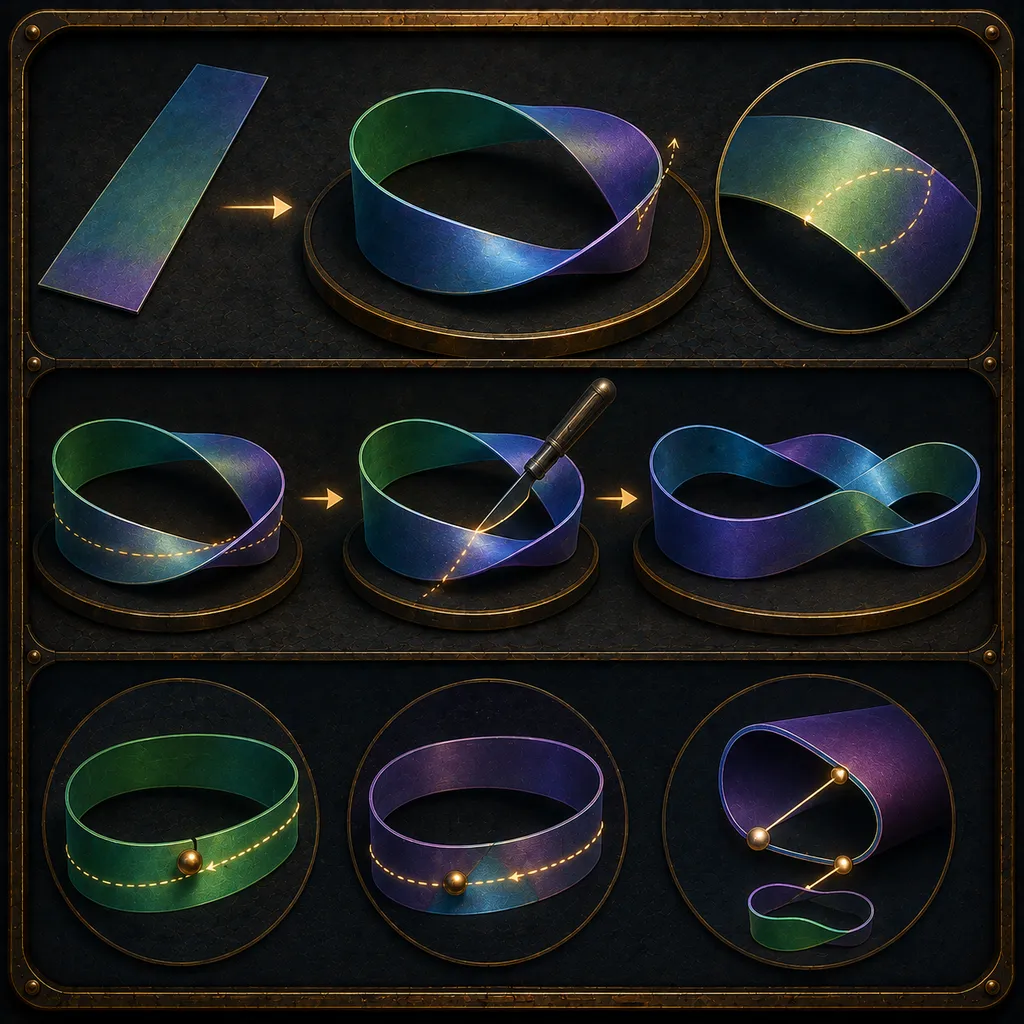
An extension of the topic of geometry and surfaces (intuitively, beyond the curriculum). The Möbius strip — a strip of paper glued together after a single half-twist — has only one side and one edge. Cut along its centre line, it does not fall apart into two separate bands but forms one longer band with a double twist. It was discovered independently by August Ferdinand Möbius and Johann Benedict Listing in 1858.
I will give you a strip glued after a certain number of half-twists — guess how many sides it has: one or two. The parity of the number of half-twists decides.
What just happened?
A Möbius strip is formed when a long strip of paper is glued at its ends AFTER making a single half-twist (180°). As a result it has only one side and only one edge — what looks like the "top" and "bottom" of the strip becomes, after gluing, one continuous surface. Cutting along the centre (the line equidistant from both edges) might seem symmetric — as if it should give two separate strips. Yet the half-twist "joins" the originally separated sides of the cut into a single loop, so the result is one longer and narrower band, with a double twist (360°) instead of a single one.
Note — a curiosity beyond the school curriculum
The Möbius strip is not part of the school mathematics exam — it is a classic, illustrative example from topology, excellently showing the concepts of surfaces, orientability and geometric invariants, which do not appear in the curriculum but help you understand what this branch of mathematics is about.
The invariant — one side, one edge:
Formally, the Möbius strip can be defined as a rectangle with the left and right edges glued together with a sign reversal:
It is precisely this "jump" at the gluing that accounts for the single half-twist — and makes the surface non-orientable: you cannot consistently define the notions of a "right" and a "left" side on it. A two-dimensional creature travelling along the strip, without leaving the surface, would return to the starting point as its own mirror image — and by running a finger along the "surface" without lifting it, you would reach every point of it, on both "sides" of the original strip, eventually returning to the start.
The classical parametrization (for the curious):
The Möbius strip in 3D space is described by the equations:
for (the run along the strip) and (position across the width). The term in the twist angle is precisely this single half-twist — over a full run the cross-section rotates by only (180°), not by the full .
Who discovered it, and when?
The properties of this surface were discovered independently in 1858 by two German mathematicians: August Ferdinand Möbius and Johann Benedict Listing (it was he who coined the term "topology"). The strip is easy to make yourself: just twist one end of a paper strip by a half-turn (180°) and glue it to the other end.
Where is it useful?
The Möbius shape has found practical uses — for example in some conveyor belts, which, thanks to a single continuous "side", wear evenly instead of only on top. It has also inspired art (including the works of M.C. Escher) and jewellery, and its simplified, triangular variant is the basis of the recycling symbol.
Why you need this for the exam:
Directly — nothing, the topic is beyond the curriculum. Indirectly: it is good exercise for geometric imagination and a first encounter with the idea that the properties of a surface (number of sides, number of edges, orientability) can matter more than its exact shape — that is the essence of topology.
Remember: a Möbius strip (before cutting) always has exactly one side and one edge. Cut along its centre, it does not split into two parts — it gives one longer, narrower band with a double twist. It was discovered independently by Möbius and Listing in 1858.
Theory & formulas
One side, one edge
A strip glued after a single half-twist is non-orientable: walking along it, you return to the "other side" without ever crossing an edge. It has only one side and one edge.
Cutting along the centre line
It does not split into two strips — you get one longer band with a full (double) twist.
Cutting at one third of the width
This yields two interlinked bands: a shorter one (again a Möbius strip) and a longer one. What you get depends on the number of half-twists made when gluing.
Frequently asked questions
›How many sides does a Möbius strip have?
Only one — it is a non-orientable surface.
›What happens when you cut a Möbius strip along its centre line?
You get one longer band with a double twist, not two separate bands.
›Who discovered the Möbius strip?
August Ferdinand Möbius and Johann Benedict Listing, independently of each other, in 1858.
Teaching? Embed this experiment on your site.
Free widget — paste it on your school site, blog or notes. It links to the full version.