The Klein bottle — a surface with no inside
An extension of the topic of surfaces and topology (beyond the curriculum). The Klein bottle is a closed surface which — like the Möbius strip — is one-sided (non-orientable), but closed (without a boundary). It has no separate inside and outside. Fully, without self-intersection, it exists only in 4 dimensions. It was described by Felix Klein in 1882.
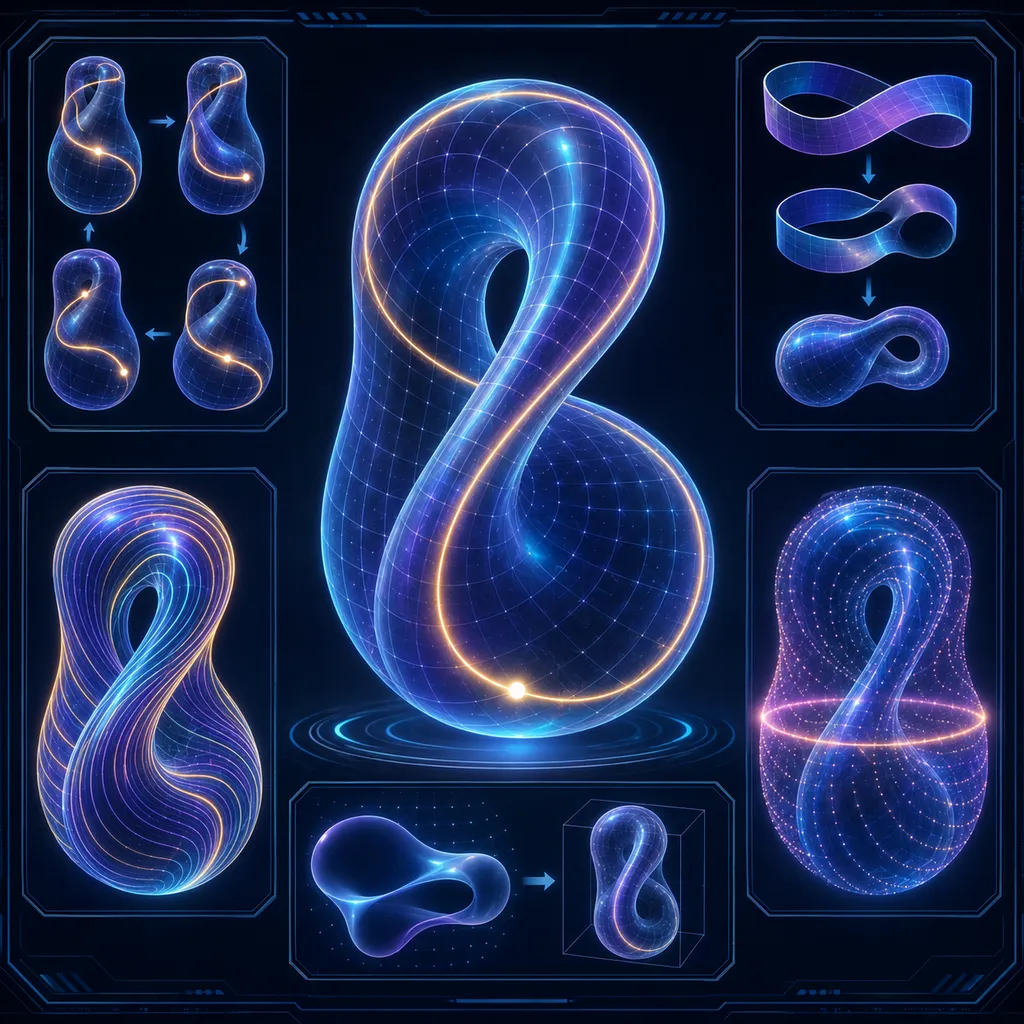
I’ll give you a surface — decide whether it is one-sided (non-orientable) or two-sided.
What do you see in the scene?
The Klein bottle is one of the most famous objects in topology, described by the German mathematician Felix Klein in 1882. It is a closed surface that is non-orientable (one-sided) — like a Möbius strip, but “closed”: without a boundary, like a sphere or a torus, only with no distinction of sides. Its most astonishing property: it has no separate inside and outside — what seems to be the “inside” flows smoothly into what is “outside”. The neck curls round, passes through the wall and joins the base from inside.
Note — this is a curiosity beyond the core curriculum
The Klein bottle is not part of the mathematics exam — it is a classic, illustrative example from topology, the “closing up” of the Möbius strip. It beautifully shows that the properties of a surface (number of sides, number of edges, orientability) can matter more than its particular shape — and how higher dimensions resolve paradoxes impossible in 3D.
Where does the self-intersection come from?
Fully, smoothly and without self-intersection, the Klein bottle exists only in 4-dimensional space. In our three-dimensional space its neck must “pierce” the wall — this self-intersection (the yellow ring in the scene) is a 3D artefact, not a property of the real surface. In the fourth dimension the “intersection” can be avoided — just as a knot tied in a string could be undone by stepping into an extra dimension.
How it is built — gluing the edges of a square:
Formally, the Klein bottle is obtained from a square by gluing one pair of edges normally and the other with a flip (a mirror reflection):
This “jump” when gluing the second pair of edges is responsible for the reversal of orientation — exactly the same as one half-twist in a Möbius strip. For comparison: gluing both pairs normally would give a torus (two-sided, orientable), and flipping both — the projective plane.
The invariant — 1 side, 0 edges, χ = 0:
The Klein bottle is a closed surface (without a boundary — which is why the “edges” bar on the panel shows 0) and one-sided. Its Euler characteristic equals zero:
The same as the torus — but the torus is orientable, while the Klein bottle is not. This shows that the Euler characteristic alone does not distinguish these surfaces; information about orientability has to be added. A two-dimensional creature wandering across the Klein bottle, without leaving the surface, would reach every point of “both sides” and return to the start as its own mirror image — which is exactly what the journey slider shows.
Where does the name “bottle” come from?
An etymological curiosity: the name “bottle” (German Flasche) is probably a mistranslation of the German Fläche — meaning simply “surface”. The “Klein surface” became the “Klein bottle”, and since the shape really does resemble a strange bottle, the name stuck.
Why this matters for the exam:
Directly — nothing, the topic goes beyond the core curriculum. Indirectly: it is an exercise in spatial imagination and a first encounter with the idea that topology studies properties of shapes independent of their particular form, and that higher dimensions can “resolve” paradoxes impossible in 3D.
Remember: the Klein bottle is a one-sided (non-orientable) and closed (boundary-less) surface — it has no split into inside and outside. Without self-intersection it exists only in 4 dimensions. It was described by Felix Klein in 1882.
Theory & formulas
A one-sided, closed surface
The Klein bottle is non-orientable (like the Möbius strip), but without a boundary — closed. It has no distinct "inside" and "outside": the neck goes inward and joins the wall.
Why the self-intersection in 3D
In three-dimensional space the model must intersect itself. Without an intersection the bottle exists only in four dimensions — the intersection is an artefact of the projection into 3D.
Relation to the Möbius strip
The Klein bottle can be thought of as two Möbius strips glued together along their edges.
Frequently asked questions
›Does the Klein bottle have a separate inside and outside?
No — the "inside" flows smoothly into the "outside"; it is a one-sided (non-orientable) surface.
›How does it differ from the Möbius strip?
It is closed (without a boundary), whereas the Möbius strip has a single edge.
›Why does the Klein bottle intersect itself in 3D?
Because fully, without an intersection, it exists only in 4-dimensional space — the self-intersection is a 3D artefact.
Teaching? Embed this experiment on your site.
Free widget — paste it on your school site, blog or notes. It links to the full version.
Related experiments