Non-Euclidean geometry
An extension of the topic of the angle sum of a triangle (broken here). On the plane the angle sum of a triangle = 180°, but on a sphere it is greater, and on a saddle surface smaller — there exist consistent geometries other than the Euclidean one. They were discovered independently by Lobachevsky (1829), Bolyai (1832) and Riemann (1854); Riemann's geometry became the foundation of general relativity.
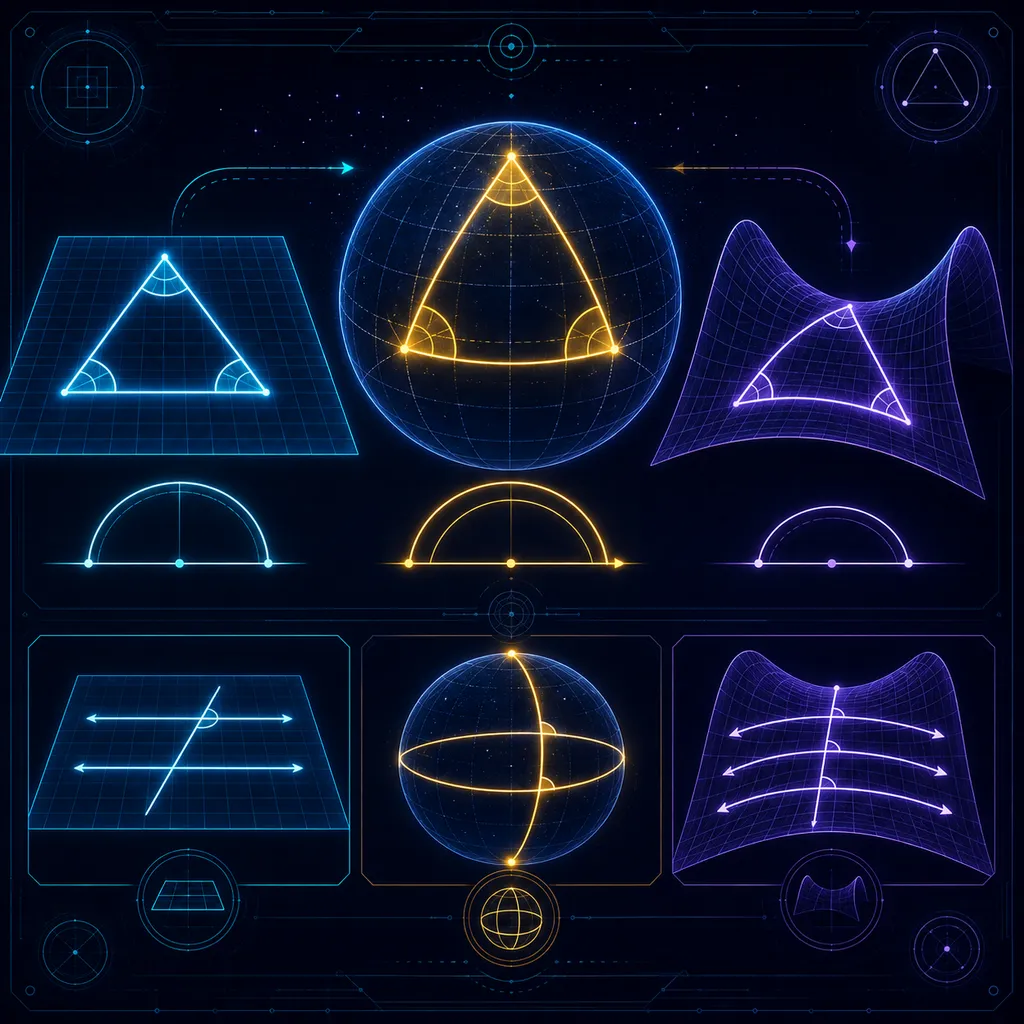
I’ll give you a surface — judge the angle sum of a triangle drawn on it. Curvature decides.
What just happened?
From school you know one “law”: the angle sum of a triangle is always . That is true — but only on the plane. When you draw a triangle on a curved surface, its angle sum stops being constant: it depends on the curvature of that surface.
Three geometries — three angle sums:
On a sphere (positive curvature) a triangle with one vertex at the pole and two on the equator has three right angles: . On a saddle surface (negative curvature, hyperbolic geometry) the sum is less than .
The invariant — angular excess and deficit:
The deviation of the angle sum from — the excess on a sphere or the deficit on a saddle — is directly proportional to the curvature of the surface and the area of the triangle. The larger the triangle on the sphere, the more its angle sum exceeds .
The 19th-century revolution:
For over two thousand years mathematicians believed that Euclid’s geometry (with an angle sum ) was the only possible, “true” geometry of space. They tried to derive his fifth postulate (about parallel lines) from the others — in vain. The breakthrough came when Nikolai Lobachevsky (1829), János Bolyai (1832) and Bernhard Riemann (1854) independently discovered consistent non-Euclidean geometries. These were not “wrong” geometries, but just as logically consistent as the Euclidean one — simply dependent on the curvature of space.
Why it matters:
The discovery revolutionised mathematics and philosophy: space need not be “flat”. Riemann’s differential geometry became the mathematical language of Einstein’s general theory of relativity, in which gravity is the curvature of spacetime — a triangle with angles other than is physics today, not just abstraction.
Why this matters for the exam:
The rule “the angle sum of a triangle = ” holds in Euclidean geometry — and that is what the exam uses. But it is worth knowing that this is an axiom of the plane, not an absolute truth: changing the fifth postulate gives other, equally correct geometries.
Remember: the angle sum of a triangle depends on the curvature of the surface — on a flat one, on a sphere (positive curvature), on a saddle (negative, hyperbolic geometry).
Theory & formulas
Angle sum and curvature
The angle sum of a triangle depends on the curvature of the surface:
- plane:
- sphere (positive curvature):
- saddle surface (negative):
Spherical excess
On a sphere of radius the area of a triangle is related to the angular excess (in radians):
Significance
There exist consistent geometries other than the Euclidean one; Riemann's geometry became the mathematical foundation of general relativity.
Notation: the angles of the triangle, the radius of the sphere, the area.
Frequently asked questions
›What is the sum of the angles of a triangle on a sphere?
More than 180° — on a surface of positive curvature the angle sum is greater.
›What does the angle sum of a triangle depend on?
On the curvature of the surface: =180° (flat), >180° (sphere), <180° (saddle/hyperbolic).
›What was non-Euclidean geometry useful for?
Riemann's geometry became the mathematical foundation of Einstein's general theory of relativity.
Teaching? Embed this experiment on your site.
Free widget — paste it on your school site, blog or notes. It links to the full version.