Irrationality of √2 — proof by contradiction
An extension of the topic of irrational numbers and proof by contradiction. Assuming √2 = p/q (irreducible), we get 2q²=p² → p even → q even → contradiction (it was meant to be irreducible). So √2 is irrational. This discovery (attributed to Hippasus, c. 500 BCE) was a shock to the Pythagoreans, who believed that “everything is a rational number”.
I will give you a number — decide whether it is rational (can be written as a fraction p/q) or irrational. Watch out for traps.
What just happened?
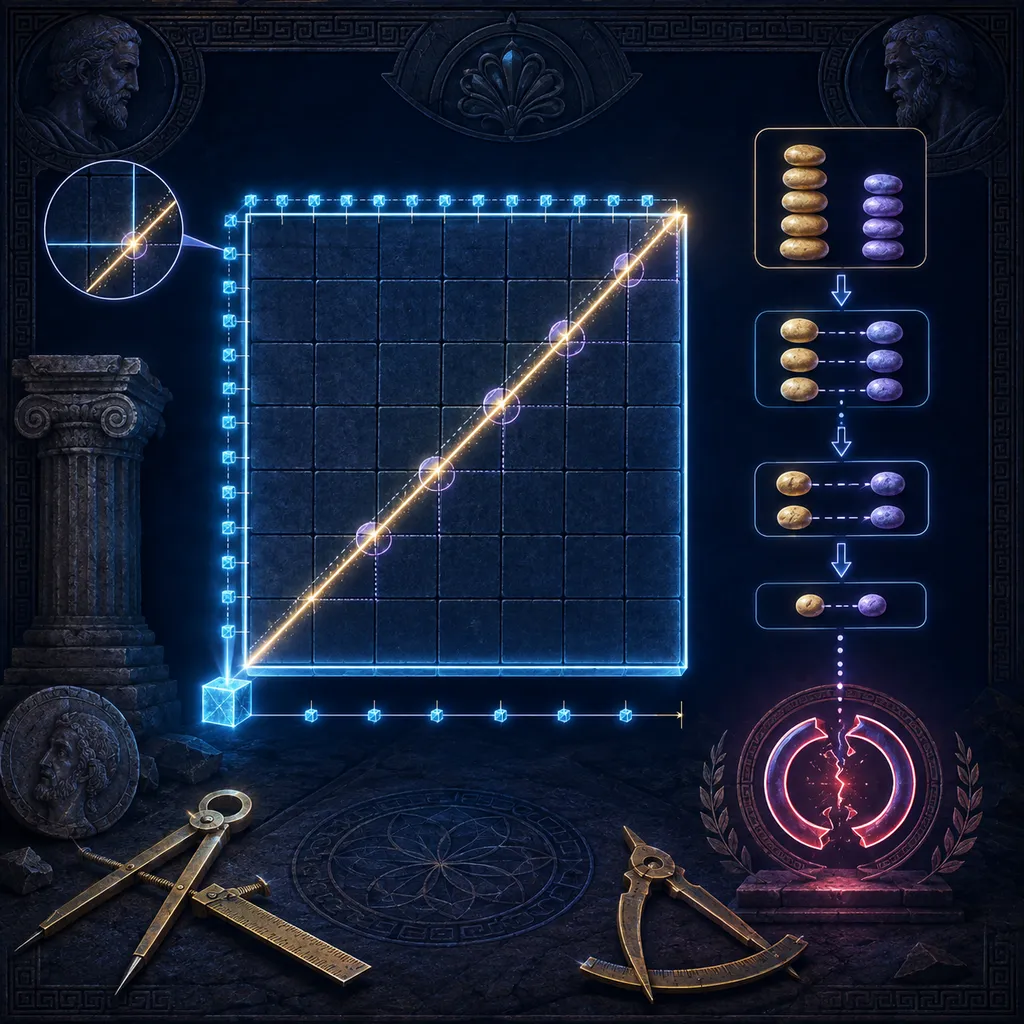
is the length of the diagonal of a square with side 1 (Pythagoras' theorem: ) — a concrete, measurable length. And yet it cannot be written as an exact fraction . We prove this by contradiction: we assume it can, and arrive at a contradiction.
Proof by contradiction, step by step:
Suppose the opposite — that is rational, so it can be written as an irreducible fraction (with no common divisors):
We square both sides and multiply by :
Since , the number is even — and the square of an odd number is odd, so is even: . We substitute this back:
Now is even, so is also even. But then and are both even — they share the divisor 2 — which contradicts the assumption that the fraction was irreducible.
A contradiction means the assumption was false. Hence is not any fraction — it is an irrational number.
Why was this a shock?
The discovery was made by the ancient Pythagoreans (c. 500 BCE, attributed to Hippasus of Metapontum). They believed that “all is number” — that is, a fraction — so the existence of a length that cannot be written as a fraction shattered their worldview. Legend has it that Hippasus revealed this secret and was punished for it. The discovery forced mathematicians to extend the notion of number to include irrational numbers (such as ) and to build solid foundations for analysis.
Why this matters for your exams:
The proof of the irrationality of is a classic example of a proof by contradiction: you assume the negation of the claim and derive a contradiction, which proves the claim. Proofs by contradiction are a required element of advanced mathematics — this scheme (assumption → derivation → contradiction) carries over to many other problems.
Remember: forces and to be even — a contradiction with irreducibility. That is why is irrational, and the “by contradiction” method is one of the most powerful proof tools.
Theory & formulas
Proof by contradiction
Suppose that (an irreducible fraction). Then:
Contradiction
even → even → → → → even. Both are even, which contradicts irreducibility.
Conclusion
The assumption was false: is an irrational number. Geometrically, it is the length of the diagonal of a square with side .
Notation: integers of the irreducible fraction, an integer.
Frequently asked questions
›Can √2 be written as a fraction p/q?
No — √2 is an irrational number, which is proved by reduction to a contradiction (proof by contradiction).
›What is a proof by contradiction?
We assume the negation of the claim and show that it leads to a contradiction — which proves the claim.
›What is √2 geometrically?
The length of the diagonal of a square with side 1 (from Pythagoras' theorem: 1²+1²=2).
Teaching? Embed this experiment on your site.
Free widget — paste it on your school site, blog or notes. It links to the full version.