The three-body problem
An extension of the topic of gravitation and chaos (touching on physics). For two bodies the orbits can be predicted by a formula (Kepler), but for three there is no general formula — the motion can be chaotic and unpredictable in the long run. Henri Poincaré discovered this while studying the stability of the Solar System (prize-winning work in 1889, published in 1890) — it was the first mathematical analysis of chaos.
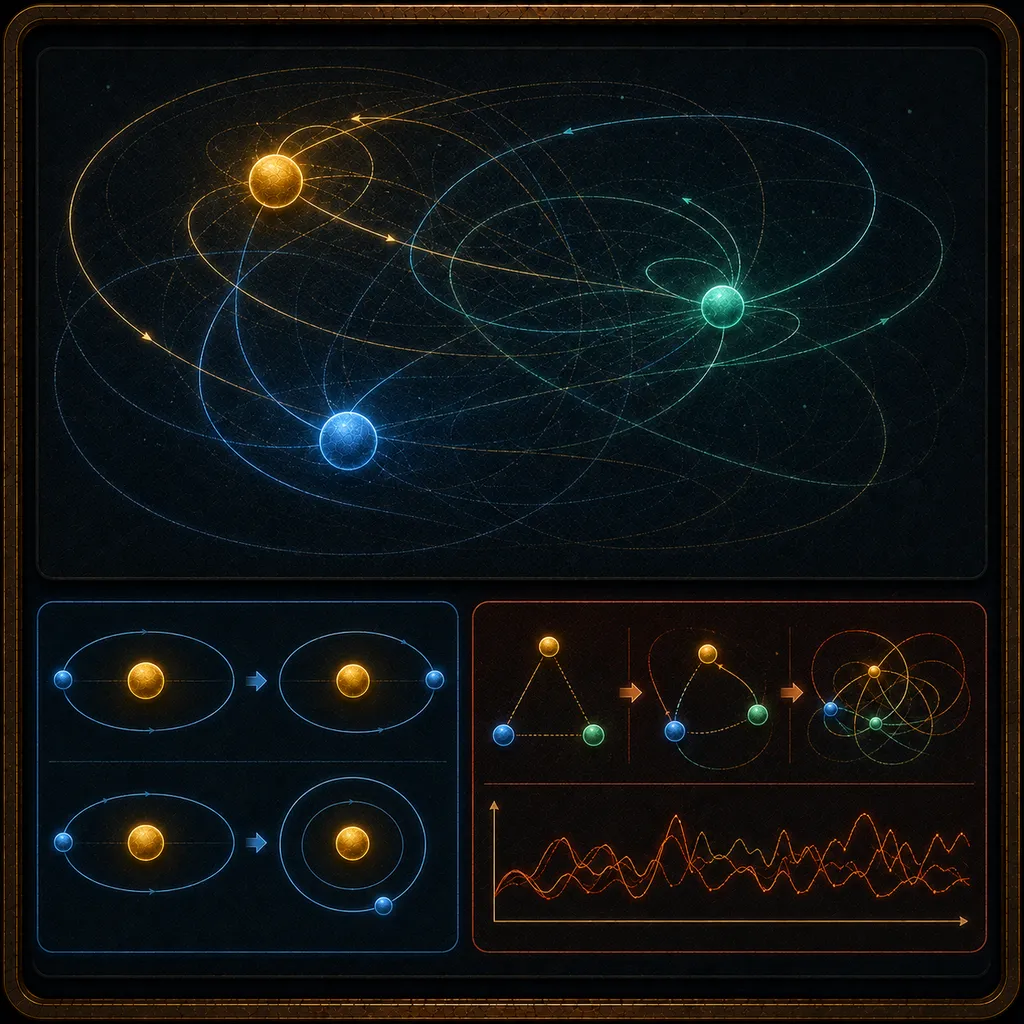
I’ll give you a system of gravitating bodies — decide whether the path is described by a compact formula, or has to be simulated (chaos).
What just happened?
Three bodies attract one another gravitationally and weave an irregular dance. A tiny change of the initial conditions (slider ) leads to a completely different evolution — even though every step is fully determined by Newton’s laws. This is exactly deterministic chaos.
Two bodies — easy, three — not:
For two bodies (e.g. Sun–planet) Kepler and Newton showed that the orbit is a conic section — an ellipse described by a compact formula. It is governed by the law of universal gravitation:
But already for three bodies there is no general formula for the path of motion — the system has to be integrated numerically step by step, exactly as this simulation does.
Poincaré and the birth of chaos theory:
Studying the stability of the Solar System in a competition held by King Oscar II of Sweden, Henri Poincaré discovered (prize-winning work in 1889, published in 1890) that a three-body system can behave chaotically: it is fully deterministic, yet so sensitive to the initial conditions that long-term prediction is impossible. This was the first mathematical analysis of chaos — long before Edward Lorenz.
The invariant — what stays certain:
Although the path itself cannot be predicted, the total energy and the total momentum of the system are conserved (as is the position of the centre of mass when the momentum is zero):
In the plot on the right of the scene and stay flat — they are invariants, even though the path is unpredictable.
Where do you see it?
The three-body problem has real astronomical significance — the stability of orbits, space missions using “gravity assists” — and a cultural one: it is the title of Liu Cixin’s famous science-fiction novel. It shows the limit of predictability even in the “deterministic” world of physics.
Why this matters for the exam:
This is a model example of the difference between a closed-form solution (two bodies → ellipse) and a numerical simulation (three bodies → chaos). Remember the law of gravitation and that determinism does not mean predictability.
Remember: for two bodies the orbit is an ellipse given by a formula; for three there is no general formula for the path — the motion can be chaotic (Poincaré, 1890), although energy and momentum always remain conserved.
Theory & formulas
Two bodies — solvable
For two bodies gravity gives conic orbits (Kepler's laws), described by a formula once and for all.
Three bodies — no general formula
For three (and more) bodies there is no general solution in closed form; the motion can be chaotic — a tiny change in the initial conditions gives a completely different path.
What is conserved
Even in chaos the total energy and momentum of the system remain conserved: Poincaré (1890) described here the first example of chaos.
Notation: total energy, momentum of the system.
Frequently asked questions
›Is the motion of three gravitating bodies predictable by a formula?
No — for three bodies there is no general formula, and the motion can be chaotic and unpredictable in the long run.
›What is conserved in the three-body problem?
The energy and momentum of the whole system — but the specific path of each body remains unpredictable.
›Who discovered chaos in the three-body problem?
Henri Poincaré, in his 1890 work — it was the first mathematical analysis of chaos.
Teaching? Embed this experiment on your site.
Free widget — paste it on your school site, blog or notes. It links to the full version.