Kepler's Laws
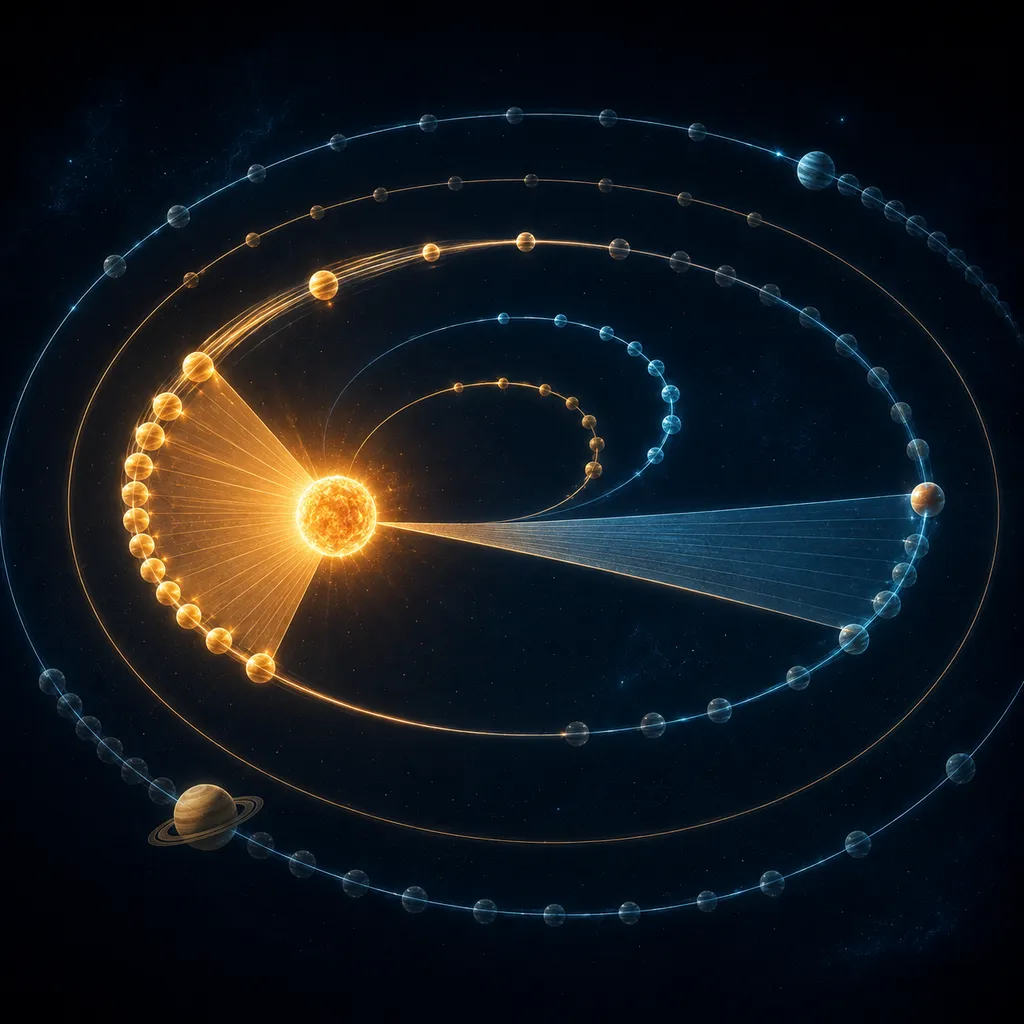
The motion of the planets around the Sun is described by Kepler's laws: orbits are elliptical (with the Sun at one of the foci), a planet sweeps out equal areas in equal times (second law — faster at perihelion), and the ratio T²/a³ is the same for every planet in the system (third law). Change the semi-major axis and the eccentricity.
What just happened?
The planet orbits along an ellipse, and the Sun sits at one of its foci — not at the center. Close to the Sun (perihelion) it races fastest, far away (aphelion) it slows down. The two shaded sectors have equal areas, because the planet sweeps them out in the same time.
First law (orbit shape):
The orbit of every planet is an ellipse with the Sun at one of its foci. The eccentricity tells you how flattened the ellipse is: is a circle, is a very elongated ellipse.
Third law (period and orbit size):
The square of the orbital period is proportional to the cube of the semi-major axis. The same constant holds for all planets of a given system — which is why more distant planets orbit more slowly. In units where is in AU and in years, this gives .
Second law (conservation of angular momentum):
The areal velocity (the area swept out per unit time) is constant — another way of writing conservation of angular momentum. When decreases, the angular velocity must increase, so at perihelion the planet races fastest. This ties in with the law of universal gravitation: it is the Sun's gravity that bends the path into an ellipse and sustains the motion.
Why this matters for your exam:
The third law solves "compare the periods/distances of two planets or satellites" problems, while the second law explains why the speed changes along the orbit. The trick: write the constant for one body and set it equal to the other.
Remember: an orbit is an ellipse with the Sun at a focus, is constant for the whole system, and the planet is fastest at perihelion.
Theory & formulas
The three laws of Kepler
The orbit of every planet is an ellipse, and the Sun lies at one of its foci (first law). The shape of the ellipse is described by the semi-major axis and the eccentricity .
Second law — equal areas
The Sun–planet line sweeps out equal areas in equal times. That is why at perihelion (closest to the Sun) the planet moves fastest, and at aphelion slowest. This is a consequence of the conservation of angular momentum.
Third law
For every planet in the system the ratio is constant: The larger the semi-major axis, the longer the orbital period.
Notation: — semi-major axis of the orbit, — eccentricity, — orbital period.
Frequently asked questions
›Why are orbits elliptical?
Because gravity gives a force ∝1/r² — the solutions of motion in such a field are conic sections, and for planets they are closed ellipses with the Sun at a focus.
›What does Kepler's third law say?
The square of the orbital period is proportional to the cube of the semi-major axis: T²/a³ = const for every planet in a given system.
›Why does a planet speed up near the Sun?
Because angular momentum is conserved — the closer to the Sun (smaller r), the greater the speed, so as to sweep out equal areas in equal times (second law).
Teaching? Embed this experiment on your site.
Free widget — paste it on your school site, blog or notes. It links to the full version.