Cosmic microwave background (CMB) — the afterglow of the Big Bang
Reference card (beyond the core syllabus) — the cosmic microwave background (CMB) is the afterglow of the Big Bang: uniform radiation at a temperature of about 2.7 K filling the entire Universe, discovered by accident by Penzias and Wilson in 1964 (Nobel 1978). Later precise measurements by the COBE satellite (Mather and Smoot, Nobel 2006) revealed tiny temperature fluctuations in the CMB — the seeds of today's galaxies.
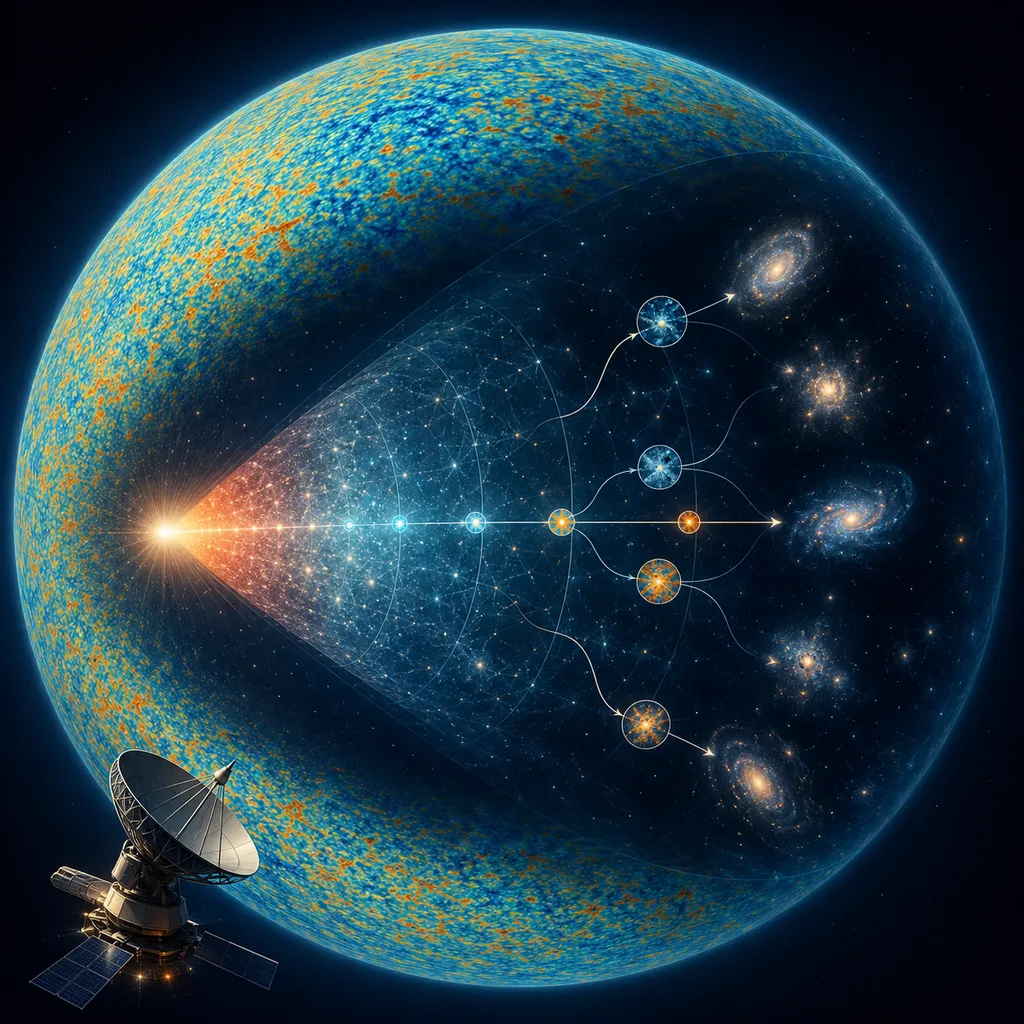
What is the CMB?
The cosmic microwave background (CMB) is the afterglow of the Big Bang — uniform radiation at a temperature of just , filling literally the entire Universe and reaching us from every direction in the sky.
An accidental discovery (1964)
Arno Penzias and Robert Wilson, testing a radio antenna at Bell Labs, ran into a mysterious, uniform noise they could not get rid of — not even after cleaning pigeon droppings out of the antenna. It turned out to be relic radiation, exactly as expected from a hot Big Bang. The discovery confirmed the hot Big Bang theory and earned them the 1978 Nobel Prize in Physics.
Where does the CMB come from?
About 380 000 years after the Big Bang the Universe had cooled enough (to about 3000 K) for electrons to combine with nuclei into neutral atoms — this is recombination. Before that, the hot plasma scattered light; after recombination the photons could finally stream freely through space. Ever since, the Universe has been expanding, and those same photons are stretched (redshifted) and cooled — today we observe them as microwave radiation at a temperature of about 2.7 K:
The COBE satellite and “seeds of galaxies” (2006)
Later, far more precise measurements by the COBE satellite showed that the CMB is not perfectly uniform — it carries tiny temperature fluctuations (of the order of one part in a hundred thousand). These small density variations became the “seeds” from which, under gravity, today’s galaxies and galaxy clusters formed. For this work John Mather and George Smoot received the 2006 Nobel Prize in Physics.
Why this matters for your exam:
The CMB is the strongest observational evidence for the Big Bang theory and a natural extension of the topics of cosmology and Hubble’s law () — together they explain why the Universe expands, cools, and why we see in it uniform relic radiation at exactly the predicted temperature.
Remember: CMB = relic radiation at T ≈ 2.7 K, produced at recombination (~380 000 years after the Big Bang), discovered by accident by Penzias and Wilson (Nobel 1978), and its tiny fluctuations measured by COBE (Mather, Smoot — Nobel 2006) are the seeds of today’s galaxies.
Theory & formulas
The afterglow of the Big Bang
The CMB is uniform microwave radiation filling the entire Universe — a remnant of its hot beginning. It was discovered by accident by Penzias and Wilson (1964, Nobel 1978).
Temperature ~2.7 K
The CMB spectrum is an almost ideal black-body spectrum at a temperature of . The emission peak (Wien's law ) falls in the microwave range.
Fluctuations
The COBE satellite (Nobel 2006) detected tiny temperature differences — the seeds of today's galaxies.
Symbols: — radiation temperature, — wavelength of the peak, — Wien's constant.
Frequently asked questions
›What is the CMB background radiation?
Uniform microwave radiation at a temperature of about 2.7 K, a remnant of the Big Bang.
›How was it discovered?
By accident — in 1964 Penzias and Wilson could not eliminate the "noise" in their antenna, which turned out to be the CMB.
›What did the CMB fluctuations (the COBE satellite) reveal?
Tiny temperature differences, which are the seeds of today's galaxies and structures of the Universe.
Teaching? Embed this experiment on your site.
Free widget — paste it on your school site, blog or notes. It links to the full version.