Hubble's law — the expansion of the Universe
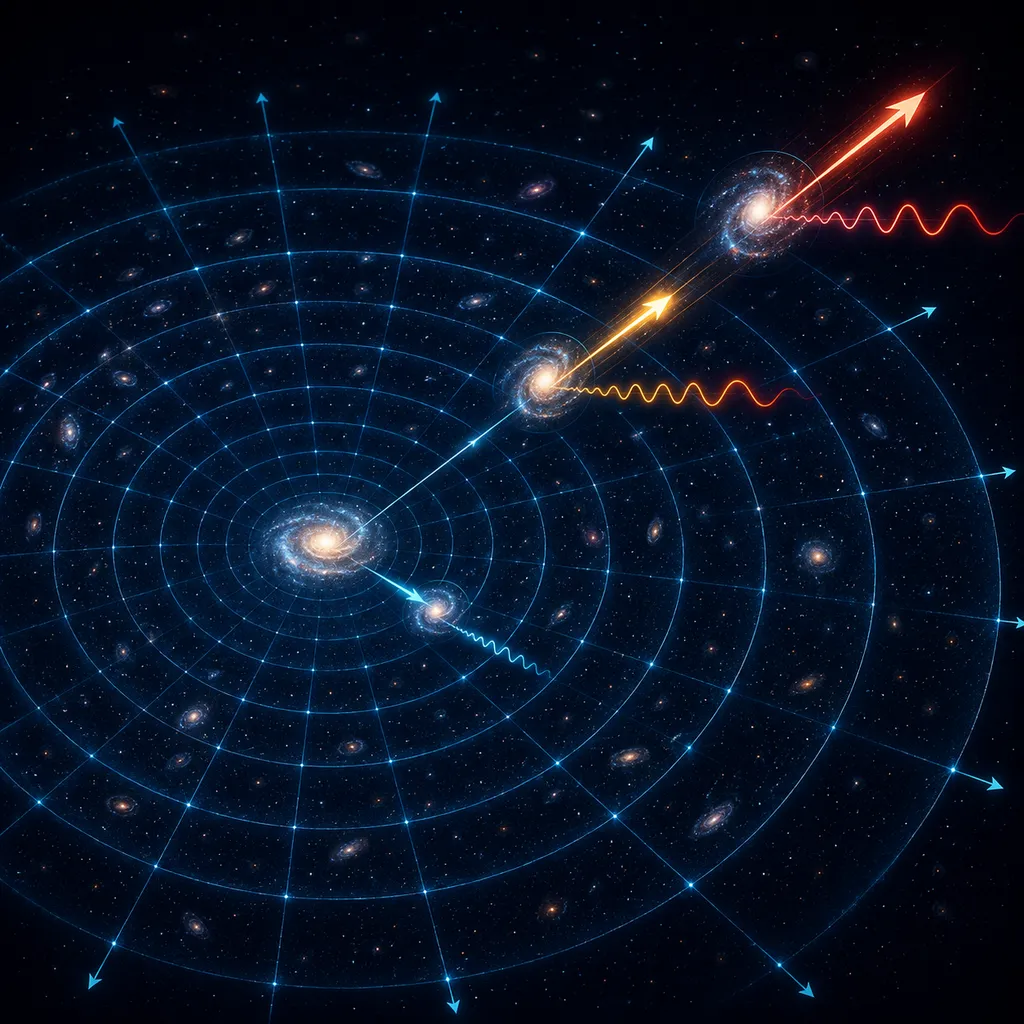
Distant galaxies recede from us faster the farther away they are: v = H₀·d (Hubble's law). The ratio of velocity to distance is constant and equal to the Hubble constant H₀. This is direct evidence that the Universe is expanding. Change the galaxy's distance.
What just happened?
You doubled the galaxy's distance, and its recession velocity doubled as well. The farther a galaxy is, the faster it recedes from us — and the relationship is linear.
Hubble's law:
— a galaxy’s recession velocity is directly proportional to its distance. v — recession velocity (km/s), d — distance (Mpc), H₀ — the Hubble constant (≈ 70 km/s/Mpc).
The invariant — one constant for the whole cosmos:
For every galaxy the ratio of velocity to distance is the same. That is why all points on the v–d graph fall on a single straight line with slope H₀. This is direct evidence that the Universe is expanding.
How do we know how fast? Redshift.
Light from a receding galaxy is stretched toward longer wavelengths (the red end): . The larger the redshift, the greater the velocity — this is how we measure v and determine distances across the cosmos. It connects to the “redshift” experiment.
Are we at the center of the Universe?
No. It is space itself that expands — like raisins in rising dough. Every observer, in any galaxy, sees the same thing: everything recedes from them, and the farther away it is, the faster. The recession of galaxies singles out no special point.
Why this matters for your exam:
v = H₀·d solves problems about the velocity and distance of galaxies and about the age of the Universe (≈ 1/H₀). The trick: compute v from the formula or from the redshift z = v/c, and the ratio v/d always gives H₀.
Remember: the farther a galaxy, the faster it recedes — v = H₀·d. This is evidence that the Universe is expanding, not that we are at its center.
Theory & formulas
Hubble's law
The farther a galaxy, the faster it recedes: The ratio is constant and equal to the Hubble constant .
What it means
It is evidence that the Universe is expanding. Every observer sees the same thing — we are not at the center (like dots on an inflating balloon).
Age of the Universe
From we estimate the time since the Big Bang: billion years.
Notation: — recession velocity, — galaxy distance, — the Hubble constant ().
Frequently asked questions
›What does Hubble's law say?
A galaxy's recession velocity is directly proportional to its distance: v=H₀·d. The farther away, the faster.
›Does this mean we are at the center?
No — in an expanding Universe every observer sees the same thing (all galaxies recede from one another, like dots on an inflating balloon).
›What is the Big Bang?
Running the expansion backward in time, all matter was once concentrated — the beginning of the Universe ~13.8 billion years ago is the Big Bang.
Teaching? Embed this experiment on your site.
Free widget — paste it on your school site, blog or notes. It links to the full version.