The accelerating expansion of the Universe
An extension of the topic of Hubble's law. Distant Type Ia supernovae (standard candles) are fainter than a constant expansion rate would imply — the Universe is expanding ever faster, driven by dark energy (Nobel Prize 2011).
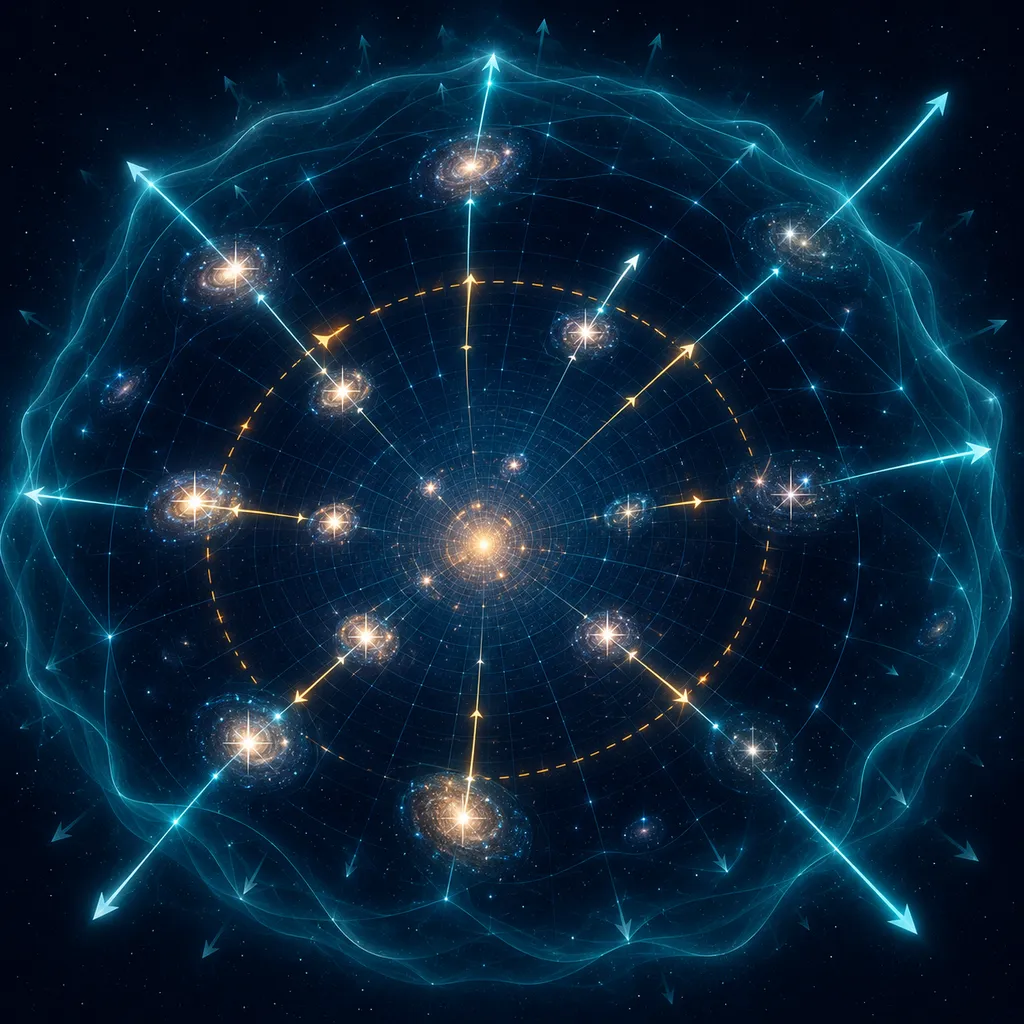
What just happened?
Type Ia supernovae are "standard candles" — they always explode with almost the same absolute brightness, so from their observed brightness we read off the distance. The most distant ones turned out fainter than a constant expansion rate predicts — that is, they are farther than they should be.
Hubble's law:
— a galaxy's recession velocity grows proportionally to its distance. is the Hubble constant. On a plot this gives a straight line.
Why is this proof of acceleration?
The most distant supernova points deviate upward from the Hubble line, and the deviation grows with distance:
The scale factor grows ever faster () — the expansion is accelerating. This observation (SN Ia) won the 2011 Nobel Prize; it is driven by dark energy.
Why you need this for the exam:
Hubble's law plus the idea of standard candles solve problems about the expansion of the Universe and distance measurement. The trick: a straight line = constant rate; points deviating upward = acceleration.
Remember: distant Type Ia supernovae lie above the Hubble line, and the farther they are the larger the deviation — that is how we know the expansion of the Universe is accelerating (dark energy).
Theory & formulas
Standard candles
Type Ia supernovae have a known absolute luminosity, so from the observed brightness we determine their distance .
Deviation from Hubble's law
Distant supernovae are fainter (farther away) than a constant rate would predict. The conclusion: the expansion is accelerating.
Dark energy
The acceleration is driven by an unknown dark energy (~68% of the content of the Universe). Discovery: Nobel Prize 2011.
Symbols: — observed brightness, — absolute luminosity, — distance, — recession velocity, — Hubble constant.
Frequently asked questions
›How do we know the expansion is accelerating?
Distant Type Ia supernovae are fainter (farther away) than a constant rate predicts — the deviation from Hubble's law grows with distance.
›What is dark energy?
An unknown form of energy driving the accelerated expansion of the Universe (~68% of its content).
›Why are Type Ia supernovae "standard candles"?
They have a known, repeatable brightness, so from their observed brightness we can determine the distance.
Teaching? Embed this experiment on your site.
Free widget — paste it on your school site, blog or notes. It links to the full version.