Eclipses — the geometry
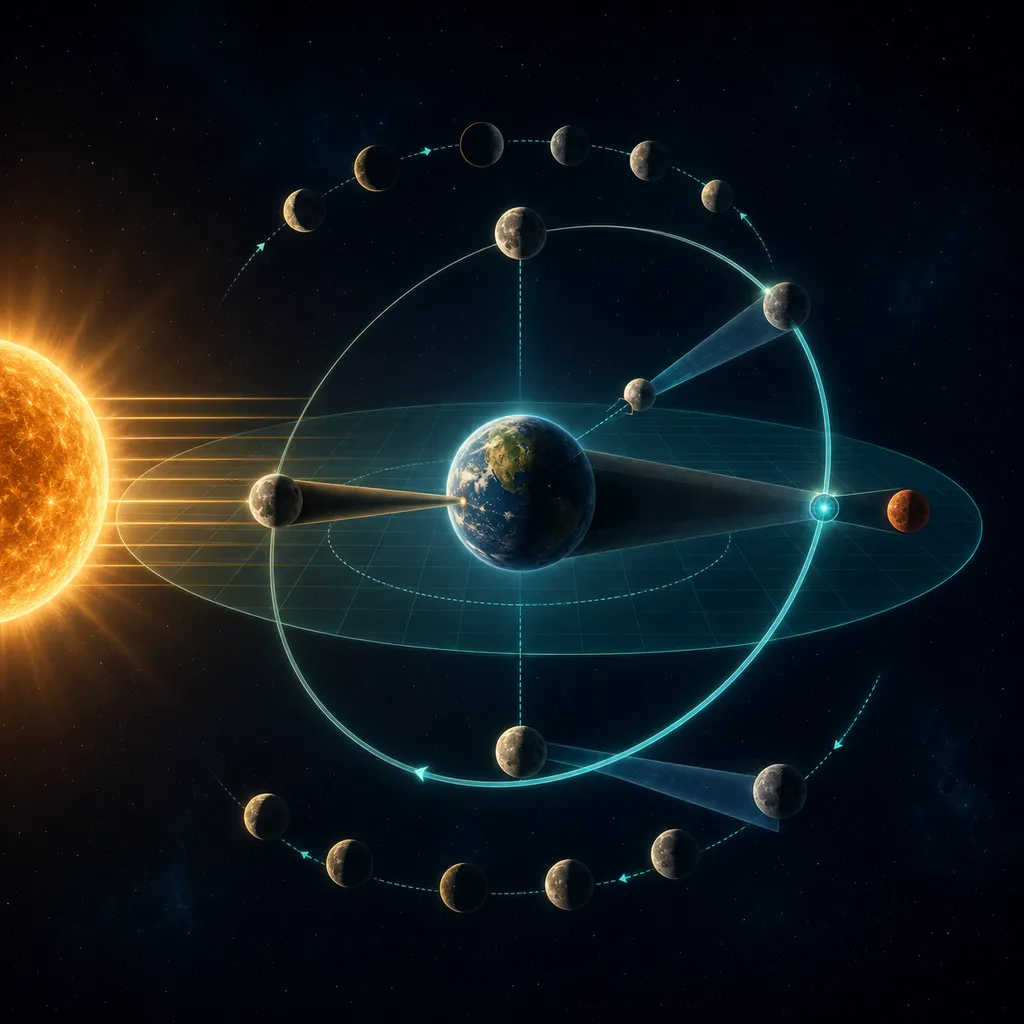
An eclipse needs two conditions: alignment (new moon → solar, full moon → lunar) and the Moon being close to an orbital node. Set the phase and the Moon's latitude β, and you'll see when the shadow hits and when it misses. The orbit's ~5.14° tilt means it usually misses.
What just happened?
An eclipse needs two conditions at once: (1) alignment — new moon (solar) or full moon (lunar) — and (2) the Moon close to a node, where its orbit crosses the ecliptic. Without the second condition the shadow simply misses.
Eclipse condition:
The orbital tilt means that at a typical new moon the Moon sits too high or too low. The “eclipse seasons” (when a node points toward the Sun) return every ~173 days.
Invariant — the phase determines the type:
A solar eclipse is always at new moon (Moon between us and the Sun), and a lunar one — always at full moon (Moon in Earth's shadow). Both only at a node. The Saros cycle (223 synodic months = 6585.32 d) repeats a similar eclipse every ~18 years.
Why this matters on the exam:
The Sun–Earth–Moon geometry, the node condition, and the difference between a phase and an eclipse are classic astronomy questions. Don't confuse phases (illumination angle) with an eclipse (shadow).
Remember: eclipse = alignment + node. Solar ↔ new moon, lunar ↔ full moon. Orbit tilted 5.14° → not every month.
Theory & formulas
Two conditions at once
An eclipse requires, simultaneously:
- alignment (new moon → solar eclipse, full moon → lunar eclipse),
- the Moon being close to an orbital node (where it crosses the ecliptic).
Why not every month
The Moon's orbit is tilted by ~5.14°, so at most new and full moons the shadow misses its target (passing above or below). Hence the "eclipse seasons" every ~173 days.
The Saros cycle
After 6585 days (~18 years 11 days) the Sun–Earth–Moon geometry nearly repeats and a similar eclipse returns.
Frequently asked questions
›What is the Saros cycle?
A period of 6585.32 days (223 synodic months ≈ 18 years 11 days 8 h) after which the Sun–Earth–Moon geometry nearly repeats and a very similar eclipse returns — shifted by ~1/3 of a day (~120° of longitude). Eclipses are grouped into Saros series.
›Why isn't there an eclipse every month?
Because the Moon's orbit is tilted by ~5.14° relative to the ecliptic. At most new and full moons the Moon passes above or below the shadow. An eclipse requires the new/full moon to fall close to an orbital node — hence the "eclipse seasons" every ~173 days.
›What are the types of eclipses?
Solar: total (the Moon fully covers the disk), annular (the Moon is farther away — a ring remains), partial, hybrid. Lunar: total, partial, penumbral (the Moon is only in Earth's penumbra — it dims slightly). The type depends on the Moon's distance and how exact the alignment is.
Teaching? Embed this experiment on your site.
Free widget — paste it on your school site, blog or notes. It links to the full version.