Phases of the Moon — geometry
The Moon shines by reflected light; the Sun always lights one half of it. Rotate the Moon's position on its orbit and you will see how the slice of the lit half visible from Earth changes — from new moon through the quarters to full moon. New moon: the Moon between the Earth and the Sun.
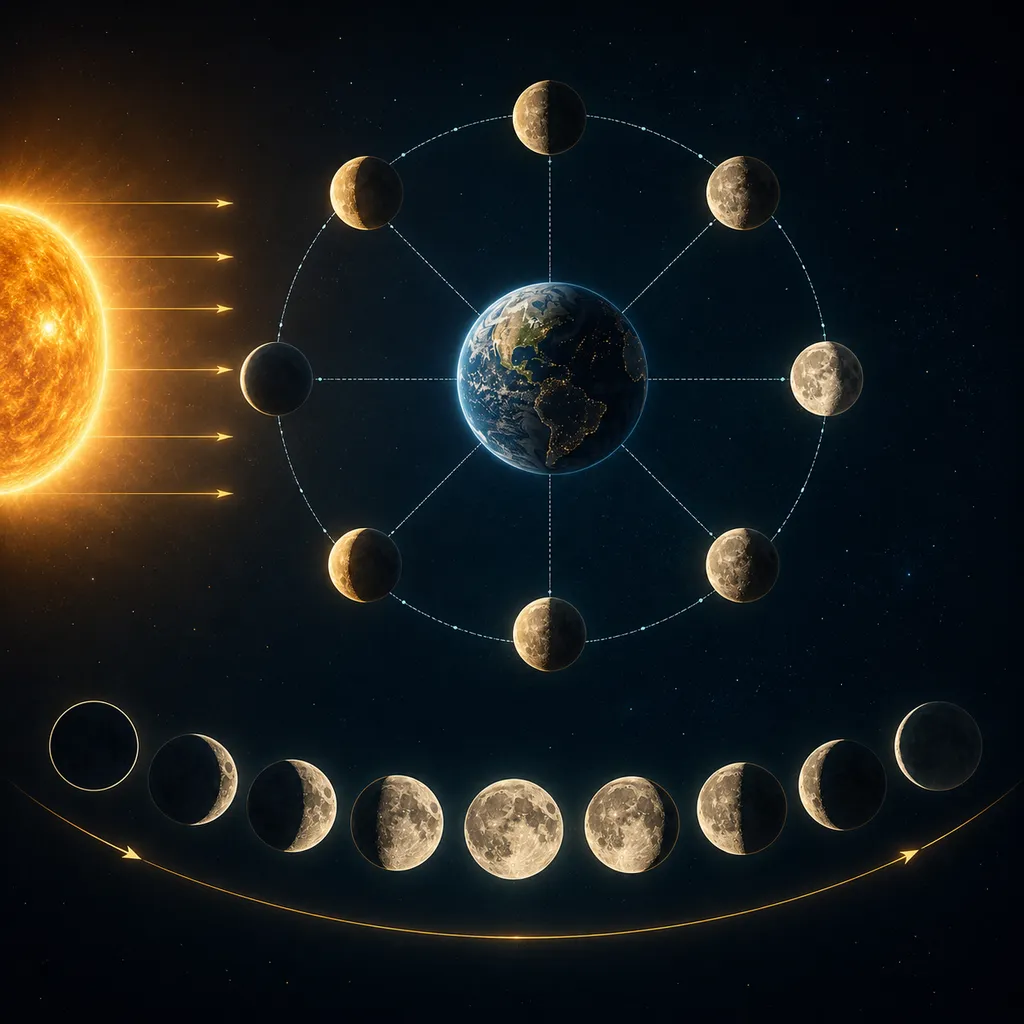
What just happened?
The Moon shines by light reflected from the Sun. The Sun always lights exactly half of its sphere — the half facing the Sun. The phases are the result of how large a slice of that lit half we see from Earth, depending on the Moon’s position on its orbit.
Disc illumination:
For (Moon opposite the Sun) — full moon; (between us and the Sun) — new moon; — quarter.
Invariant — half always lit:
Half of the Moon is lit the whole time — this never changes. “Phases” are solely a change of viewing angle. We also always see the same side of the Moon (synchronous rotation), but lit to different degrees.
Why you need this for the exam:
The Sun–Earth–Moon geometry, orbital motion and reflected light are standard in the astronomy part of the exam. Do not confuse phases with an eclipse — an eclipse is a shadow, a phase is the illumination angle.
Remember: half of the Moon is always lit; the phase = how much of it is visible. New moon: Moon between Earth and Sun; full moon: on the opposite side.
Theory & formulas
Always a lit half
The Moon shines by reflected light; the Sun always lights exactly half of its sphere. The phase is a matter of which slice of that lit half we see from Earth.
The successive phases
- New moon — the Moon between the Earth and the Sun (the lit side faces away from us)
- Quarters — 50% of the disc is visible
- Full moon — the Earth between the Sun and the Moon, the whole lit half is visible
The month
The cycle of phases (the synodic month) lasts about 29.5 days. The Moon rotates synchronously (rotation period = orbital period ≈ 27.3 d), which is why we always see the same side.
Frequently asked questions
›Why does the Moon have phases?
Because it shines by light reflected from the Sun, which always lights only half of its sphere. As the Moon orbits the Earth, from Earth we see a larger or smaller slice of that lit half — from the new moon (0%) through the quarters (50%) to the full moon (100%).
›Why do we always see the same side of the Moon?
Because the Moon rotates about its own axis in the same time in which it orbits the Earth (synchronous rotation: rotation period = sidereal month 27.32 d). This is an effect of tidal forces. The "dark side of the Moon" is not dark — it does get lit, we just never see it from Earth.
›How does a phase differ from an eclipse?
A phase is a matter of the illumination angle (we see a different slice of the always-lit half). An eclipse is a shadow: of the Moon on the Earth (solar eclipse) or of the Earth on the Moon (lunar eclipse). Eclipses are rare because the Moon's orbit is tilted by ~5°.
Teaching? Embed this experiment on your site.
Free widget — paste it on your school site, blog or notes. It links to the full version.