Pinhole camera (camera obscura)
What we'll do: We'll send light from an object through a small hole and check what image forms on the screen, and how the hole size and screen distance change it.
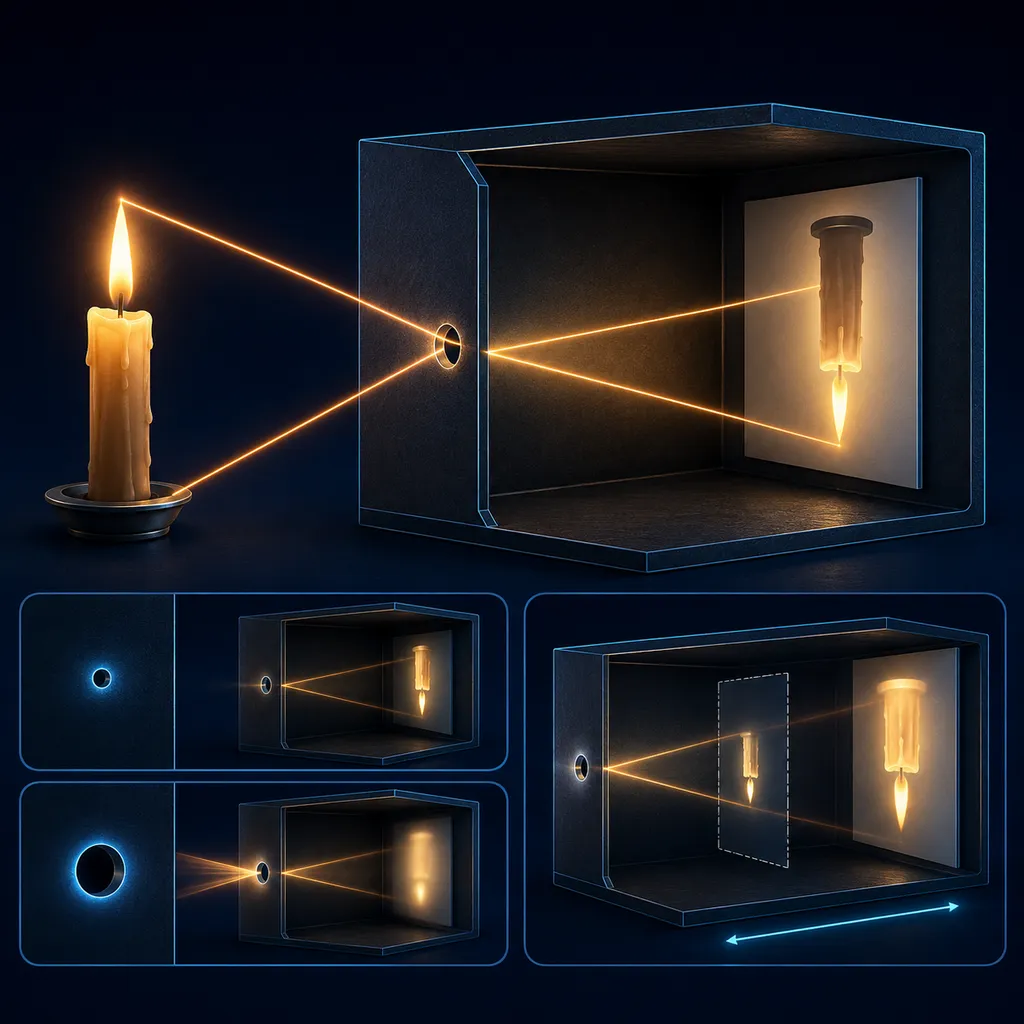
What you see on screen: An object, an aperture plate with a hole, and a screen, with rays between them crossing at the hole and forming an inverted image; the sliders change the hole size (sharpness and brightness) and the screen distance (image size). Readouts: hole size, screen distance, orientation, image sharpness, and brightness.
What just happened?
Light from the object, passing through the small hole, formed an image on the screen — flipped upside down.
Why is the image inverted?
Because light travels in STRAIGHT LINES. Rays leaving the TOP of the object pass through the hole and land on the BOTTOM of the screen, and rays from the bottom — land on top. The rays cross at the hole, so the image is inverted (and real).
The role of the hole size:
a small hole gives a SHARP but dark image (a narrow beam passes through each point); a larger hole lets in more light (brighter), but the image blurs.
Screen distance:
the farther the screen is from the hole, the LARGER the image (but weaker).
— image height, — object height.
Where does this apply?
This is how the EYE and the camera work (before lenses were invented) — the image on the retina is also inverted, and the brain “flips” it.
Why you need this for the exam:
the rectilinear propagation of light and image formation in a pinhole camera are a core topic in optics. Remember: rays crossing at the hole → inverted image.
Remember: light travels in straight lines, so a pinhole camera gives an inverted, real image; a smaller hole = sharper, but dimmer.
Theory & formulas
Rectilinear propagation of light
Light travels in straight lines. Rays from the object cross at the small hole: those from the top of the object land at the bottom of the screen and vice versa — that is why the image is inverted.
Image size
From similar triangles, the image size depends on the screen distance: Moving the screen away (larger ) enlarges the image.
Hole size and quality
- smaller hole — a sharper image, but darker,
- larger hole — brighter, but more blurred.
Notation: — object height, — image height, — distance of the object from the hole, — distance of the screen from the hole.
Frequently asked questions
›Why does a pinhole camera produce an inverted image?
Because light travels in straight lines and the rays cross at the hole — the top of the object lands at the bottom of the screen and vice versa.
›How does the hole size affect the image?
A smaller hole gives a sharper but darker image; a larger one — brighter, but more blurred.
›What happens to the image when we move the screen away?
The image becomes larger (but weaker).
Teaching? Embed this experiment on your site.
Free widget — paste it on your school site, blog or notes. It links to the full version.