Detecting exoplanets — the radial-velocity method
An extension of the Doppler effect and Kepler's laws. A planet and its star orbit a common centre of mass — a more massive planet makes the star "wobble" more and produces a larger Doppler shift in its spectrum. This is how Mayor and Queloz detected the first exoplanet (Nobel 2019).
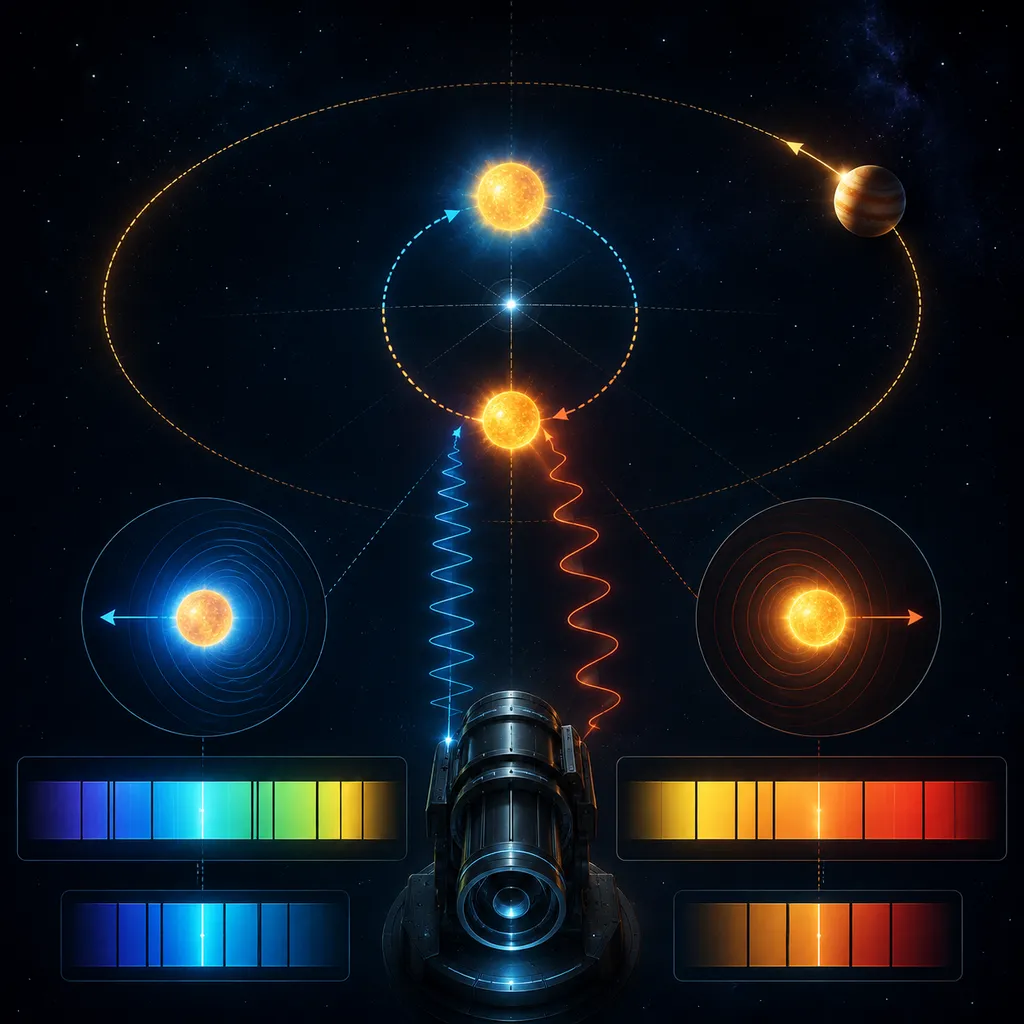
What just happened?
You increased the planet's mass, and the star began to wobble more strongly around their common centre of mass. Its radial velocity oscillates with a larger amplitude, so the spectral line jumps further toward the red and toward the blue.
Common centre of mass:
The planet and star orbit the same point. The more massive the planet (), the larger the star's orbit () and the faster the star moves.
Radial-velocity amplitude:
For a fixed star and orbital period, the amplitude is directly proportional to the planet mass. That is the signal we look for.
The Doppler effect — how do we measure it?
When the star recedes, its spectral lines shift toward the red; when it approaches — toward the blue. The alternating, periodic shift betrays the presence of an unseen planet. That is how Mayor and Queloz discovered 51 Pegasi b in 1995 (Nobel Prize in Physics 2019). Fun fact: Jupiter rocks the Sun by roughly one of its own radii.
Why this matters for your exam:
It is a model example of motion around the centre of mass + the Doppler effect + conservation laws. The trick: remember that the signal grows with the planet mass, and the line shift follows directly from the radial velocity.
Remember: a more massive planet → a larger star wobble → a larger radial-velocity amplitude → a larger Doppler shift. K ∝ m_p.
Theory & formulas
The common centre of mass
A planet and its star orbit a common centre of mass: . That is why the star traces a small orbit — it "wobbles".
The Doppler signal
The wobble changes the star's radial velocity, which shows up as a periodic shift of the spectral lines: A more massive planet → a larger → an easier measurement.
The discovery
This is how Mayor and Queloz detected 51 Pegasi b (1995, Nobel 2019).
Notation: — the masses of the star and the planet, — their distances from the centre of mass, — the star's radial velocity, — the spectral shift.
Frequently asked questions
›How are exoplanets detected with the radial-velocity method?
By measuring the periodic Doppler shifts of the star's spectral lines, caused by its motion around the common centre of mass it shares with the planet.
›Why is a heavier planet easier to detect?
It causes a larger variation in the star's velocity, so a larger (easier to measure) Doppler shift.
›Who discovered the first exoplanet around a Sun-like star?
Michel Mayor and Didier Queloz (51 Pegasi b, 1995; Nobel Prize in Physics 2019).
Teaching? Embed this experiment on your site.
Free widget — paste it on your school site, blog or notes. It links to the full version.
Related experiments