Doppler effect — redshift
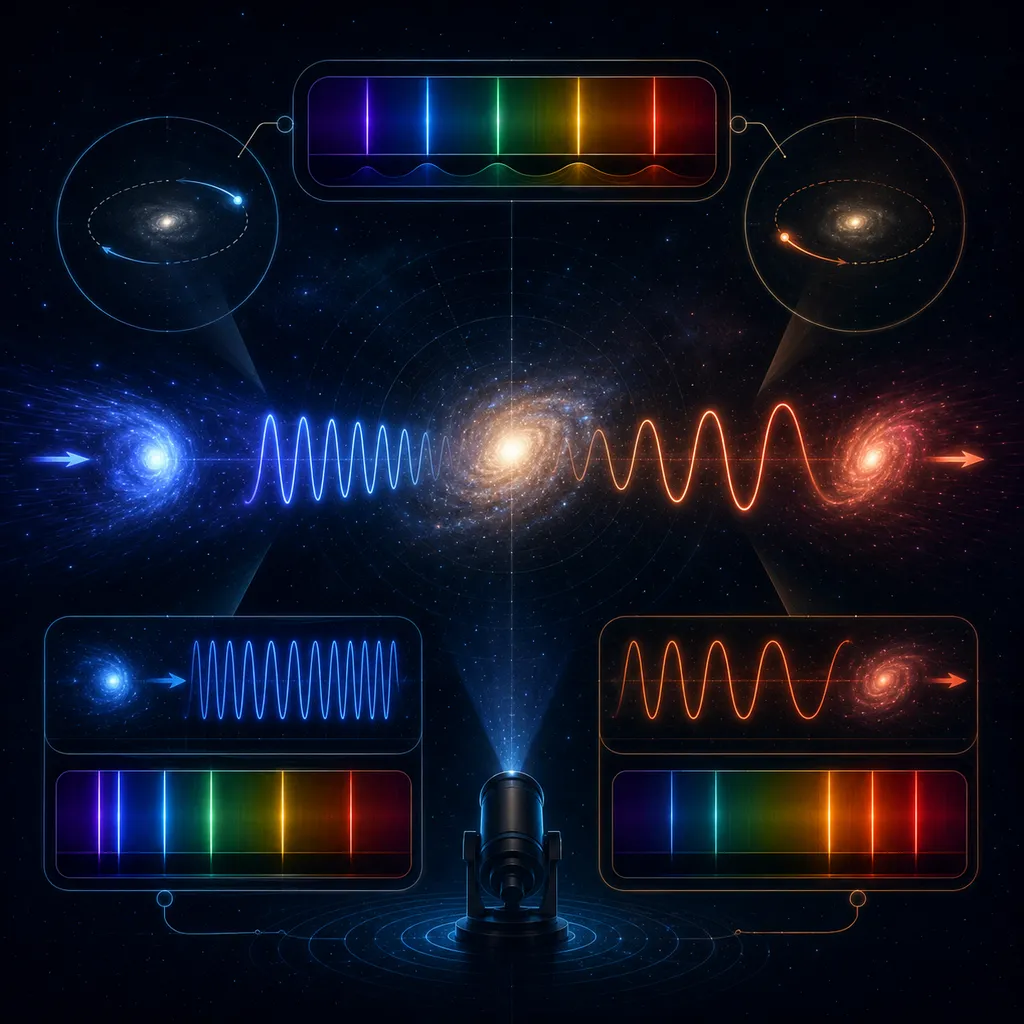
When a star or galaxy moves, its spectral lines are shifted: Δλ/λ = v/c. Receding shifts them toward red (redshift), while approaching shifts them toward blue (blueshift). This is the Doppler effect for light — it lets us measure the radial velocities of celestial bodies. Change the radial velocity.
What just happened?
The hydrogen absorption lines known from the lab (Hα, Hβ, …) sit at different positions in a star's spectrum than at rest. When the star recedes, the whole pattern of lines moves toward red; when it approaches — toward blue. This is the Doppler effect for light.
The formula for the Doppler shift:
— the relative change in wavelength equals the ratio of the radial velocity to the speed of light. — change in wavelength, — rest wavelength, — radial velocity, .
The sign decides everything:
The direction of the shift depends solely on the sign of the radial velocity — not on the brightness or type of the star. By measuring of a single line, we compute the velocity: . This is how we learn the motion of stars and galaxies whose movement we cannot "see" directly.
How does this differ from the Doppler effect for sound?
Sound needs a medium (air), and its shift depends separately on the motion of the source and of the observer relative to the medium. Light travels through a vacuum — only the relative radial velocity matters, and no medium is needed. For small both cases are described by the same simple formula .
Why you need this for the exam:
Galaxy redshift is a cornerstone of cosmology — it ties in with Hubble's law (): the farther a galaxy is, the faster it recedes and the larger its redshift. The trick: from the line shift compute , and from Hubble's law — the distance.
Remember: redshift = receding, blueshift = approaching. The sign of the shift follows the sign of the radial velocity: Δλ/λ = v/c.
Theory & formulas
The Doppler effect for light
A source's motion changes the observed wavelength. For velocities small compared to :
Red and blue
- Receding (): increases → shift toward red (redshift)
- Approaching (): decreases → toward blue (blueshift)
From the shift of known spectral lines we read off the body's radial velocity.
Notation: — change in wavelength, — rest wavelength of the source, — radial velocity, — speed of light.
Frequently asked questions
›What is a redshift?
A shift of spectral lines toward longer wavelengths (toward red) when the source is receding from us (the Doppler effect for light).
›How do we measure the velocity of a star?
From the shift of known spectral lines: Δλ/λ = v/c. The direction of the shift tells us whether the object is approaching or receding.
›How does it differ from the Doppler effect for sound?
Light needs no medium, and the formula depends on the relative velocity of the source and the observer (at large v — the relativistic version).
Teaching? Embed this experiment on your site.
Free widget — paste it on your school site, blog or notes. It links to the full version.