The supermassive black hole at the centre of the Galaxy
An extension of the topic of gravitation and Kepler's laws. By tracking the orbits of stars around an invisible object at the centre of the Milky Way, Kepler's third law gives its mass — millions of solar masses in a tiny volume. This is the supermassive black hole Sgr A* (Nobel 2020).
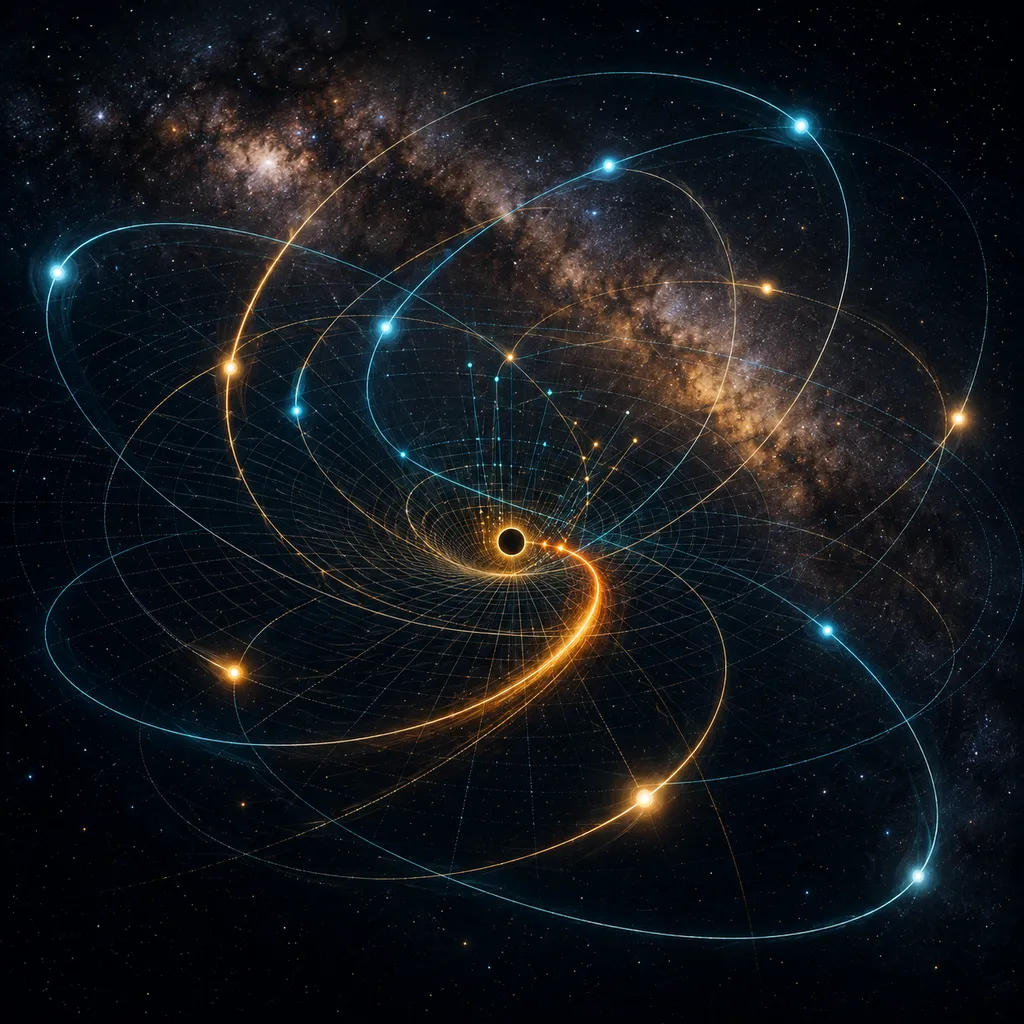
What just happened?
We track stars (like S2) moving on tight, elliptical orbits around an invisible point — Sgr A* at the centre of the Milky Way. Knowing the orbit size and the orbital period , we determine the mass of whatever holds them.
Kepler's third law (mass of the central object):
In convenient units ( in AU, in years, in solar masses) this simplifies to . For S2 (, yr) this gives about 3.9 million .
Why must it be a black hole?
Millions of solar masses fit into a volume smaller than the star's orbit — no star cluster or gas cloud reaches such a density without collapsing. The only object that explains this is a supermassive black hole. The measurements of stellar orbits around Sgr A* were awarded the 2020 Nobel Prize.
Why this matters for your exam:
Kepler's third law lets you "weigh" an invisible body from the motion of its satellites alone — the key to problems about orbits and the masses of the Sun, planets and stars. The trick: write down and , substitute into .
Remember: the motion of the stars reveals the mass of whatever holds them. Millions of in a tiny volume ⇒ a supermassive black hole.
Theory & formulas
Mass from Kepler's third law
By tracking the orbits of stars (e.g. S2) around an invisible centre, the generalised third law of Kepler gives the mass: This yields millions of solar masses in a tiny volume — the supermassive black hole Sgr A*.
The argument
Such a large mass in such a small volume is an object denser than anything other than a black hole (Nobel 2020: Penrose, Genzel, Ghez).
Notation: — central mass, — semi-major axis of the star's orbit, — its period, — the gravitational constant.
Frequently asked questions
›How do we know there is a black hole at the centre of the Galaxy?
Stars orbit an invisible object; from their orbits (Kepler's third law) the mass works out to millions of Suns in a small volume.
›How was the mass of Sgr A* determined?
From Kepler's third law M=4π²a³/(GT²), using the measured orbits of stars (e.g. S2).
›Who won the Nobel Prize for this?
Penrose (theory), Genzel and Ghez (observations) — Physics 2020.
Teaching? Embed this experiment on your site.
Free widget — paste it on your school site, blog or notes. It links to the full version.