Black hole — the Schwarzschild radius
Compress a mass into a small enough region and you get a black hole. Its event horizon has radius R_s=2GM/c² and grows linearly with mass. Nothing escapes from beneath the horizon — not even light (the escape velocity exceeds c). As a black hole, Earth would be ~9 mm across, the Sun ~3 km. Change the mass of the object.
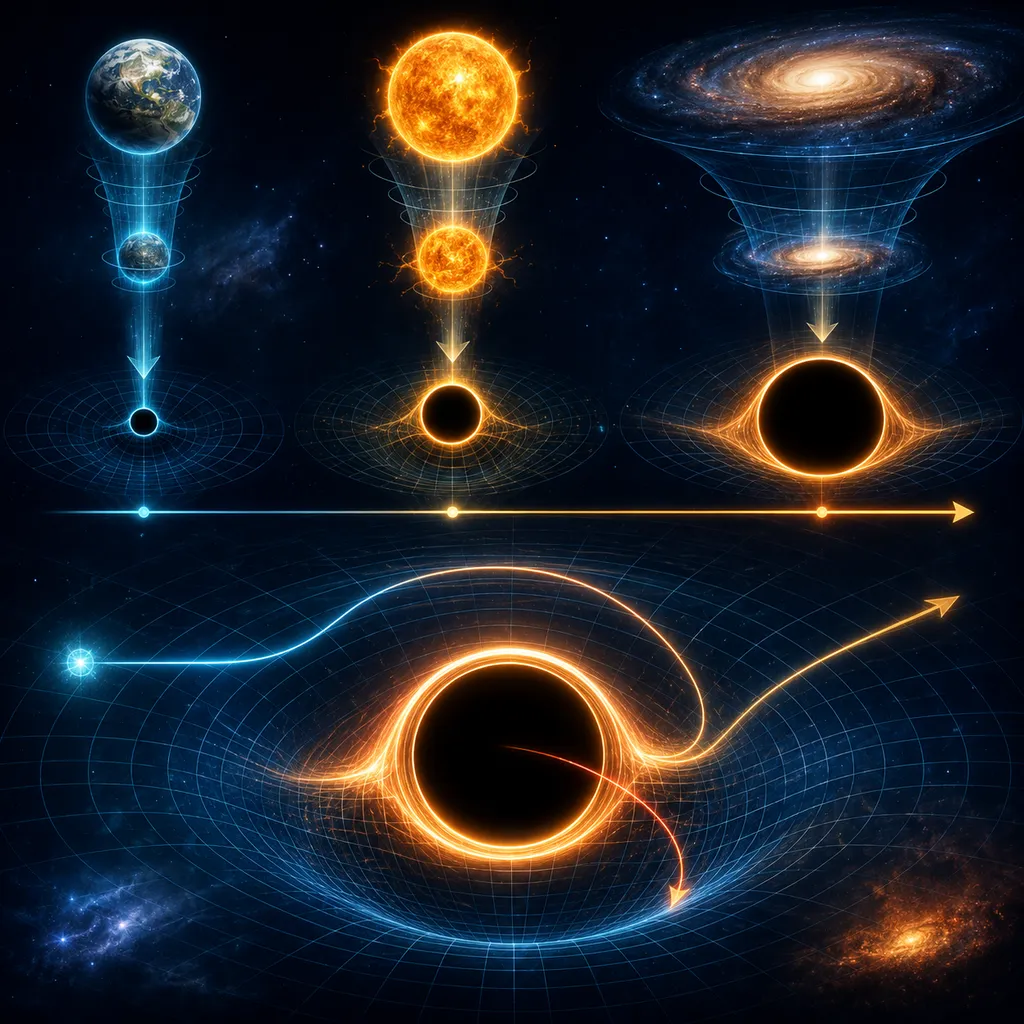
What just happened?
You doubled the mass, and the event horizon grew exactly twofold. The Schwarzschild radius is directly (linearly) proportional to mass — there is no power or root involved.
Schwarzschild radius:
— where is the mass of the object, — the gravitational constant, — the speed of light. It is the radius of the ball into which the mass must be compressed for it to become a black hole.
What is the event horizon?
It is the boundary around a black hole with radius . Nothing escapes from beneath it — neither matter nor light. It is not a physical surface but a “point of no return”: every path outward leads back inside.
Why does even light not escape?
The escape velocity grows with mass and falls with distance. At the event horizon it reaches the value — the speed of light. Closer to the centre it would have to exceed , and nothing moves faster than light. That is why a photon aimed “outward” falls inward anyway.
How small would Earth or the Sun be?
If you compressed the entire Earth into a black hole, its horizon would have a radius of ≈ 9 mm — smaller than a walnut. The Sun would fit into a ball of radius ≈ 3 km. Black holes are not “large” — they are extremely dense.
Why this matters for your exam:
The formula is a classic astrophysics problem: plug in the mass, compute the radius, compare it with the size of the object. The trick: grows linearly with mass — 10× more mass means a 10× larger horizon, no more, no less.
Remember: the event horizon is the boundary from beneath which nothing escapes, and its radius grows linearly with mass: .
Theory & formulas
The Schwarzschild radius
The event horizon has radius: It grows linearly with mass. Nothing escapes from beneath the horizon — the escape velocity exceeds .
Where it comes from
Set the escape velocity equal to : gives . The same result follows from general relativity.
Scale
Earth as a black hole: ; the Sun: .
Notation: — Schwarzschild radius, — gravitational constant, — mass, — speed of light.
Frequently asked questions
›What is the Schwarzschild radius?
The radius of a black hole's event horizon: R_s=2GM/c². It marks the boundary from beneath which nothing can escape.
›Why does light not escape from a black hole?
Because beneath the horizon the escape velocity exceeds the speed of light c — even a photon lacks enough "speed" to get out.
›How small would Earth be as a black hole?
You would have to compress its entire mass down to a radius of ~9 mm — then R_s=2GM/c² creates an event horizon.
Teaching? Embed this experiment on your site.
Free widget — paste it on your school site, blog or notes. It links to the full version.