Gravitational waves — merging black holes (LIGO)
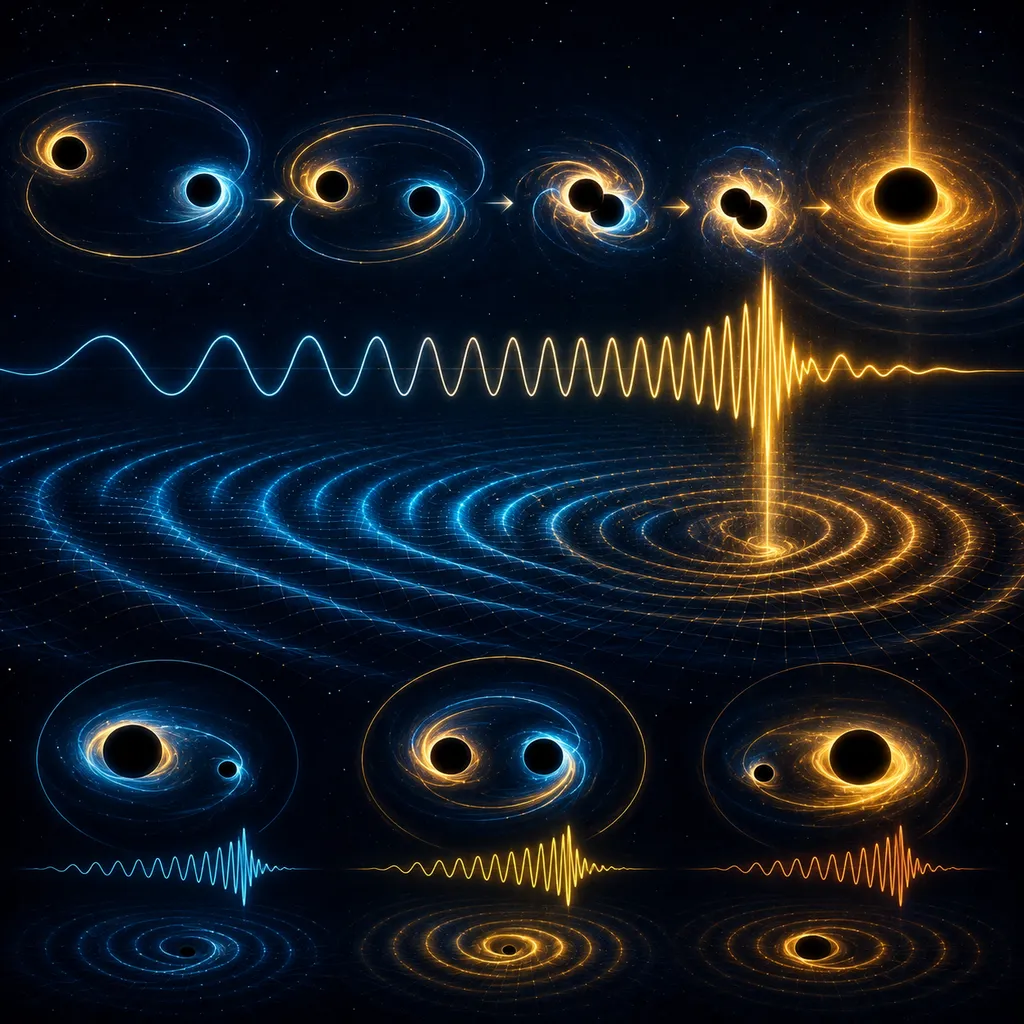
This extends the school topics of waves and their properties, and of gravity and black holes — beyond the syllabus. Set the black-hole masses: in the inspiral phase the frequency and amplitude of the gravitational wave rise (the "chirp") right up to the merger. These are ripples in spacetime, detected by LIGO in 2015.
I will give you a target chirp mass — pick masses M₁ and M₂ to reach it. Mc = (M₁M₂)^(3/5) / (M₁+M₂)^(1/5).
What just happened?
Two black holes orbit a common centre and radiate energy as gravitational waves — ripples in spacetime itself. As they lose energy, the orbit tightens, the revolution speeds up, and the wave grows in frequency and amplitude until the merger (chirp). Then the resulting remnant "rings" and the oscillation decays away (ringdown).
Chirp mass — the parameter that drives the signal:
It determines how fast the chirp builds and how strong the signal is. The wave frequency in the inspiral phase grows as , and the received amplitude falls off with distance: .
Invariant — the energy balance:
The energy carried away by the waves is exactly the loss of the system's orbital energy. That is why the orbit cannot stay constant — it must tighten, and that inevitably drives the frequency up. Hence the characteristic chirp just before the merger.
LIGO detection:
The first direct measurement of a gravitational wave (GW150914) came in 2015 — the merger of two black holes of about 36 and 29 solar masses, over a billion light-years away. Nobel Prize 2017. The interferometer measures changes in arm length smaller than a thousandth of a proton's diameter. It is a new "window" onto the Universe — we observe objects invisible in any light.
Why this matters for your exam:
It is a spectacular extension of the waves topic — it shows live that a wave has frequency, amplitude and speed (gravitational waves travel at the speed of light), and that these properties can change over time. It links the waves unit with gravity and black-hole physics — a favourite context for "real-life" problems and questions about modern physics.
Remember: the system loses energy to the waves → the orbit tightens → the frequency rises sharply (chirp) until the merger. .
Theory & formulas
Ripples in spacetime
Violently accelerating large masses (e.g. black holes orbiting each other) emit gravitational waves — disturbances of spacetime that travel at the speed of light .
The inspiral phase and the "chirp"
As the orbit tightens, the orbital frequency rises, and with it the frequency and amplitude of the wave. Key relations:
- the wave has twice the frequency of the orbit: ,
- the closer to the merger, the faster and the amplitude grow — the recorded waveform resembles a chirp.
Detection
LIGO (2015, Nobel Prize 2017) measures the tiny changes in the length of the interferometer's arms caused by a passing wave — relative changes of order .
Frequently asked questions
›What are gravitational waves?
Ripples in spacetime that propagate at the speed of light, produced by the violent motion of large masses.
›How were they detected?
With the LIGO detector (2015, Nobel Prize 2017), which measures tiny changes in the length of the interferometer's arms.
›Why is the signal a "chirp"?
As the inspiral tightens, the frequency and amplitude rise — the recorded waveform resembles a chirp.
Teaching? Embed this experiment on your site.
Free widget — paste it on your school site, blog or notes. It links to the full version.